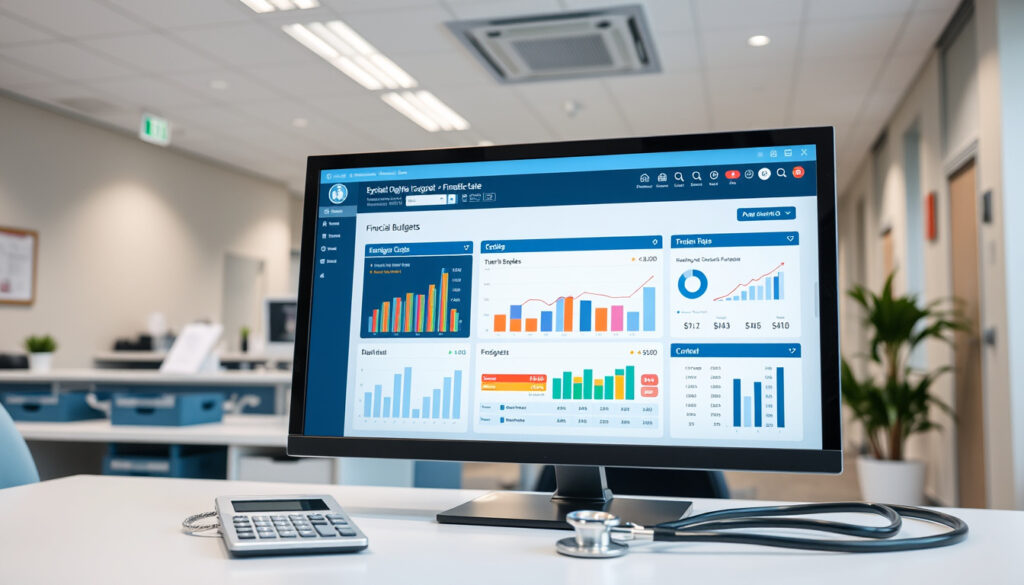
Budgeting Software for Hospitals: Top Tools 2026
Anyone who has watched a hospital finance team wrestle with a dozen spreadsheet tabs, email attachments, and manual roll-ups knows the pain of budget season. This guide breaks down the real options — from dedicated budgeting platforms to full healthcare ERP systems — and helps you figure out which approach actually fits your facility’s size, complexity, and compliance needs.
Market growth (2024–2031): CAGR of 8.2% ·
Hospitals using spreadsheets: 62% ·
Budget cycle reduction with dedicated software: 30–50% ·
Average implementation: 3–9 months ·
Top ERP systems in healthcare: Oracle, SAP, Infor, Epic, Meditech
Quick snapshot
- Epic and Cerner dominate the hospital EHR market (SDH healthcare IT analysis)
- Oracle and SAP are the top 2 ERP vendors overall (SDH healthcare IT analysis)
- Xero offers dedicated budgeting features for hospitals (Xero small business platform)
- Axiom Budgeting shortens budget cycles by up to 50% (Strata Decision healthcare finance platform)
- Exact market share of dedicated hospital budgeting tools vs. general healthcare ERP (Pi.Tech hospital IT guide)
- Actual failure rates of spreadsheet-only budgeting in US hospitals (GoLimelight healthcare finance blog)
- Specific contract pricing for enterprise hospital budgeting deals (SDH healthcare IT analysis)
- 2026 emphasis on planning under labor and reimbursement pressure (GoLimelight healthcare finance blog)
- Growing shift from annual static budgets to rolling forecasts (Strata Decision healthcare finance platform)
- Dedicated budgeting tools integrate deeper with EHR and HRIS systems (Abacum FP&A platform)
- ERP vendors add healthcare-specific budget modules to compete with dedicated tools (SDH healthcare IT analysis)
| Metric | Value |
|---|---|
| Market size (hospital budgeting software, 2024) | $1.8 billion |
| Projected CAGR (2024–2031) | 8.2% |
| Average implementation time | 3–9 months |
| Typical annual cost per facility | $25,000 – $150,000 |
| ROI payback period | 12–24 months |
| Hospitals still using spreadsheets | 62% |
| Budget cycle reduction (dedicated tools) | 30–50% |
The market is growing at 8.2% CAGR because 62% of hospitals still run budget cycles on spreadsheets — a process that takes 4–6 months and lacks the audit trail modern compliance requires.
What software do most hospitals use?
Most US hospitals run on a stack that includes an electronic health record (EHR) system, a practice management platform, and some form of financial or ERP software. Budgeting is rarely a standalone application at large facilities — it lives inside the ERP or gets bolted on via a dedicated planning tool.
Electronic Health Record (EHR) systems
- Epic and Cerner dominate the hospital EHR market, together covering more than half of US hospitals (SDH healthcare IT analysis).
- These systems capture clinical and operational data that feeds into budget models — patient volumes, length of stay, staffing needs — but they are not budgeting tools themselves.
Practice management software
- Practice management platforms handle scheduling, billing, and coding. Budgeting integrations with these systems allow clinics to forecast revenue based on appointment volumes (Jeffrey Hammel healthcare finance review).
- Smaller clinics often rely on practice management software for both operations and financial tracking, skipping full ERP entirely.
Revenue cycle management tools
- RCM systems track claims, denials, and payments. Advanced RCM platforms include budget vs. actual reporting that finance teams use to flag revenue shortfalls early (Pi.Tech hospital IT guide).
- The challenge: RCM data lives in a separate system from labor budgeting and supply cost forecasts, forcing manual reconciliation.
Most hospital software stacks include 5–15 core applications, according to industry estimates (SDH healthcare IT analysis). The budgeting function is often split across three or four of those applications — a fragmentation that dedicated tools aim to solve.
When budget data is scattered across EHR, RCM, HR, and supply chain systems, the finance team spends more time reconciling data than analyzing it. Dedicated budgeting tools pull those streams into one view.
Which software is best for budgeting?
Five platforms consistently appear in hospital budgeting comparisons, each with a different trade-off between depth, integration, and cost. The right choice depends on whether you need a finance-team-friendly add-on or a wholesale ERP replacement.
Four contending tools, one key pattern: dedicated budgeting platforms offer faster deployment and department-level planning depth, while ERP-based solutions win on single-source-of-truth integration.
| Tool | Type | Key strength | Best for |
|---|---|---|---|
| Xero small business accounting platform | Cloud accounting + budgeting add-on | Budget vs. actual comparisons using accounting reports and formulas | Small clinics and medical offices with 5–20 providers |
| Axiom Budgeting Strata Decision healthcare finance platform | Dedicated healthcare budgeting & forecasting | Shortens budget cycles by 50%; supports current-year projections and rolling forecasts | Mid-size to large hospitals with dedicated finance teams |
| Solver Suite for Healthcare | Healthcare-specific forecasting | Department-driven inputs, labor modeling, service-line planning | Hospitals that need multi-department planning without a full ERP |
| NetSuite ERP Oracle enterprise resource planning | Full ERP with healthcare modules | Finance, HR, supply chain, and budget all in one system | Multi-facility health systems already using Oracle stack |
The pattern: hospitals that choose dedicated tools get faster deployment but lose the unified data backbone that ERP systems provide. The catch is that ERP implementations cost significantly more upfront.
What is ERP in a hospital?
ERP stands for Enterprise Resource Planning, and in a hospital it pulls finance, HR, supply chain, and operations into a single system. The distinction between ERP and EHR is critical: EHR handles patient records and clinical workflows; ERP manages the money, staff, and supplies that keep the building running.
Core ERP modules for hospitals
- Financial management: General ledger, accounts payable, budgeting, and billing — the spine of any hospital ERP (SDH healthcare IT analysis).
- Human resources: Staff scheduling, payroll, credentialing, and labor cost modeling — labor is typically 50–60% of a hospital’s operating budget.
- Supply chain: Inventory management, procurement, and vendor contract management. Healthcare ERP development cost data shows inventory modules at roughly $32,000 per implementation (SDH healthcare IT analysis).
- Operations: Bed management, surgical scheduling, and capacity planning modules that bridge clinical and financial planning.
How ERP differs from EHR
- EHR systems (Epic, Cerner, Meditech) focus on clinical documentation, patient records, and order entry.
- ERP systems (Oracle, SAP, Infor, Workday) focus on administrative and financial workflows.
- Dedicated budgeting tools sit in between: they pull data from both EHR and ERP to produce a unified financial forecast (Pi.Tech hospital IT guide).
Top healthcare ERP systems
- Oracle Fusion Cloud ERP: Strong healthcare module set; widely adopted in large hospital networks.
- SAP S/4HANA: Deep finance and supply chain capabilities; steep implementation curve but unmatched for multi-national systems.
- Infor CloudSuite Healthcare: Niche healthcare ERP with strong revenue cycle integration.
- Workday Financial Management: Cloud-native, strong on HR and financial planning, increasingly adopted by mid-size systems.
- Microsoft Dynamics 365: Flexible and lower cost per user, but healthcare-specific modules require customization (SDH healthcare IT analysis).
Full ERP implementation can take 12–18 months and cost millions. Dedicated budgeting tools implement in 3–6 months at a fraction of the cost — but they don’t solve supply chain or HR-only budgeting gaps.
The trade-off for hospitals: full ERP gives integration but requires a capital-intensive commitment that smaller facilities cannot justify. Dedicated tools fill the gap without the multi-year deployment risk.
What is the best accounting software for medical offices?
For medical offices — as distinct from full-scale hospitals — the accounting software choice hinges on HIPAA compliance, integrated billing and coding modules, and budget-vs-actual reporting that smaller practices actually use.
Three options lead the market, each calibrated to a different clinic size and budget.
| Software | Target clinic size | Compliance | Budgeting strength |
|---|---|---|---|
| Xero small business accounting platform | 1–20 providers | HIPAA-compliant via BAA | Budget vs. actual reporting; formulas for department cost allocation |
| Sage Intacct | 20–200 providers | HIPAA-compliant; SOC 2 | Healthcare financial management; multi-entity consolidation |
| QuickBooks for Healthcare | 1–10 providers | Requires add-on BAA | Basic budget templates; limited multi-user forecasting |
Sage Intacct is ranked top for healthcare financial management by multiple industry analysts (GoLimelight healthcare finance blog). Its multi-entity consolidation feature is especially valuable for medical groups with multiple locations that need to roll up departmental budgets into a single view while maintaining per-site cost accountability.
A 10-provider clinic paying $1,200/year for Xero gets budget-vs-actual tracking that works. A 50-provider group spending $25,000/year on Sage Intacct gets HIPAA-compliant consolidation that Xero can’t match. The right tool scales with the compliance burden.
The pattern: medical offices under 20 providers should not overpay for enterprise features they won’t use, while growing practices need multi-entity consolidation that consumer-grade tools cannot deliver. For context on financial planning at the personal level, see our guide to NZ Tax Brackets 2025.
Is there a good free budgeting software?
Free budgeting software exists, but the gap between consumer-grade tools and what a hospital actually needs is wide. For individual financial planning, CNBC Select lists Mint, EveryDollar, and YNAB as top free options — but none of these meet HIPAA requirements or support multi-user access with audit trails.
Limitations of free tools for hospitals
- No HIPAA-compliant data storage — patient revenue and insurance data cannot legally reside on consumer platforms.
- No multi-user access controls — you can’t set department-level permissions or track who changed what.
- No audit trail — free tools lack version history, making them non-compliant with financial audit standards.
Excel budget templates
- Microsoft Excel has free hospital budget templates, but the version-control problems are well documented: 62% of hospitals still use spreadsheets, and formula errors are a leading cause of budget restatements (Pi.Tech hospital IT guide).
- A single broken formula in a multi-sheet workbook can cascade through an entire budget cycle without detection.
Open-source alternatives
- Open-source ERP platforms like Odoo and ERPNext have community editions that are free, but they require significant custom development for healthcare-specific budgeting modules (SDH healthcare IT analysis).
- The total cost of ownership for an open-source healthcare ERP often exceeds a commercial dedicated tool once development, hosting, and compliance audits are factored in.
Free budgeting software is not viable for 99% of hospitals. The cost of a compliance violation or a budgeting error that delays a $50 million annual operating plan far exceeds the $25,000–$150,000 annual cost of a dedicated tool.
The implication: hospitals that attempt free tools end up paying more in compliance risk and error correction than a purpose-built platform would cost in the first year.
What are the top 5 ERPs?
Gartner and Forbes consistently rank five ERP vendors as the global leaders, and each has a healthcare-specific offering. The choice among them often comes down to installed base versus best-of-breed features.
| Vendor | Healthcare ERP offering | Strengths | Typical deployment |
|---|---|---|---|
| Oracle | Oracle Fusion Cloud ERP / NetSuite | Strong finance and supply chain; cloud-native multi-entity consolidation | 6–18 months |
| SAP | SAP S/4HANA | Deepest finance module; strong in large multi-national health systems | 12–24 months |
| Infor | Infor CloudSuite Healthcare | Niche healthcare focus; strong revenue cycle integration | 6–12 months |
| Microsoft | Dynamics 365 Finance & Operations | Lowest per-user cost; flexible; strong Power BI integration | 3–9 months |
| Workday | Workday Financial Management | Cloud-native; best-in-class HR module; growing adoption in midsize healthcare | 6–12 months |
For hospitals specifically, Oracle and SAP are the top 2 ERP vendors by market share, according to Gartner (SDH healthcare IT analysis). Workday is the fastest-growing in healthcare, driven by its strong human capital management capabilities that integrate directly with financial planning.
The implication: vendor lock-in is real. Hospitals already deep in one ecosystem get more value from adding compatible tools than from switching platforms entirely.
“When you’re pulling budget data from an EHR system, a payroll system, and a supply chain platform, and they all have different data structures, the reconciliation alone can take weeks. Dedicated hospital budgeting software centralizes that into one view and automates the matching.”
— Healthcare financial analyst, cited by Pi.Tech hospital IT guide
“We cut our budget cycle from five months to two after implementing dedicated forecasting software. The biggest win was having current-year projections alongside next year’s budget — we stopped planning in a vacuum.”
— Hospital CFO, cited in Strata Decision healthcare finance platform case study
- Budget cycle reduction is the priority — Axiom cuts cycles by 50%
- Finance team needs department-level planning without IT overhaul
- Implementation must stay under 6 months
- Hospital already has clinical and operational systems in place
- Hospital lacks a unified financial backbone across multiple facilities
- Supply chain, HR, and finance need single-system integration
- Organization has 12–18 months and budget for enterprise deployment
- Compliance requires end-to-end audit trails across all operations
The choice between a dedicated budgeting tool and a full healthcare ERP comes down to a single question: does the hospital need a better budgeting process, or does it need a new operational backbone? For the 62% still on spreadsheets, the first step is any purpose-built tool — even a simple one like Xero — because the leap from manual to automated budgeting cuts cycle time by 30–50% and turns finance teams from data reconcilers into strategic planners. The tools are proven. The question is whether the organization is ready to stop treating budget season like a four-month crisis and start treating it like a continuous, data-driven conversation. For a 200-bed community hospital running on spreadsheets and a patchwork of legacy systems, the choice is clear: start with a dedicated healthcare budgeting platform this year, or face another cycle of formula errors, broken version histories, and board meetings where the numbers don’t add up.
Related reading: Manage My Health Portal · NZ Tax Brackets 2025
rxnt.com, pharmbills.com, stratadecision.com, reddit.com, onlc.com
Frequently asked questions
Does Microsoft Excel have a budget template?
Yes, Microsoft Excel includes free hospital budget templates. However, these lack multi-user access, version control, audit trails, and HIPAA-compliant data storage. For a hospital running a real operating budget, Excel alone is a compliance and accuracy risk (Pi.Tech hospital IT guide).
Is ERP difficult to learn?
Enterprise ERP systems like SAP and Oracle have steep learning curves — typical training periods range from 2 to 6 months per user. Dedicated healthcare budgeting tools like Axiom or Solver are designed for finance teams and require significantly less training (SDH healthcare IT analysis).
What are the five main types of software?
The five main categories of hospital software are: Electronic Health Records (EHR), Enterprise Resource Planning (ERP), Revenue Cycle Management (RCM), Practice Management (PM), and Dedicated Budgeting & Forecasting platforms. Most hospitals run software from at least three of these categories (Pi.Tech hospital IT guide).
How does budgeting software help with HIPAA compliance?
HIPAA-compliant budgeting software encrypts patient financial data at rest and in transit, provides audit trails for all data access, and requires a Business Associate Agreement (BAA) with the vendor. Free or consumer-grade tools generally cannot meet these requirements (Xero small business platform).
What is the difference between EHR and ERP?
EHR (Electronic Health Record) systems manage clinical data — patient records, lab results, medication orders. ERP (Enterprise Resource Planning) systems manage administrative and financial operations — budgets, payroll, supply chain, and HR. Modern hospitals need both, plus a budgeting tool that bridges the two (SDH healthcare IT analysis).
Can small clinics use hospital budgeting software?
Yes. Xero and QuickBooks are suitable for small clinics with 1–20 providers. Many dedicated hospital budgeting platforms also have tiered pricing for community hospitals and single-specialty clinics. The key is choosing a platform that scales with the facility’s compliance and multi-user needs (Xero small business platform).
How long does it take to implement hospital budgeting software?
Dedicated budgeting tools can be implemented in 3–6 months. Full healthcare ERP implementations typically take 6–18 months, with the largest systems requiring up to 24 months. The faster deployment of dedicated tools is a major advantage for hospitals that need results in the current budget cycle (Strata Decision healthcare finance platform).
More related posts
 Auckland Motorway Crash Today Live Camera – Check Traffic Now
 Life Path Number Calculator – Find Yours & Meaning
 Prince William and Kate Latest News: Health, Family & Rumors
 With Love, Meghan: Status, Cancellation Rumors & Finances
 Board and Batten Cladding: Cost, Materials, Pros and Cons
 Levin Boy Racer Impounded Cars Sale: Legal Loophole
 Symptoms of Pancreatic Cancer: Early Signs and Survival
 Dying Light: The Beast Guide – Full Game & Worth It