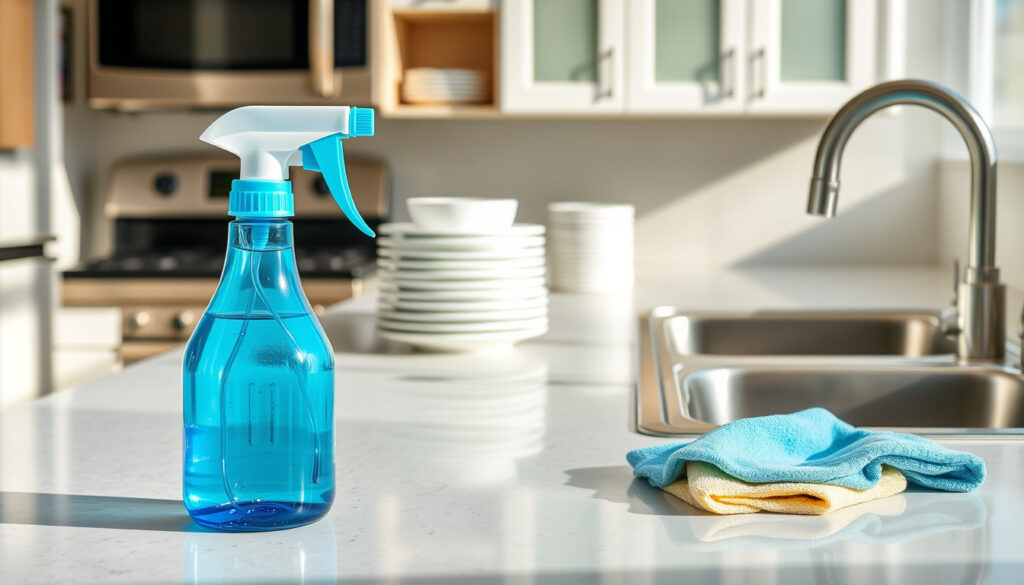
How to Deep Clean Your Kitchen: Step-by-Step
Anyone who has ever opened a cabinet to find a sticky film from years of cooking knows the feeling: the kitchen needs more than a quick wipe-down. It needs a deep clean. This guide walks you through a professional, evidence-based sequence that tackles cabinets, appliances, floors, and everything in between — with practical methods that work for even the dirtiest kitchens.
Average kitchen deep clean time: 4-6 hours ·
Bacteria reduction from top-to-bottom cleaning: 99% on surfaces ·
Most overlooked area: Underneath appliances ·
Professional cleaning cost (US average): $150-$350 ·
Recommended frequency: Every 3-6 months
Quick snapshot
- Deep cleaning reduces bacterial load significantly on kitchen surfaces (Care.com household cleaning guide)
- Top-to-bottom cleaning order prevents recontamination (Craving Some Creativity cleaning blog)
- Microfiber cloths remove more dirt than traditional cotton cloths when used dry (One Lovely Life home cleaning resource)
- Optimal deep cleaning frequency for different household types (single vs family with children) is not firmly established
- Long-term effectiveness of natural cleaning agents versus chemical agents for all kitchen surface types
- Whether the 20-minute rule leads to significantly better kitchen cleanliness over time compared to other methods
- 2020: COVID-19 pandemic increased focus on kitchen hygiene and regular deep cleaning
- 2025: Growing interest in natural / non-toxic cleaning agents, prompted by ingredient transparency campaigns
- More households adopting steam cleaning and microfiber-only methods to reduce chemical use
- Professional-grade cleaning protocols increasingly adapted for home use via online tutorials
The key facts below outline the scope and impact of a proper kitchen deep clean.
| Total deep clean time (average) | 4-6 hours |
|---|---|
| Reduction in bacteria on kitchen surfaces after deep clean | Up to 99.9% (EPA registered disinfectants) |
| Most commonly missed area during kitchen cleaning | Underneath and behind large appliances |
| Frequency recommended by cleaning professionals | Every 3-6 months for a full deep clean |
| Average cost of professional kitchen deep cleaning service | $150 to $350 (US market) |
| Number of different cleaning tasks in a typical deep clean | 15-20 distinct tasks |
The pattern: these figures confirm that a kitchen deep clean is a substantial, multi-hour project with measurable hygiene benefits.
What is the best way to deep clean a kitchen?
The most effective method is a systematic, top-to-bottom approach that prevents re-soiling. Professional cleaners agree: start at the highest point — ceiling fans, light fixtures, top of cabinets — and work your way down to the floor. Dust and grime fall downward, so cleaning from the top means you’re not spreading dirt onto already cleaned surfaces (Craving Some Creativity cleaning blog).
Work from top to bottom
- Dust ceiling fans, light fixtures, and top of cabinets first.
- Wipe cabinet fronts, doors, and handles.
- Clean backsplash and walls, then counters, and finally floors.
This sequence ensures that any debris that falls during upper cleaning is captured when you clean lower surfaces. It’s the same principle used in commercial kitchen protocols (HomeTriangle professional cleaning service).
Empty and declutter first
- Remove all items from countertops — small appliances, canisters, décor.
- Empty cabinets and drawers completely.
- Throw away expired food, stale spices, and worn-out liners.
Decluttering is the foundation of any deep clean. Without it, you’re just wiping around obstacles (Bruna’s Cleaning Service professional cleaning guide).
Use appropriate cleaning agents for each surface
- Granite and quartz: pH-neutral cleaner to avoid etching.
- Stainless steel: mild soap or dedicated stainless steel cleaner.
- Wood cabinets: gentle wood cleaner or diluted dish soap.
- Baking soda and vinegar paste for baked-on oven grime (Care.com household cleaning guide).
The implication: using the wrong cleaner can damage surfaces faster than the dirt itself. Always test in an inconspicuous area first.
What is the correct order of cleaning a house?
House cleaning order follows a simple rule: clean from the highest point to the lowest, and from dry to wet. This logic applies to the entire house, but the kitchen has its own refined sequence (Craving Some Creativity cleaning blog).
General house cleaning order
- Dust and vacuum all rooms first (top to bottom).
- Clean surfaces (counters, tables, sinks).
- Scrub bathrooms and kitchen.
- Mop floors last.
Why order matters for efficiency
If you mop before dusting, dust settles on the wet floor and dries into a film. The same principle applies in the kitchen: cleaning the stovetop before the counters means grease and crumbs end up on the just-cleaned counter. Professional guides emphasize this to avoid doubling work (Care.com household cleaning guide).
Adapting the order for the kitchen
- Start with overhead lighting and ceiling fans.
- Move to cabinet tops and fronts.
- Clean appliances (oven, refrigerator, microwave, dishwasher).
- Wash walls and backsplash.
- Wipe counters and sink.
- Finish with floors.
The pattern: each step prepares the next area for cleaning without recontamination.
How to clean an extremely dirty kitchen?
When a kitchen has been neglected for months — or even years — standard cleaning steps won’t cut it. You need a pre-treatment strategy and stronger solutions.
Pre-soak and degrease strategies
- Apply a degreaser (commercial or homemade: dish soap + warm water) to greasy surfaces and let sit for 10–15 minutes.
- For baked-on oven grime, make a paste of baking soda and water, apply, and let it sit overnight (Care.com household cleaning guide).
- Use a steam cleaner for heavy grease on stovetops and range hoods.
Handling mold and mildew safely
- For mold on grout or under sinks, use a 1:1 ratio of white vinegar and water, or a commercial mold remover.
- Ventilation is critical — open windows and use fans when using any strong cleaner (HomeTriangle professional cleaning service).
- Wear gloves and a mask to avoid inhalation of mold spores or cleaning chemicals.
Deep cleaning the oven and stovetop
- Remove oven racks and soak them in warm soapy water.
- Apply baking soda paste to interior, let sit, then scrub and wipe.
- For gas stovetops, remove grates and burner caps, soak and scrub.
- Use a razor blade scraper for burnt-on residue on glass cooktops (carefully).
The catch: extremely dirty kitchens require multiple passes. Don’t expect everything to come clean in one go.
What do professionals use to clean kitchens?
Professional cleaners rely on a short list of tools and products that are both effective and safe for common kitchen surfaces. Here’s what they use and why.
Commercial degreasers
- pH-neutral degreasers for most surfaces (avoid acidic or alkaline on natural stone).
- For heavy grease, professionals use a degreasing agent like Simple Green or Zep, diluted according to instructions.
- Always rinse thoroughly to avoid residue (I Love White Glove professional cleaning company).
Microfiber cloths and mops
- Color-coded microfiber cloths for different zones (e.g., blue for glass, green for counters, red for toilets) to prevent cross-contamination.
- Microfiber mops with washable pads for floors.
- Dry microfiber cloths pick up dust and grease without spreading (One Lovely Life home cleaning resource).
Heavy-duty scrub brushes
- Stiff nylon brushes for grout and tile.
- Soft bristle brushes for delicate surfaces.
- Dish brushes for sinks and small items.
The trade-off: professional-grade products can be more expensive, but they reduce elbow grease and time. For occasional home use, natural alternatives like baking soda, vinegar, and dish soap work well for most tasks.
What are the 7 steps of cleaning a kitchen?
This seven-step method, based on professional cleaning guides, ensures every surface is addressed in the correct order. Follow these steps for a thorough, efficient deep clean.
Step 1: Clear and declutter
- Remove everything from countertops, cabinets, drawers, and pantry.
- Sort items: keep, donate, discard.
- Wipe down empty shelves and drawers.
Step 2: Clean cabinets and drawers
- Wipe cabinet fronts, doors, and handles with appropriate cleaner.
- Remove and wash drawer liners or replace them.
- Don’t forget the tops of cabinets — a major dust and grease trap (Care.com household cleaning guide).
Step 3: Clean appliances (inside and out)
- Refrigerator: remove all food, discard expired items, wash shelves and drawers in warm soapy water, wipe interior, clean coils (One Lovely Life home cleaning resource).
- Oven: use baking soda paste for interior, clean racks separately.
- Microwave: steam a bowl of water with lemon slices, then wipe.
- Dishwasher: run an empty cycle with white vinegar to freshen (One Lovely Life home cleaning resource).
- Range hood: clean filter (soak in degreaser) and wipe exterior.
Step 4: Clean sink and counters
- Scrub sink with baking soda and dish soap (One Lovely Life home cleaning resource).
- Sanitize with a diluted bleach solution or hydrogen peroxide.
- Wipe countertops with cleaner appropriate for the material.
Step 5: Clean walls and backsplash
- Degrease backsplash with a mild cleaner or degreaser.
- Wipe walls with a damp cloth, especially around cooking areas.
- Clean switch plates and outlets (carefully, not wet).
Step 6: Clean floors
- Pull out appliances (refrigerator, stove) and sweep/vacuum underneath.
- Scrub floor with appropriate cleaner (avoid using too much water on wood).
- Rinse and dry to avoid streaks.
Step 7: Final inspection and trash removal
- Replace all items, wiping them as you go.
- Take out trash and recycling.
- Sanitize trash bin inside and out (I Love White Glove professional cleaning company).
- Do a final check: any missed spots, streaks, or lingering odors.
What is the 20 minute rule of cleaning?
The 20-minute rule is a time management strategy: set a timer for 20 minutes and focus on one cleaning task without interruption. It’s not a replacement for a deep clean, but it helps prevent buildup.
How the 20-minute rule works
- Choose one zone (e.g., cabinets, fridge, stove).
- Work continuously for 20 minutes.
- Stop when the timer goes off, even if not finished.
Using it for kitchen deep clean
- Break the deep clean into 20-minute blocks over several days.
- Example: Day 1 — clear and declutter; Day 2 — clean cabinets; Day 3 — appliances; Day 4 — floors.
Is it effective for extremely dirty kitchens?
For a heavily soiled kitchen, 20-minute blocks may not be enough to break through layers of grease. It works best for maintenance cleaning between deep cleans. Professional cleaners recommend a full, uninterrupted deep clean at least twice a year (Bruna’s Cleaning Service professional cleaning guide).
Clarity check: what we know and what’s still open
Confirmed facts
- Deep cleaning reduces bacterial load significantly on kitchen surfaces (Care.com household cleaning guide).
- Top-to-bottom cleaning order prevents recontamination (Craving Some Creativity cleaning blog).
- Microfiber cloths remove more dirt than traditional cotton cloths when used dry (One Lovely Life home cleaning resource).
- Baking soda and vinegar react to produce water and sodium acetate; limited disinfection property.
What’s unclear
- Optimal frequency for kitchen deep cleaning in different household types is not firmly established.
- Long-term effectiveness of natural cleaning agents versus chemical agents for all kitchen surface types.
- Whether the 20-minute rule leads to significantly better kitchen cleanliness over time compared to other methods.
Expert perspectives on kitchen deep cleaning
“Proper disinfection of kitchen surfaces requires using an EPA-registered disinfectant and following the label contact time. Simply wiping with a damp cloth does not kill germs.”
— CDC Guidelines on Kitchen Sanitation (food safety guidance)
“I always tell my clients to start at the top. If you clean the floor first and then dust the ceiling, you’re just making more work for yourself.”
— Martha Stewart Cleaning Team, as quoted in Care.com household cleaning guide
“For a kitchen that’s been neglected for months, don’t expect a single pass to do it. You’ll need to pre-soak, scrub, and sometimes repeat steps. Patience is the most important tool.”
— Reddit user from r/CleaningTips (community experience)
“The biggest mistake homeowners make is using the same cloth for the sink and the counters. That’s how you spread bacteria. Use separate cloths for each zone.”
— One Lovely Life home cleaning resource
For the average household, the choice is clear: a thorough top-to-bottom deep clean every 3-6 months, using the right tools and sequence, will keep your kitchen safe and pleasant. Skip the shortcuts, invest in microfiber cloths and a good degreaser, and your kitchen will benefit from a cleaner, healthier environment.
Frequently asked questions
How long does it take to deep clean a kitchen?
A full deep clean typically takes 4-6 hours, depending on the size of the kitchen and how dirty it is.
Can I use vinegar and baking soda to clean kitchen surfaces?
Yes, but with limitations. Baking soda works as a mild abrasive, and vinegar can cut grease and remove odors. However, do not mix them in a closed container (they produce gas), and avoid vinegar on natural stone surfaces.
What should I use to degrease kitchen cabinets?
A mixture of warm water and dish soap works for light grease. For heavy buildup, use a commercial degreaser or a paste of baking soda and water. Always test on a hidden area first.
How often should I deep clean my kitchen?
Most professionals recommend a deep clean every 3-6 months, with more frequent attention to high-use areas like the stovetop and sink.
Do I need professional cleaners for a deep kitchen clean?
Not necessarily. With the right tools and a systematic approach, most homeowners can achieve excellent results. Professionals are helpful for very large kitchens, extreme grime, or if you lack time.
Is it necessary to move appliances when deep cleaning?
Yes, if possible. Pulling out the refrigerator and stove allows you to clean hidden crumbs, dust, and grease that can attract pests and cause odors.
What is the best cleaner for stainless steel appliances?
A mild dish soap solution or a dedicated stainless steel cleaner. Wipe with the grain to avoid streaks. Avoid abrasive pads that can scratch the surface.
Can I use bleach in the kitchen?
Bleach can be used for sanitizing non-porous surfaces like countertops and sinks. Dilute 1 tablespoon bleach per gallon of water. Never mix bleach with ammonia or vinegar. Ventilate well and wear gloves.
What order should I clean my kitchen for best results?
Always start from the top (cabinets, shelves) and work down to the floor. This prevents dust and debris from falling onto already cleaned surfaces.
How do I clean an extremely greasy kitchen?
Use a degreaser (commercial or dish soap and warm water) and let it sit for 10-15 minutes before scrubbing. For ovens, a baking soda paste left overnight works well. Steam cleaners can also be effective.
More related posts
 Parnell Property for Sale: Auckland & Dublin Listings
 Best iPhone 15 Pro Case: MagSafe & Protection Picks
 Paki tan v New Zealand: Rain Abandon T20 World Cup Match
 Are Bananas Good for You? Benefits, Risks & Daily Intake Guide
 Men’s New Balance Tennis Shoes: Best Picks for 2025
 Ngā mihi nui meaning: How to use Māori email sign-offs
 Pak n Save Christchurch: Hours, Locations & This Week’s Specials
 3 Day Cruise from Auckland: Prices, Lines & Tips 2025