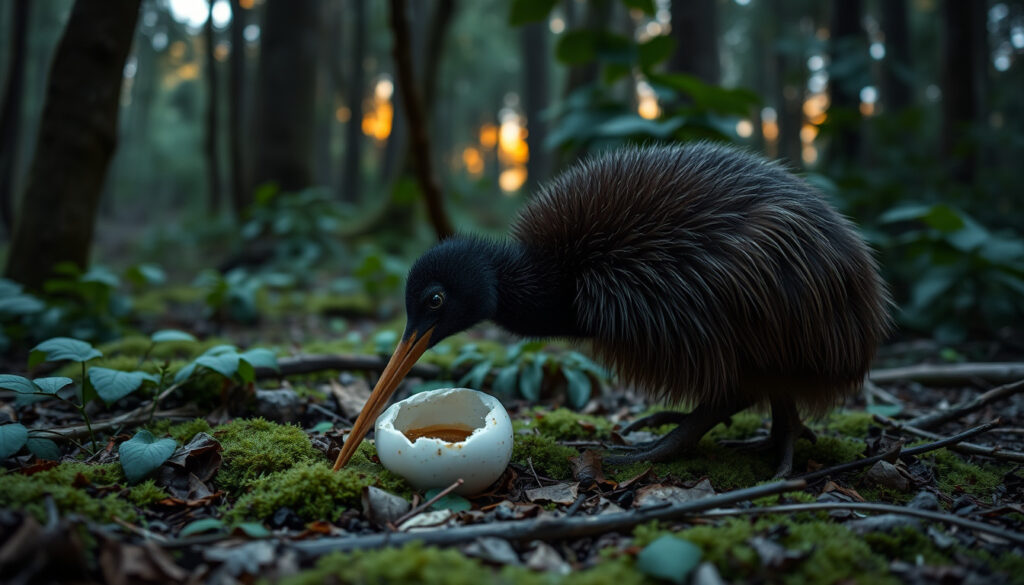
10 Facts About Kiwi Birds: Flightless, Giant Eggs & More
Imagine a bird with hair-like feathers, a beak that doubles as a nose, and an egg so huge it takes over a quarter of its body weight — that’s the kiwi, New Zealand’s living oddity. This flightless, nocturnal national icon hides a bundle of evolutionary surprises behind its pear-shaped silhouette, from its 15% egg-to-body ratio to its surprisingly fast sprint.
Flight capability: Flightless · Maximum lifespan: Up to 60 years · Egg weight relative to body: 15% of female’s body weight · Running speed: Up to 12 mph (19 km/h) · Population estimate (2026): Around 68,000
Quick snapshot
- Kiwi are flightless with tiny vestigial wings (Department of Conservation (New Zealand’s wildlife authority))
- Largest egg-to-body ratio of any bird: 15% of body weight (Department of Conservation)
- Endemic to New Zealand (BBC News)
- Nocturnal with strong sense of smell (Department of Conservation)
- Kiwi sanctuaries established in 2000 (Department of Conservation)
- Populations were falling ~2% per year as of 2016 (BBC News)
- Recovery goal: 100,000 kiwi by 2030 (Department of Conservation)
- DOC’s 2018–2028 kiwi recovery plan targets 2% annual growth across all five species (Department of Conservation)
- Predator control and dog management remain key strategies (Department of Conservation)
- Tangata whenua leadership in conservation increasing (Department of Conservation)
“Kiwi have tiny wings, but they can’t fly. Due to being flightless, they are particularly vulnerable to predators such as stoats, dogs and cats.” — WWF New Zealand
Seven key facts, one pattern: kiwi are evolutionary outliers with a conservation story that’s both alarming and hopeful — each number tells a part of the same saga.
| Label | Value |
|---|---|
| Scientific name | Apteryx spp. |
| Average weight | 1.4–3.3 kg (3–7 lbs) |
| Average height | 45–55 cm (18–22 in) |
| Lifespan | Up to 60 years |
| Egg weight | Up to 450 g (1 lb) |
| Running speed | 12 mph (19 km/h) |
| Population (2026 estimate) | ~68,000 |
Kiwi are simultaneously New Zealand’s most celebrated bird — the national symbol — and among its most endangered. The same evolutionary quirks that make them fascinating also make them catastrophically vulnerable to introduced predators.
Why is kiwi bird special?
How fast can kiwis run?
- Kiwis can run up to 12 miles per hour (19 km/h), making them surprisingly agile despite their flightless condition (Department of Conservation).
- Their strong, muscular legs account for about one-third of their body weight — built for sprinting, not flying (Department of Conservation).
Do kiwi birds kick?
- Yes. Kiwi use their powerful legs and sharp claws to kick predators such as stoats, ferrets, dogs, and cats (Department of Conservation).
- A defensive kick can deliver a serious blow — it’s their primary weapon since they can’t fly away (BBC News).
What is the kiwi’s egg-to-body ratio?
- The egg averages 15% of the female’s body weight — compared to 2% for the ostrich (Department of Conservation).
- At up to 450 grams, a single kiwi egg can weigh a quarter of the mother’s total mass (Department of Conservation).
Are kiwi birds flightless?
- Kiwi are flightless with tiny vestigial wings hidden beneath their hair-like feathers (Department of Conservation).
- Because they evolved with no ground-based mammalian predators for millions of years, they lost the ability to fly (BBC News).
“The egg averages 15% of the female’s body weight (compared to 2% for the ostrich).” — National Kiwi Hatchery
The implication: kiwi evolved in a predator-free paradise, and every physical trait — from flightlessness to hair-like feathers — is a response to that ancient New Zealand environment. The moment humans introduced dogs, cats, and mustelids, those same traits became deadly liabilities.
How old are kiwi birds?
What is the kiwi bird life cycle?
- Kiwi can live up to 60 years in captivity and around 50 years in the wild (Department of Conservation).
- They reach sexual maturity at 2–3 years of age (Department of Conservation).
- The incubation period for a kiwi egg is 75–85 days — unusually long for a bird its size (Department of Conservation).
- Chicks hatch fully feathered and independent — they don’t get fed by their parents (Department of Conservation).
Why this matters: a 60-year lifespan means a kiwi can outlast most pet dogs and cats — but it also means replacing lost adults requires decades, not seasons. Predator kills hit the population harder because reproductive output is slow.
What do kiwi birds eat?
- Kiwi are omnivores: insects, worms, spiders, berries, and seeds make up their diet (Department of Conservation).
- They use their long, thin beak — with nostrils at the tip, the only bird with this feature — to probe soil and leaf litter (Department of Conservation).
- A kiwi’s sense of smell is so acute it can detect prey underground; they’re the only bird with a well-developed olfactory system (Department of Conservation).
- They feed at night, using their beak like a probe while walking slowly through forest or scrubland (Department of Conservation).
The pattern: the kiwi evolved a beak that functions more like a mammal’s nose — a rare case of convergent evolution between bird and mammal feeding strategies.
Where do kiwi birds live?
- Kiwi are endemic to New Zealand — found nowhere else on Earth (Department of Conservation).
- They inhabit forests, scrublands, and coastal areas across both North and South Islands (Department of Conservation).
- Kiwi are nocturnal and burrow nest — they dig underground dens or use tree hollows for daytime shelter (Department of Conservation).
- There are five recognized species, each with its specific geographic range (BBC News).
The great spotted kiwi is restricted to the South Island’s alpine zones, while brown kiwi roam North Island forests — habitat fragmentation means each species faces different pressures.
The implication: geographic isolation created distinct species, each with unique conservation needs.
How many kiwi birds are left in 2026?
What eats a kiwi bird?
- Introduced predators — stoats, ferrets, dogs, cats, and possums — are the primary threat (Department of Conservation).
- Dogs can kill adult kiwi; stoats and cats prey heavily on chicks and eggs (Department of Conservation).
- Habitat loss and human encroachment compound the problem (BBC News).
The estimated population sits around 68,000 individuals (BBC News). Numbers were declining at roughly 2% per year as of 2016 (BBC News).
Species-level conservation status varies considerably. According to New Zealand’s Department of Conservation (2018-2028 threat classification):
- Haast kiwi/tokoeka: Nationally Critical — the most endangered kiwi (Department of Conservation).
- Rowi (Okarito brown kiwi): Nationally Vulnerable with fewer than 650 birds (Department of Conservation; Wild Kiwi).
- Great spotted kiwi: Nationally Vulnerable (Department of Conservation).
- Brown kiwi: At Risk – Declining (Department of Conservation).
- Little spotted kiwi: At Risk – Recovering (Department of Conservation).
The trade-off: recovery is possible — DOC’s plan targets 100,000 kiwi by 2030 with a 2% annual growth rate — but each species moves at a different speed. For Haast tokoeka and rowi, every individual counts.
Kiwi conservation has a clear, measurable goal. The Department of Conservation (New Zealand’s biodiversity authority) aims for 100,000 kiwi by 2030 using predator control, dog management, genetic-diversity protection, and Māori leadership. For New Zealanders and ecotourism operators alike, the choice is straightforward: fund and support the sanctuary network, or watch the national symbol slide into deeper trouble. The next decade decides whether kiwi remain an evolutionary oddity or become a conservation memory.
worldanimalrescuenetwork.org, en.wikipedia.org, doc.govt.nz, doc.govt.nz, doc.govt.nz, earthsky.org, strangeanimals.info, youtube.com
For those interested in seeing these remarkable birds up close, the Pūkaha National Wildlife Centre offers a firsthand look at kiwi conservation efforts in New Zealand.
Frequently asked questions
Are kiwi birds endangered?
Yes, several species are threatened. Haast tokoeka is Nationally Critical, while rowi, great spotted kiwi, and North Fiordland tokoeka are Nationally Vulnerable (Department of Conservation). The little spotted kiwi is At Risk – Recovering.
What is the kiwi bird’s scientific name?
The genus is Apteryx, meaning “wingless” (Department of Conservation).
How do kiwi birds reproduce?
Kiwi lay one of the largest eggs relative to body size — up to 450 g. The male incubates the egg for 75–85 days, and the chick hatches fully feathered and independent (Department of Conservation).
How do kiwi birds defend themselves?
They use powerful legs and sharp claws to kick predators. Since they can’t fly away, a strong kick is their main defense (Department of Conservation).
What are the different species of kiwi?
There are five recognized species: brown kiwi, little spotted kiwi, great spotted kiwi, rowi (Okarito brown kiwi), and tokoeka (including Haast tokoeka) (BBC News).
More related posts
 Prince William and Kate Latest News: Health, Family & Rumors
 Jet Boat Accident Wairarapa – Fatal Crash on Ruamahanga River
 Bang Bang Chicken Salad: Recipe, History, and Heart-Healthy Tips
 What to Do in Franz Josef: Top Activities & Glacier Tours
 Ozempic NZ Buy Online: Prescriptions, Costs & Alternatives
 2025 F1 Driver Standings: Norris Edges Verstappen by 2
 Current Personal Loan Rates NZ: Compare April 2026 Offers
 Gamefallout.com Author Jeffery Williams: Verified Facts