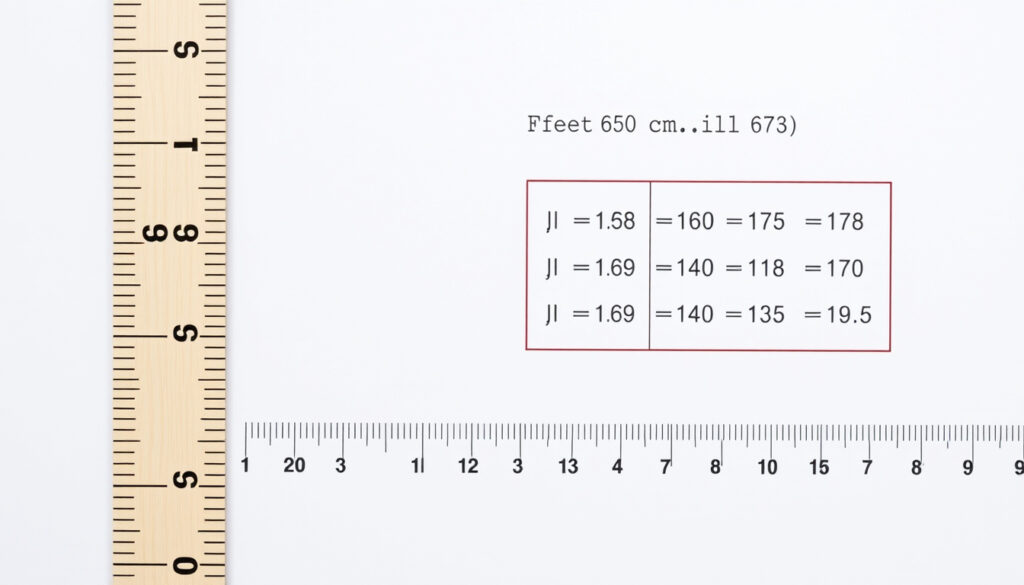
160 cm in Feet: Exact Conversion and Height Guide
Few numbers in the height world get asked about as often as 160 cm. Anyone who’s checked a conversion chart for this specific measurement already knows part of the story — the math is simple — but what 160 cm actually means for height perception is a different question entirely.
1 cm = 0.0328084 ft: 0.0328084 ·
160 cm in feet (decimal): 5.24934 ft ·
160 cm in feet and inches: 5 ft 2.99 in ·
Global average female height: 159.5 cm (5 ft 2.8 in) ·
Global average male height: 171 cm (5 ft 7.3 in)
Quick snapshot
- 160 cm = 5.24934 ft (RapidTables conversion calculator)
- 160 cm = 5 ft 2.99 in (Calculatio height converter)
- Common rounding: 5 ft 3 in (Inch Calculator height tool)
- 1 foot = 30.48 cm exact (The Calculator Site reference)
- Whether 160 cm is “short” depends on region and gender — no universal threshold
- Cultural beauty standards shift what counts as ideal height over time
- Average human height has increased ~10 cm over the past century due to nutrition improvements (Britannica human growth data)
- Expect height conversion tools to get more precise as metric adoption increases
- Global average height data updates from WHO each decade
Six key facts, one pattern: the math behind 160 cm in feet is fixed, but its meaning changes drastically once you place it against global averages.
Here is the quick reference table for the conversion values and global comparisons.
| Label | Value |
|---|---|
| Exact conversion | 160 cm = 5.24934 ft |
| Rounded to nearest inch | 5 ft 3 in |
| Average female height (global) | 159.5 cm |
| Average male height (global) | 171 cm |
| Difference from female average | +0.5 cm (above) |
| Difference from male average | −11 cm (below) |
Is 160 cm 5’3″?
The short answer: almost, but not quite. When you convert 160 cm to feet and inches, the result is 5 feet and 2.99 inches — just 0.01 inches shy of a full 5’3″. That’s why most conversion charts round it up and call it 5 feet 3 inches, but the exact number matters in contexts like medical records, clothing sizing, and aviation requirements.
How to convert 160 cm to feet and inches
The conversion formula is simple because one foot equals exactly 30.48 centimeters. To convert any centimeter value to feet, you divide by 30.48:
- Feet (decimal) = centimeters ÷ 30.48 → 160 ÷ 30.48 = 5.24934 ft (The Calculator Site conversion tool)
- Feet (integer) = 5, so the remainder in inches = (0.24934 × 12) = 2.99 inches
- Final result: 5 ft 2.99 in (RapidTables verified conversion)
The catch: because 2.99 inches rounds to 3 inches in everyday conversation, “5’3″” has become the standard shorthand, but purists will note it’s a hair under.
What is the exact decimal conversion?
If you need the value as a pure decimal in feet and nothing else, the exact figure is 5.249343832 feet. Most consumer calculators stop at 5.2493 ft after rounding to four decimal places (Inch Calculator decimal output).
Anyone using 160 cm for a driver’s license, a medical form, or an online profile should remember that 5’3″ is a rounding, not the exact measurement. Airlines and medical professionals typically use the raw decimal or the exact feet-and-inches figure.
The implication: if you tell someone you’re 160 cm, they’ll picture 5’3″ — and that’s close enough for casual conversation. But precision matters when the number has legal or medical weight.
How tall is 160 cm for a girl?
It depends entirely on where in the world you ask. 160 cm lands at or near the global average for adult women, but the perception shifts depending on regional averages, cultural beauty standards, and generational trends.
Is 160 cm considered short or average for a woman?
The most commonly cited global female adult average height is approximately 159.5 cm (5 ft 2.8 in). That places a woman who is 160 cm right on the global average line — above average in some regions, below in others (HeightProfiles global height distribution report).
Here’s a quick regional breakdown of where 160 cm lands for women:
- Southeast Asia (Indonesia, Philippines, Vietnam): above average — regional averages range 150–155 cm
- East Asia (China, Japan, South Korea): near average — typical female averages 157–162 cm
- Western Europe (UK, Germany, France): below average — female averages range 164–168 cm
- Scandinavia (Netherlands, Denmark, Sweden): distinctly below average — female averages 167–170 cm
A 160 cm woman in the Netherlands is in the 5th percentile for female height, while a 160 cm woman in Indonesia is in the 65th percentile (WHO growth reference datasets). The same number means very different things based on geography.
What this means: if you’re a 160 cm woman reading this, the category you fall into depends on your local population. Globally, you’re exactly average. In the US or UK, you’re slightly shorter than average. In parts of Asia, you’re taller than the norm.
How does 160 cm compare to global female averages?
Relative to the global female average of 159.5 cm, 160 cm is only 0.5 cm above the midpoint — a difference thinner than a typical thumb’s width. The perception of “short” or “tall” for a woman at 160 cm is mostly a function of the people she’s standing next to, not the number on the measuring tape.
Is 160 cm short for a guy?
For men, the picture is different. The global adult male average height sits around 171 cm (5 ft 7.3 in), which means a 160 cm man is roughly 11 cm (about 4.3 inches) shorter than the worldwide male average (HeightProfiles global height distribution report).
Average male height worldwide
Men’s average heights vary significantly by region, but 160 cm falls below nearly every national male average:
- Netherlands (tallest): 183 cm — 160 cm is 23 cm shorter = in the 1st percentile
- United States: 177 cm — 160 cm is 17 cm shorter = around the 2nd percentile
- India: 166 cm — 160 cm is 6 cm shorter = around the 10th percentile
- Indonesia: 163 cm — 160 cm is 3 cm shorter = around the 20th percentile
In every measured national population, a 160 cm man is below the 25th percentile for male height. The degree varies, but the direction does not.
Regional differences in male height perception
The practical experience of being a 160 cm man changes by context:
- In Western Europe and North America, 160 cm is rare for an adult male and often stands out as noticeably shorter than peers
- In parts of South and Southeast Asia, 160 cm is on the shorter end but more common, especially in older generations
- In online dating and social contexts, studies show that height below 165 cm for men is associated with social perception differences (ScienceDirect study on height and social perception)
Men at 160 cm face a biological disadvantage in environments designed for taller averages — from car ergonomics to workplace clothing — but also report lower rates of back pain and knee injuries in some cohort studies (NIH research on height and health outcomes).
worldometers.info, youtube.com, youtube.com, youtube.com, symbolab.com, calculat.io, inchcalculator.com
Frequently asked questions
What is 160 cm in inches?
160 cm equals approximately 62.99 inches (Inch Calculator conversion tool). The exact calculation is 160 ÷ 2.54 = 62.9921 inches.
How many feet is 160 cm exactly?
Exactly 5.249343832 feet, commonly rounded to 5.25 feet or 5 feet 2.99 inches (CK-12 flexi answer page).
Is 160 cm a good height for a girl?
Globally, 160 cm is essentially the average adult female height — about 159.5 cm according to estimates. In many Asian countries it’s slightly above average, while in Western Europe it’s slightly below. “Good” depends on local norms, but it’s a common, healthy height worldwide.
What is the ideal weight for 160 cm height?
A healthy BMI range for 160 cm (5 ft 3 in) is approximately 47–64 kg (104–141 lb), according to the CDC BMI guidelines. Ideal weight also depends on bone structure, muscle mass, and body composition.
How tall is 160 cm compared to 5’2″?
160 cm (5 ft 2.99 in) is about 1 inch taller than 5’2″ (157.48 cm). The difference is roughly the width of a standard business card.
Is 160 cm tall for a boy?
For an adult male, 160 cm is well below the global average of 171 cm and below every national male average. For a child or adolescent, whether 160 cm is tall depends on age — it’s tall for a 12-year-old but short for an 18-year-old (CDC growth charts).
What is the conversion formula for cm to feet?
The formula is: feet = centimeters ÷ 30.48. To get inches from the remainder, multiply the decimal part by 12. Example: 160 ÷ 30.48 = 5.24934, then 0.24934 × 12 = 2.99 inches.
For anyone standing at 160 cm and wondering where that places them, the answer is both simple and layered: the conversion gives you a reliable number, but the real story is in the global averages and regional norms that give that number meaning. Whether you’re looking for a clothing size, a medical measurement, or just trying to figure out if you’re tall enough to reach the top shelf, 160 cm puts you right in a complex middle ground — exactly average in one context, notably different in another.
For the person at 160 cm in the United States or Europe, the implication is clear: own the exact number, because rounding to 5’3″ masks a small but meaningful gap — and in a world built around averages, being a few millimeters off can change the fit of a garment, the setting of a seat, or the perception of a profile.
Related reading
More related posts
 Greek Salad Recipe NZ – Authentic Horiatiki Guide
 Best 55 Inch Smart TV 2026: Ireland Deals & Reviews
 Warriors vs Timberwolves Stats: Head-to-Head & Key Numbers
 New Plymouth to Taupo: Best Routes, Stops & Travel Guide
 John Tamihere Daughter Accident: Who Is Kiri Tamihere
 How to Cancel ChatGPT Subscription: Step-by-Step Guide
 As Above So Below: Meaning, Origin, and Misconceptions