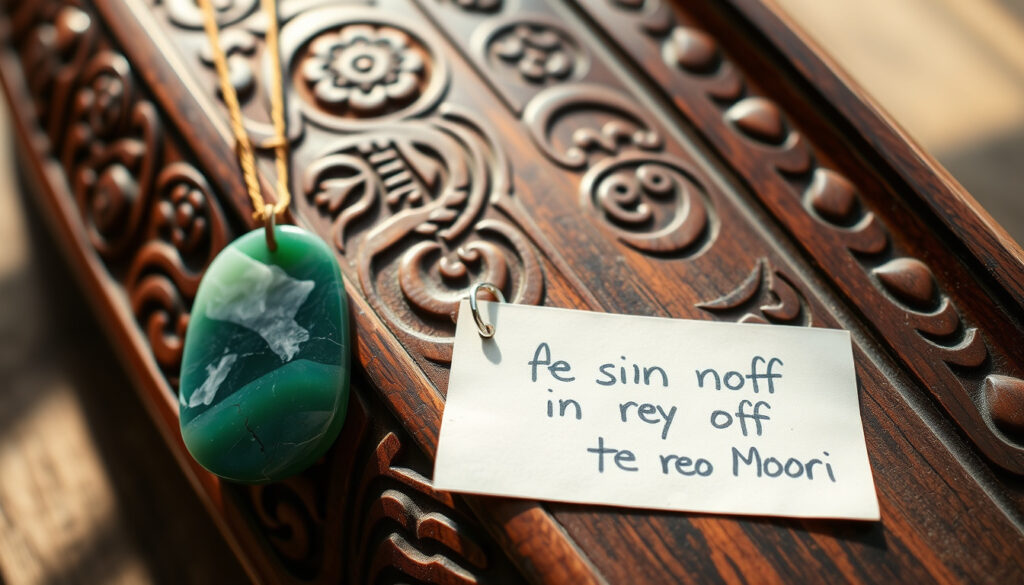
Ngā mihi nui meaning: How to use Māori email sign-offs
Most of us sign off emails without thinking twice — “Kind regards” goes out a hundred times a week. But when a message closes with ngā mihi nui, it carries more than a farewell: it’s a small act of cultural recognition, and the University of Auckland (te reo Māori language guide) lists it as an email closing meaning “kind regards,” with extra weight on gratitude.
Literal translation: many thanks / warm greetings · Pronunciation: /ŋaː ˈmi.hi nuː.i/ · Language: Te reo Māori · Common context: Email sign-off, letter closing · Formality level: Formal to semi-formal
Quick snapshot
- Ngā mihi nui is the warmer, more grateful relative of the everyday sign-off ngā mihi — a closing that carries real weight (Verbavia (language-learning guide)).
- Pronunciation guides differ: one learner resource renders it “ngah MEE-hee NOO-ee,” an approximation rather than a fixed standard (Ling App (te reo learner blog)).
- Whether the phrase sits naturally in every regional dialect is an open question — no official guide cited here rules on it. (Ling App (te reo learner blog))
- Ngā mihi can open or close a conversation or a written message; as a sign-off it reads as “best wishes” (New Zealand Government (Whainga Amorangi office-language guide)).
- When a message closes with ngā mihi nui, a “kia ora” in reply is the standard acknowledgment (Preply (Māori greetings guide)).
Six aspects of the phrase, one pattern: the deeper the intended gratitude, the more specific and careful the form becomes.
| Aspect | Details | Source |
|---|---|---|
| Literal translation | “Many thanks” or “warm greetings” | Te Aka Māori Dictionary (reference dictionary) |
| Pronunciation | /ŋaː ˈmi.hi nuː.i/ — roughly “ngah MEE-hee NOO-ee” | Ling App (te reo learner blog) |
| Language | Te reo Māori | — |
| Typical use | Email closing, letter sign-off | Verbavia (language-learning guide) |
| Level of formality | Formal to semi-formal | — |
| Addressee forms | ngā mihi nui ki a koe (one person), ki a kōrua (two), ki a koutou (three or more) | New Zealand Government (Whainga Amorangi office-language guide) |
What does “ngā mihi nui” mean in an email?
The short answer: it is a sign-off that says “thanks — and I mean it.”
- It belongs at the end of a message, in the slot where English writers place “kind regards” or “best wishes.”
- It is the amplified version of ngā mihi — same courtesy, extra weight.
- Professional te reo guidance places it in a specific register: the email where thanks carries real weight (RANZCP (professional te reo guide and glossary)).
Literal translation
- “Many thanks” or “warm greetings” — the literal gloss used most often by bilingual speakers.
- Mihi is the greeting; nui is what scales it up into something emphatic.
The macrons do real work here: ngā carries the plural, mihi carries the greeting, and nui adds magnitude. The ng at the start is the same as the ng in “singer,” and a macron marks a long vowel — both details change how the phrase sounds (Preply (Māori greetings guide)). Pronunciation is where English speakers hesitate, but the rhythm is friendlier than the spelling suggests: three clear beats, no swallowed vowels.
Cultural context
- Te reo Māori runs through New Zealand professional life, and institutional sign-offs are one of the places it shows up.
- Professional bodies now publish their own te reo guidance — a signal that the phrase belongs in real workplaces, not only on formal occasions.
The Royal Australian and New Zealand College of Psychiatrists, for example, maintains a te reo guide for members and is explicit that ngā mihi nui suits moments of stronger appreciation — like thanking someone for a useful report. That is the pattern to notice: the longer form appears exactly where a plain “thanks” would feel thin. For more on how the language moves through public life, see our guide to Te Wiki o te Reo Māori 2026.
When to use ngā mihi nui?
The rule is simple: keep ngā mihi for routine closes and upgrade when the thanks is real.
- Formal correspondence — letters, official replies, and external emails where “kind regards” fits.
- Thank-you moments — after a favor, a detailed reply, or a report that saved you time.
- Routine closes — the everyday email where the shorter form is the standard choice.
Formal occasions
- Use ngā mihi nui in official messages that end with genuine appreciation.
- Skip it for five-line FYIs; the shorter ngā mihi keeps the register right.
Professional guidance points in the same direction: ngā mihi nui is for stronger appreciation, not for every message. If someone has gone out of their way, the long form names it; if the email is routine, the short form lets the content speak.
Email sign-offs
- The sign-off sits after the body, above your name.
- It can stand alone or take an addressee — ngā mihi nui ki a koe turns the thanks toward one person.
Placement is consistent across the guides: closing line, then name, nothing else. A comma before the sign-off is optional; most New Zealand writers drop it and let the phrase breathe.
Compared to other salutations
Ngā mihi is the automatic wave; ngā mihi nui is the handshake that lingers. Save the long form for people who actually did something for you.
Think of the two forms as siblings with different energy. Language-learning guide Verbavia puts it plainly: ngā mihi is the everyday standard email closing, while ngā mihi nui is warmer and more grateful (Verbavia (language-learning guide)). The difference is not grammatical — the grammar is identical — it is relational: one closes a message, the other closes it with feeling.
How do you end a letter in Māori?
The core closing set is small, and each form has a job.
Common closings
- Ngā mihi — the baseline close: “kind regards.”
- Ngā mihi nui — “many thanks,” the warmer version.
- Ngā mihi nui ki a koe / kōrua / koutou — aimed at one, two, or three or more people.
RANZCP’s te reo glossary treats ngā mihi as an acceptable closing for emails and letters, roughly the equivalent of “kind regards” in that position (RANZCP (professional te reo guide and glossary)). The nui form is the upgrade when the message carries real weight.
The New Zealand Government’s office-language guide adds the precision that English sign-offs lack: ki a koe addresses one person, ki a kōrua two, and ki a koutou three or more (New Zealand Government (Whainga Amorangi office-language guide)). If your letter or email is going to a named individual, the ki a koe form is the most personal choice.
Ngā mihi nui as a closing
- Use it after a favor, a detailed answer, or a piece of work that saved you time.
- In a letter, it goes on its own line after the body, before your name.
That placement is consistent across institutional guidance: the closing rests at the end of the message, where an English sign-off would sit, and it carries the same grammatical weight as “kind regards” — only warmer.
Other Māori sign-offs
- Ka kite, ka kite anō, and hei konā belong to the spoken “see you” family, not the written thanks family.
- For letters, the ngā mihi forms remain the safer, more professional default.
If a goodbye fits better than a thanks, the spoken farewells are covered in the next section. For the rest of the message — subject lines, tone, structure — see how to write an email.
What is the correct response to ngā mihi?
There is no set ritual. The phrase is a courtesy, and the matching courtesy is enough.
Verbal responses
- “Kia ora” — the all-purpose greeting fits almost any reply.
- “Tēnā koe” — a more formal, one-to-one acknowledgment.
- “Ngā mihi” — returning the thanks directly is always polite.
The easiest reply is kia ora. Preply’s beginner guide treats it as the default New Zealand greeting — a word that works as hello, as thanks, and as a reply to itself (Preply (Māori greetings guide)). In writing, a short “kia ora” at the top of your reply acknowledges the closing without over-explaining.
Non-verbal acknowledgment
In spoken exchanges the acknowledgment matters more than the wording — a smile and a nod are part of the register, not a substitute for it.
In person, a smile and a nod do the work. Māori greetings are exchanged face to face as often as on paper, and the tone of the exchange matters more than the exact wording.
Cultural norms
- Reciprocity: a greeting earns a greeting, and a thanks earns a thanks.
- The register stays light — no ceremony is required to respond correctly.
The norm underneath it all is reciprocity: if someone closes with gratitude, the natural move is to acknowledge it, not to leave it hanging. A quick kia ora back does exactly that — no ceremony, no English translation needed.
What this means: the response matters less than the acknowledgment itself. The person who wrote ngā mihi nui is not testing your pronunciation; they are extending goodwill.
What is the farewell greeting in Māori?
Greeting and farewell in te reo come from the same small set, which makes them easy to learn together.
How do Māori say hello?
- Hello: kia ora (everyday), tēnā koe (formal, one person), tēnā koutou (formal, group).
- Kia ora koutou — “hello to you all” — is the common opening for group messages.
Kia ora is the everyday hello, and it doubles as thanks and as a warm goodbye — the most flexible word in the greeting set. Tēnā koe raises the register for one person, tēnā kōrua for two, and tēnā koutou for a group (Te Aka Māori Dictionary (reference dictionary)). You may also hear tēnā koutou katoa — “greetings to you all” — with katoa adding the “all.” The farewell counterparts follow the same logic: ka kite anō (“see you again”) and hei konā (“bye for now”) are the standard spoken goodbyes (Te Aka Māori Dictionary (reference dictionary)).
Responding to Kia Ora
- The reply to kia ora is kia ora — the same word signals that the greeting was received and returned.
- No need to vary it, and no need to switch to English.
This symmetry is the most useful detail in the whole greeting set. It removes the awkward pause: both sides say the same word, and the exchange closes on a shared courtesy.
Introducing yourself in Māori
- The standard spoken formula is “Tēnā koutou, ko [name] ahau” — “greetings to you all, I am [name].”
- Longer pepeha belong to formal settings; the short form fits emails, meetings, and first introductions.
When people ask how to introduce themselves in Māori, this is the pattern to memorize. It greets the group and names you in one breath, without forcing a full tribal introduction you may not be entitled to give.
How to use ngā mihi nui: a five-step checklist
Pulled together, the guidance above becomes a short workflow.
- Judge the weight of the message. Routine FYI? Keep ngā mihi. A favor, a report, a kindness? Upgrade to ngā mihi nui.
- Name your audience. Add ki a koe for one person, ki a kōrua for two, ki a koutou for a group.
- Place it correctly. After the body, before your name — the sign-off slot in emails and letters alike.
- Keep the macrons. Write ngā, not nga. The long vowel is part of the word, and dropping it turns a warm greeting into a spelling slip.
- When in doubt, shorten. A correct ngā mihi is never wrong; a misplaced ngā mihi nui can feel heavy.
The macrons are the detail that separates careful te reo from a casual approximation — ngā and nga are not the same word on the page.
The catch: the workflow takes ten seconds once the forms are familiar — and the person on the other end notices the care either way.
What’s confirmed — and what’s still unclear
A low-profile phrase can still raise open questions. Here is the honest split.
Confirmed facts
- Ngā mihi nui is glossed as “kind regards” with extra emphasis on gratitude (University of Auckland (te reo Māori language guide)).
- It is a professional-standard closing for emails and letters, formal to semi-formal in register.
- It addresses one, two, or many people through ki a koe, ki a kōrua, ki a koutou.
What’s unclear
- Where the phrase originated — no official guide consulted here traces its first use.
- Whether its register varies by region or iwi — the official glossaries are silent on dialect differences.
- Whether it suits rapid-fire internal chat — no style authority cited here rules on it.
- Pronunciation differs across learner resources; the Ling App approximation cited above is a guide, not a standard.
The honest part: what is documented is solid, and what is undocumented stays that way until researchers look at it.
What the guides say
Two institutional sources frame the practical guidance most clearly.
Ngā mihi is used in email and letter sign-offs with meanings including “kind regards,” “thank you,” “thanks,” or “cheers,” depending on context.
— University of Auckland (te reo Māori language guide)
Ngā mihi nui is appropriate when expressing stronger appreciation, such as thanking someone for a useful report.
— RANZCP (professional te reo guide and glossary)
The pattern across both: the phrase earns its place when the gratitude is specific, not generic.
The takeaway
Ngā mihi nui is not a translation challenge; it is a register choice. The phrase says “many thanks” the way a warm handshake does — and English has no exact equivalent because the form itself carries the meaning. For New Zealand professionals writing to Māori colleagues, clients, or community partners, the decision is simple: use ngā mihi nui when the thanks is real and the macrons are intact — or settle for the shorter ngā mihi that reads like the default it is.
Frequently asked questions
Can I use ngā mihi nui in all emails?
In most professional correspondence, yes — it reads as a warm, standard closing. For rapid internal messages, the shorter ngā mihi usually fits better; ngā mihi nui carries more weight and should be backed by actual appreciation.
Is ngā mihi nui formal or informal?
It sits in the formal-to-semi-formal band: appropriate for letters, emails, and official replies, and a little heavy for quick text messages.
How is ngā mihi nui different from ngā mihi?
Ngā mihi is the everyday “kind regards.” Ngā mihi nui is the amplified form — the same courtesy with more gratitude attached, closer to “many thanks.”
What does “ngā mihi nui ki a koe” mean?
It directs the greeting to one person: “many thanks to you.” Use ki a kōrua for two people and ki a koutou for three or more.
How do you pronounce ngā mihi nui?
The IPA form is /ŋaː ˈmi.hi nuː.i/. In practical terms, “ngah MEE-hee NOO-ee” — the ng is made like the end of “sing,” and the macrons lengthen the vowels (Ling App (te reo learner blog)).
Can I use ngā mihi nui in spoken conversation?
Yes. It works as a spoken thank-you, not just a written sign-off — the phrase lands the same way as a warm “thanks very much.”
Is ngā mihi nui used outside New Zealand?
Mostly in New Zealand, but the phrase travels through professional networks: the RANZCP te reo guide covers members in both Australia and New Zealand.
If a message arrives with ngā mihi nui, the reply is simple: acknowledge it, and the exchange stays warm.
More related posts
 St Clair Golf Club: Fees, Address, Scorecard & Reviews
 California King Bed NZ: Sizes, Comparisons & Guide
 Cold Sore on Lip: Causes, Triggers & Fast Treatments
 Mitre 10 Mega Rotorua: Store Info, Hours, Address & What to Know
 Perth to Bali Flight Time: 3 Hours 45 Minutes Direct
 Rainbow Fish Supply Menu & Prices for Greenmeadows & Newtown
 1000 GBP to NZD Today: Live Rate & Transfer Tips
 2025 NCEA exam timetable PDF: key dates and schedule