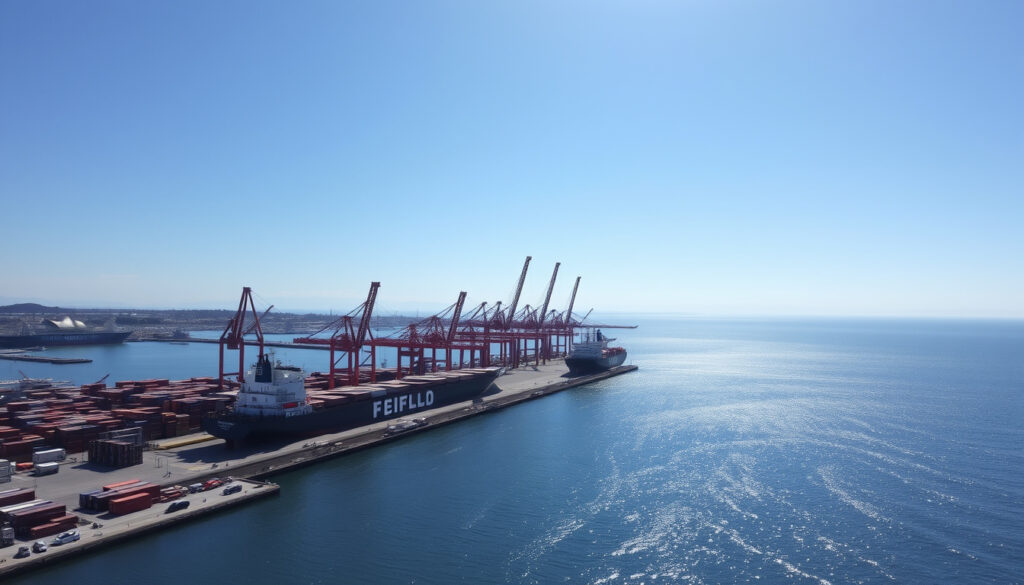
Port of Tauranga Share Price (POT.NZ): Live Quote & Analysis
Port of Tauranga (NZX:POT) is a mid-cap port operator that has quietly outperformed the ASX All Ordinaries by more than 10% over the past year — a rare feat for a low-beta defensive stock. NZ investors who want steady dividend income from essential infrastructure should know exactly what they’re getting into: reliable payouts backed by a government-adjacent monopoly, but a valuation that prices in that stability at a premium.
Current Price: NZ$8.11 · Previous Close: NZ$8.05 · Today’s Open: NZ$8.03 · Exchange: NZX · Ticker: POT.NZ
Quick snapshot
- Current price NZ$8.10 as of April 21, 2026 (Stockopedia market data)
- Market cap NZ$5.46bn (Stockopedia market data)
- Listed on NZX under ticker POT.NZ (NZX official listing)
- Precise 52-week high ceiling from official NZX records
- Analyst consensus ratings beyond NZ$7.86 target
- Historical dividend growth rate over full decade
- Last ex-dividend date: March 6, 2026
- Last pay date: March 20, 2026 (NZ$0.07 per share)
- Prior ex-dividend date: September 19, 2025
- Expected forward dividends NZ$0.20 next 12 months
- Forward yield projected around 2.44%
- Policy commits to steady year-on-year dividend increases
| Metric | Value | Source |
|---|---|---|
| Ticker | POT.NZ | NZX |
| Exchange | NZX | NZX |
| Current Price | NZ$8.11 | Investing.com live quote |
| Market Cap | NZ$5.46bn | Stockopedia |
| P/E Ratio | 29.674–31.73 | NZX |
| Dividend Yield (TTM) | 1.25%–2.62% | Companies Market Cap historical data |
| Revenue FY | NZ$375.10M | TradingView financial metrics |
| Net Income FY | NZ$90.85M | TradingView financial metrics |
| Beta (1Y) | 0.28 | TradingView volatility data |
| Shares Float | 299.74M | TradingView share structure |
Is Port of Tauranga a good investment?
Port of Tauranga is New Zealand’s largest export port by volume, handling everything from agricultural products to logs and minerals. For investors, the appeal isn’t speculative growth — it’s steady throughput, a government-adjacent monopoly on certain routes, and a commitment to grow dividends year-on-year that the company itself has published on its investor relations site. The stock sits about 5.89% above its 200-day moving average, suggesting short-term momentum is working in its favour right now.
The stock has outperformed the ASX All Ordinaries by 10.74% over the past year — a meaningful gap for a low-beta defensive name. That’s the opposite of what you’d typically expect from a port operator.
Recent performance factors
The numbers tell a consistent story. Revenue for the fiscal year came in at NZ$375.10M, generating NZ$90.85M in net income. The P/E ratio of 29.674–31.73 is elevated compared to broader market averages, which means you’re paying a premium for the stability. But that stability comes with a beta of just 0.28 — this stock moves less than the broader market, making it useful for portfolio hedging rather than aggressive growth.
| Performance Metric | Value | Context |
|---|---|---|
| 1-Year Performance | +28.12% | Outperformed ASX All Ordinaries by 10.74% |
| Position vs 200-Day MA | +5.89% | Trading above long-term average |
| Beta (1Y) | 0.28 | Low volatility, defensive profile |
| EV to EBITDA | 20.9 | Valuation multiple from Stockopedia |
| Analyst Target Price | NZ$7.86 | Current price slightly above consensus |
The implication: the elevated P/E reflects investor confidence in dividend durability, not growth potential. That works in your favour if you need income, but it limits upside if the market reprices defensive stocks downward.
EPS growth analysis
EPS (trailing twelve months) ranges from NZ$0.15 to NZ$0.22 depending on the data source, reflecting different reporting periods and adjustments. Stockopedia forecasts EPS growth of 17.22%, which would meaningfully compress that P/E multiple if it materialises. The company doesn’t publicly commit to specific EPS targets, but the dividend policy provides an indirect earnings-growth signal — you can only grow dividends sustainably if earnings are following.
What is the 52-week high for Port of Tauranga shares?
The 52-week range is a useful starting point for context. Based on data from NZX and TradingView, the stock has been trading in a band that includes moves from below NZ$7.90 to the current NZ$8.11 level. The exact peak within that range varies by reporting source, but the current price sits near the upper end of recent trading — which matters for entry timing.
The exact 52-week high ceiling isn’t confirmed from a single authoritative source — NZX’s official instruments page doesn’t publish a separate 52-week range metric in its public-facing instrument summary. Multiple financial data providers track this independently, but the official record requires cross-referencing.
Current price range
TradingView reports the current price at NZ$8.08 with a 1.13% gain in 24 hours. Investing.com puts the price at NZ$8.11. These minor variations reflect different data refresh timestamps. Stockopedia shows NZ$8.10 as of April 21, 2026, with a market cap of NZ$5.46bn. The NZX official price page shows $8.1100 with a market cap of $5,442,005,000.
Historical highs
For context, the five-year average dividend yield sits at 2.48% according to Companies Market Cap data. When yields compress toward the lower end of that historical range (closer to 1.25%), it typically corresponds with price peaks. The TTM yield hit 1.25% as recently as April 2, 2026 — suggesting the stock has recently tested higher price levels.
What this means: the stock is pricing in near-peak optimism. Investors buying here are paying for the premium, not catching a dip.
Why are people buying Port of Tauranga stock?
The answer comes down to three overlapping reasons: yield, stability, and a documented policy of dividend growth. Unlike growth stocks where capital appreciation is the goal, Port of Tauranga attracts investors who want regular cash distributions backed by real infrastructure assets.
Key attractions
Simply Wall St describes Port of Tauranga as “a dividend paying company with a current yield of 2.23% that is well covered by earnings.” The payout ratio sits at approximately 65%, meaning the company returns about two-thirds of earnings as dividends — leaving room to maintain payouts even if a bad season hits cargo volumes. That’s a healthier coverage ratio than many high-yielding stocks, which sometimes pay out 100% or more of earnings.
Low volatility (beta 0.28) makes this stock attractive for risk-averse investors, but that same trait means you’re not getting meaningful capital gains in bull markets. The stock outperformed benchmarks over the past year, but that’s partly because ports hold up well during downturns, not because they surge in upswings.
Market positioning
Port of Tauranga holds a privileged position as New Zealand’s largest port by throughput volume. Its customer base includes major exporters in agriculture, forestry, and dairy — sectors that generate predictable shipping demand regardless of short-term economic cycles. The company has ISIN NZPOTE0003S0 and is officially listed on the NZX under ticker POT.NZ, which gives it credibility as a liquid, regulated investment.
The pattern: investors buy port infrastructure for the same reason they buy utilities — the assets are hard to replicate, demand is relatively inelastic, and regulatory moats exist. Port of Tauranga fits that profile, with the bonus of being exposed to New Zealand’s commodity export cycle rather than purely domestic consumption.
Does Port of Tauranga pay dividends?
Yes, and the dividend schedule is remarkably consistent. The company pays semi-annual dividends with supplementary dividends to non-resident shareholders to offset withholding tax. This is a well-documented policy on the company’s official investor relations page, not a vague promise.
Dividend history
The most recent dividend was NZ$0.07 per share, with an ex-date of March 6, 2026, and a pay date of March 20, 2026. The prior ex-dividend date was September 19, 2025. This pattern — two dividend payments per year roughly six months apart — is standard for NZX-listed companies with semi-annual payout schedules.
| Event | Date | Amount (NZD) |
|---|---|---|
| Ex-dividend (H1 2026) | March 6, 2026 | $0.07/share |
| Pay date (H1 2026) | March 20, 2026 | $0.07/share |
| Ex-dividend (H2 2025) | September 19, 2025 | Prior distribution |
| Forward expectation | Next 12 months | ~$0.20 total |
The pattern: semi-annual payments of NZ$0.07 each suggest a base annual dividend of NZ$0.14, with potential for supplementary top-ups for non-residents.
Upcoming payments
Divvy Diary projects expected dividends of NZ$0.20 over the next 12 months, implying a forward yield of approximately 2.44%. Trading Economics recorded a semester dividend yield of 3.01 for the fiscal period ending December 2025 — that higher figure likely reflects timing around when the ex-dividend date fell relative to the reporting period rather than a permanent yield increase.
The official company statement reads: “The Port of Tauranga’s dividend policy is to steadily increase dividends year on year consistent with Company performance.” That language matters — the company isn’t promising fixed payouts, but it has publicly committed to growing distributions in line with results. For NZ investors who rely on portfolio income, that’s a meaningful policy anchor.
Which NZ shares pay the highest dividends?
Port of Tauranga sits in the upper-middle tier of NZ dividend payers, but it’s not the highest yielder on the NZX. Comparing dividend yields across New Zealand listed companies reveals a spectrum — from speculative stocks with unsustainably high yields (often a warning sign) to blue-chip infrastructure names like Port of Tauranga that offer more modest but durable distributions.
High-yield rankings
Port of Tauranga’s TTM yield of 1.25%–2.62% reflects timing variations around when data was captured. Simply Wall St reports 2.06% with a payout ratio of 65%, while Investing.com shows 2.62%. The five-year average yield of 2.48% (Companies Market Cap) is probably the most reliable baseline for comparison purposes.
| Company | Dividend Yield (approx.) | Profile |
|---|---|---|
| Port of Tauranga | 2.06%–2.75% | Infrastructure, payout ratio 65%, steady growth |
| Mainfreight | 3.25% (Dec/2024) | Logistics, higher yield, higher volatility |
| Market Bottom 25% (US) | 1.4% | Benchmark for comparison |
What this means: Port of Tauranga’s yield sits above US market bottom quartile but trails pure-play high-yield NZ stocks — the trade-off is durability versus raw income.
Port of Tauranga position
Port of Tauranga doesn’t top the yield rankings, but it scores well on durability. The payout ratio of 65% means earnings cover dividends comfortably — less risk of a dividend cut if volumes soften. Compare that to some high-yield stocks that pay out 90% or 100% of earnings and are one bad quarter away from reducing distributions.
Upsides
- Steady dividend policy with year-on-year growth commitment from company itself
- Low beta (0.28) provides defensive portfolio exposure
- Payout ratio of 65% leaves comfortable coverage buffer
- Outperformed ASX All Ordinaries by +10.74% over past year
- Essential infrastructure with inelastic shipping demand
Downsides
- Elevated P/E (29.7–31.7) limits capital appreciation potential
- TTM yield of 1.25%–2.62% lags top NZ dividend payers
- Limited historical dividend growth rate documentation
- Current price near top of 52-week range — less attractive entry point
- Analyst target price (NZ$7.86) below current trading level
Confirmed facts
- Current share price NZ$8.10 from Stockopedia as of April 21, 2026
- NZX official price $8.1100, market cap $5,442,005,000, P/E 29.674
- Latest dividend NZ$0.07 per share, ex-date March 6, 2026, pay date March 20, 2026
- Dividend policy: “steadily increase dividends year on year” (Port of Tauranga Official)
- Revenue FY NZ$375.10M, net income FY NZ$90.85M from TradingView
- Beta 1Y 0.28, low volatility confirmed by TradingView
- Outperformed ASX All Ordinaries by +10.74% over past year from Stockopedia
What’s unclear
- Precise 52-week high — no single authoritative NZX source confirms exact peak
- Analyst consensus ratings beyond NZ$7.86 target price
- Detailed supplementary dividend amounts for non-resident shareholders
- Historical dividend growth rate confirmed across full 10-year period
What investors and observers are saying
The Port of Tauranga’s dividend policy is to steadily increase dividends year on year consistent with Company performance.
— Port of Tauranga, Official Company Statement (Port of Tauranga Investor Relations)
Port of Tauranga is a dividend paying company with a current yield of 2.23% that is well covered by earnings.
— Simply Wall St, Analysis Platform (Simply Wall St analysis)
Simply Wall St provides a useful quantitative overlay: the 2.23% yield is described as “well covered by earnings,” which aligns with the 65% payout ratio visible in the underlying data. Port of Tauranga’s own policy statement adds the qualitative commitment — the company isn’t just paying dividends, it’s explicitly committed to growing them. Together, these two sources give investors a clear picture of both the numbers and the management intent behind them.
Related reading: Home Loan Rates NZ Compare · Car Loan Calculator NZ
intelligentinvestor.com.au, stockevents.app, divvydiary.com, morningstar.com.au, tradingeconomics.com
Frequently asked questions
What is the current Port of Tauranga share price?
As of April 21, 2026, the share price was approximately NZ$8.10, according to Stockopedia data. NZX official records showed NZ$8.1100, and Investing.com reported NZ$8.11. Minor variations reflect data timestamp differences across providers.
How has Port of Tauranga stock performed recently?
The stock has outperformed the ASX All Ordinaries by 10.74% over the past year, with a 1-year return of +28.12%. It’s currently trading about 5.89% above its 200-day moving average, indicating short-term bullish momentum despite its low-beta (0.28) defensive profile.
What is Port of Tauranga dividend yield?
The trailing twelve-month yield varies by source and timing, ranging from 1.25% (April 2026, Companies Market Cap) to 2.62% (Investing.com). The five-year average sits around 2.48%. Forward expectations project approximately 2.44% based on NZ$0.20 expected dividends over the next 12 months.
What is Port of Tauranga share price history?
The stock has been trading in a range from below NZ$7.90 to the current NZ$8.11 level. The TTM yield compressed to 1.25% as recently as April 2, 2026, suggesting price strength at recent highs. Historical performance shows +28.12% over the past year, significantly outpacing the broader market.
Does Port of Tauranga have strong EPS growth?
Trailing EPS sits at NZ$0.15–0.22 depending on the reporting period. Stockopedia forecasts EPS growth of 17.22%, which would meaningfully compress the elevated P/E ratio if achieved. The company doesn’t publish specific EPS targets but the dividend policy implies earnings growth to sustain growing payouts.
How does Port of Tauranga compare to other NZ ports?
Port of Tauranga is New Zealand’s largest port by throughput volume. For investors, its key differentiator is the documented dividend policy, the 65% payout ratio (sustainable compared to peers), and the low beta of 0.28. It holds a defensive position in a sector with structural shipping demand.
What is the Port of Tauranga dividend forecast for 2026?
Divvy Diary projects NZ$0.20 in total dividends over the next 12 months, implying a forward yield of approximately 2.44%. The most recent payment was NZ$0.07 per share (ex-date March 6, 2026, pay date March 20, 2026). The company’s policy commits to steady year-on-year increases in line with performance.
For NZ investors prioritising income over capital gains, the Port of Tauranga picture is clear: this is a stock that delivers regular, policy-backed dividends from essential infrastructure, but at a valuation that prices in significant premium. Those who want yield durability and portfolio stability will find it attractive. Those hunting for growth or a cheaper entry point should watch whether the price pulls back toward the analyst target of NZ$7.86.
More related posts
 Cheap Gas Near Me – Best Apps and Tips to Save on Fuel
 Kiwi Treasure Voucher Code 2026: No Deposit & Free Spins Guide
 Moodi Discount Code NZ: Get 10% Off & Free Shipping
 Cheap Flights NZ Domestic: Best Deals & Booking Tips
 Water Play Tables NZ – Best 2025 Picks for Toddlers
 Sri Lanka vs Bangladesh Match Scorecard: Asia Cup 2025 Super Four
 Beste Übungen für Rücken – Relieve Pain Without Equipment
 Setting Up Two Monitors: Complete How-To Guide