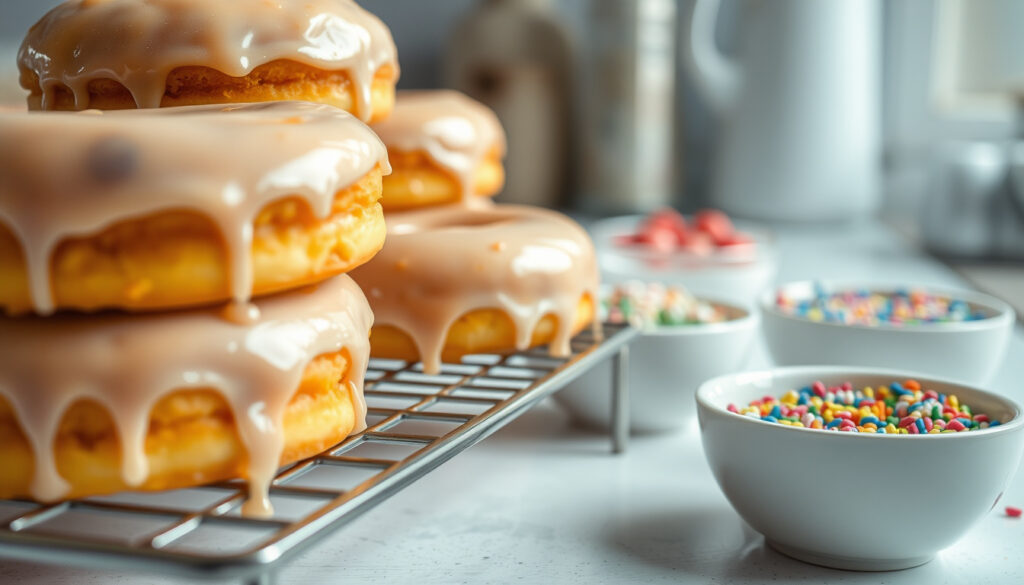
How to Glaze Donuts: Easy Recipes & Science Tips
A warm, glossy donut straight out of the fryer is hard to beat — but home bakers often find their glaze turns out too thick, too runny, or refuses to set. This guide explains the science behind glaze hardening and temperature windows, with five tested variations, including a Krispy Kreme copycat, so you can replicate bakery-quality results.
Classic Glaze Ingredients: 3 (confectioners’ sugar, milk, vanilla) ·
Glaze Hardening Time: 10–15 minutes ·
Most Searched Glaze Type: Krispy Kreme copycat ·
Common Glaze Base: Confectioners’ sugar and milk ·
Number of Varieties Covered: 5
Quick snapshot
- Basic glaze formula: confectioners’ sugar + liquid (CopyKat (copycat recipe resource))
- Glaze hardens due to water evaporation (Thrive Cuisine (food science blog))
- Krispy Kreme glaze contains corn syrup (Dinner, then Dessert (recipe developer))
- Exact ingredient proportions used by Krispy Kreme (Mashed (food media outlet))
- Whether Krispy Kreme uses a stabilizer or preservative (Instructables (community recipe site))
- The ideal liquid-to-sugar ratio isn’t standardized: copycat recipes range from water and corn syrup to milk-only glazes (Let the Baking Begin (recipe blog))
- Glaze sets in 10–20 minutes at room temperature depending on thickness (Singapore Headline (pastry tutorial))
- Some recipes recommend 40 minutes for full set (Handle the Heat (baking blog))
- Try chocolate or vanilla variations using the same base (Taste of Home (home-cooking authority))
- Experiment with corn syrup for a softer, longer-lasting glaze (Cooking Classy (recipe developer))
The table below distills the core facts covered in this guide.
| Fact | Detail |
|---|---|
| Main ingredient | Confectioners’ sugar |
| Hardening time | 10–15 minutes |
| Best temperature for glazing | Donuts warm (~100°F), glaze cool |
| Number of glaze varieties | 5 covered in this guide |
| Most popular glaze search | Krispy Kreme copycat |
How to Make Glaze for Donuts?
Classic Vanilla Glaze Recipe
- Confectioners’ sugar, milk, and vanilla extract form the base. Whisk until smooth: the consistency should be thin enough to drip off a whisk (CopyKat (copycat recipe resource)).
- Adjust thickness by adding more sugar or milk. The glaze can be made in under 5 minutes (Cooking Classy (recipe developer)).
Original Glaze Variation
- Substitute water for milk and add light corn syrup to mimic the soft, glossy finish of commercial glazes (Dinner, then Dessert (recipe developer)).
- Heat the mixture over medium heat until the sugar dissolves and the glaze steams (Taste of Home (home-cooking authority)).
Step-by-Step Glazing
- Whisk the glaze base (confectioners’ sugar plus liquid) until smooth and thin enough to drip off a whisk.
- If using the original-style glaze, heat it gently until the sugar dissolves and the mixture steams.
- Let freshly fried donuts rest for 3–5 minutes until they reach about 100°F.
- Dip each donut in the glaze, letting the excess drip off.
- Place the glazed donuts on a wire rack over a lined sheet pan and let set for 10–15 minutes (or up to 40 for a thicker coat).
- Reheat the glaze briefly if it thickens before you finish dipping.
Home bakers who swap milk for water in a classic glaze get a thinner coat that mimics commercial softness — but sacrifice the creamy mouthfeel. Decide based on whether you’re aiming for a crisp shell or a tender bite.
The pattern: a basic glaze is forgiving; the liquid swap is the lever that changes the final texture.
What Is the Glaze on Krispy Kreme?
Ingredients of Krispy Kreme Glaze
- The chain’s glaze is primarily powdered sugar, water, and corn syrup. It contains no milk or butter, which keeps it from browning or hardening fully (Mashed (food media outlet)).
- Krispy Kreme does not publicly disclose the full recipe, but multiple copycat recipes agree on the core components (Instructables (community recipe site)).
Why It Stays Soft
- The high sugar content and corn syrup inhibit full crystallization, leaving the glaze slightly tacky even after setting (Thrive Cuisine (food science blog)).
- According to Cooking Classy (recipe developer), applying glaze to warm donuts allows it to absorb slightly, creating that thin, even coat that doesn’t crack.
The pattern: the same ingredients that make the glaze creamy also make it prone to staying soft — a trade‑off between mouthfeel and snap.
How to Make Krispy Kreme Glaze at Home?
Copycat Recipe
- Combine 2 cups powdered sugar, 3 tablespoons water, 2 tablespoons light corn syrup, and ½ teaspoon vanilla. Whisk until smooth (CopyKat (copycat recipe resource)).
- Heat the mixture gently to dissolve the sugar and achieve a glossy finish (Taste of Home (home-cooking authority)).
Tips for Authentic Texture
- Glaze donuts while they are still warm (around 100°F). The heat helps the glaze spread without melting away (Singapore Headline (pastry tutorial)).
- Let the glaze set for 10–15 minutes at room temperature before serving (Handle the Heat (baking blog)).
Homemade versions can’t match the industrial stabilizers that keep Krispy Kreme’s glaze shelf‑stable for hours. Expect a slightly shorter window of perfect gloss.
The implication: a homemade version can get close to the chain’s soft texture, but should be eaten on a shorter clock than the store-bought original.
How to Get Donut Glaze to Harden?
The Science of Glaze Setting
- Glaze hardens as water evaporates from the sugar‑water solution. The more powdered sugar you add, the less water remains, so the glaze sets faster (Thrive Cuisine (food science blog)).
- In humid environments, evaporation slows and the glaze stays sticky. The ideal ambient temperature for hardening is between 70°F and 80°F (21°C to 27°C) (Thrive Cuisine (food science blog)).
Quick Harden Methods
- Chilling the donuts in the refrigerator speeds up setting by lowering the dew point locally (Handle the Heat (baking blog)).
- Adding cornstarch (as in some copycat recipes) can also help absorb moisture and promote a firmer surface (Mashed (food media outlet)).
What this means: if your glaze won’t harden, check your sugar‑to‑liquid ratio and ambient humidity before blaming the recipe.
Is It Better to Glaze Donuts Hot or Cold?
Pros of Glazing Warm Donuts
- Warm donuts absorb a thin layer of glaze, creating a seamless coat that adheres well (Cooking Classy (recipe developer)).
- The residual heat thins the glaze slightly, helping it spread evenly and drip off cleanly (Singapore Headline (pastry tutorial)).
Pros of Glazing Cool Donuts
- Cool donuts cause the glaze to sit on top, resulting in a thicker, more opaque layer (Pastry Chef Online (professional pastry resource)).
- The thicker layer takes longer to set — up to 40 minutes — but yields a more substantial bite (Handle the Heat (baking blog)).
The trade‑off: glazing warm gives you a thin, quick‑setting coat that mimics commercial donuts. Glazing cool gives you a thicker, more‑candy‑like shell. Most bakers recommend warm donuts around 100°F for the best balance.
A home baker who glazes donuts straight out of the fryer (above 110°F) will watch the glaze slide right off. Letting them rest for 3–5 minutes — until about 100°F — is the sweet spot.
The pattern: temperature controls whether the glaze becomes a thin absorbed layer or a thick candy-like shell.
Confirmed facts vs. What’s unclear
Confirmed facts
- Basic glaze formula: confectioners’ sugar + liquid (CopyKat (copycat recipe resource))
- Glaze hardens due to water evaporation (Thrive Cuisine (food science blog))
- Krispy Kreme glaze contains corn syrup (Dinner, then Dessert (recipe developer))
What’s unclear
- Exact ingredient proportions used by Krispy Kreme (Mashed (food media outlet))
- Whether Krispy Kreme uses a stabilizer or preservative (Instructables (community recipe site))
- The ideal liquid-to-sugar ratio isn’t standardized: copycat recipes range from water and corn syrup to milk-only glazes (Let the Baking Begin (recipe blog))
The split confirms the practical takeaway: reliable formulas converge on sugar plus liquid, while the commercial details remain proprietary.
Expert Perspectives
“Glaze should be whisked over medium heat until the sugar dissolves and the glaze is steaming.”
— Taste of Home (home-cooking authority)
“Immerse each doughnut in the glaze and place them on a wire rack over a lined sheet pan to catch excess glaze.”
— Handle the Heat (baking blog)
“If the glaze thickens as it cools, reheat it briefly to restore the right consistency.”
— Pastry Chef Online (professional pastry resource)
Mastering donut glaze comes down to three variables: sugar concentration, liquid type, and temperature. For home bakers chasing that perfect crackling coat, the quickest path is a high‑powdered‑sugar, low‑moisture recipe applied to donuts at 100°F. Those who prefer the soft, glossy texture of a shop‑bought donut should stick with a corn‑syrup‑based glaze and accept a longer setting time. Home bakers must choose between a crackling crust and a tender, glossy coat — no single batch delivers both.
Frequently asked questions
Can I use granulated sugar instead of powdered sugar for glaze?
No — granulated sugar will not dissolve sufficiently in a small amount of liquid, leaving a gritty texture. Powdered sugar contains cornstarch that helps it dissolve instantly.
How should I store leftover donut glaze?
Store in an airtight container in the refrigerator for up to 3 days. Reheat gently in the microwave or on the stovetop before using, adding a splash of milk or water if needed.
Can I make donut glaze without vanilla extract?
Yes — simply omit the vanilla or substitute with almond extract, maple syrup, or a pinch of salt for flavor. The glaze will still set properly.
What is the difference between glaze and icing?
Glaze is thinner (more liquid) and typically used for dipping or drizzling, while icing is thicker (more sugar) and often piped or spread. Glaze sets to a hard shell; icing stays soft.
How long do glazed donuts stay fresh?
Glazed donuts are best the same day. Store at room temperature in a paper bag; plastic bags trap moisture and make the glaze sticky. They keep for about 24 hours before the texture declines.
Can I add food coloring to donut glaze?
Yes — gel food coloring is best because it won’t thin the glaze. Add a drop at a time until you reach the desired shade. Liquid coloring may require extra powdered sugar to maintain consistency.
Is it possible to make a vegan donut glaze?
Absolutely. Replace milk with plant‑based alternatives (oat, almond, or soy milk) and use maple syrup instead of corn syrup if desired. The glaze will set the same way.
More related posts
 How Many Weeks Till Christmas 2025 – Countdown Explained
 Perth to Bali Flight Time: 3 Hours 45 Minutes Direct
 Alcaraz Wins 2026 Australian Open Results Over Djokovic
 Bane of My Existence: Meaning, Origin & Bridgerton Connection
 Super Rugby Pre Season 2026: Schedule, Results & Tickets
 Vehicle Insurance Quote NZ: Compare & Get the Best Rates in 2025
 Harvey Norman Price Match Guide: Exclusions & How to Claim
 Bed Bath N’ Table Australia: Stores, Clearance & Sale Guide