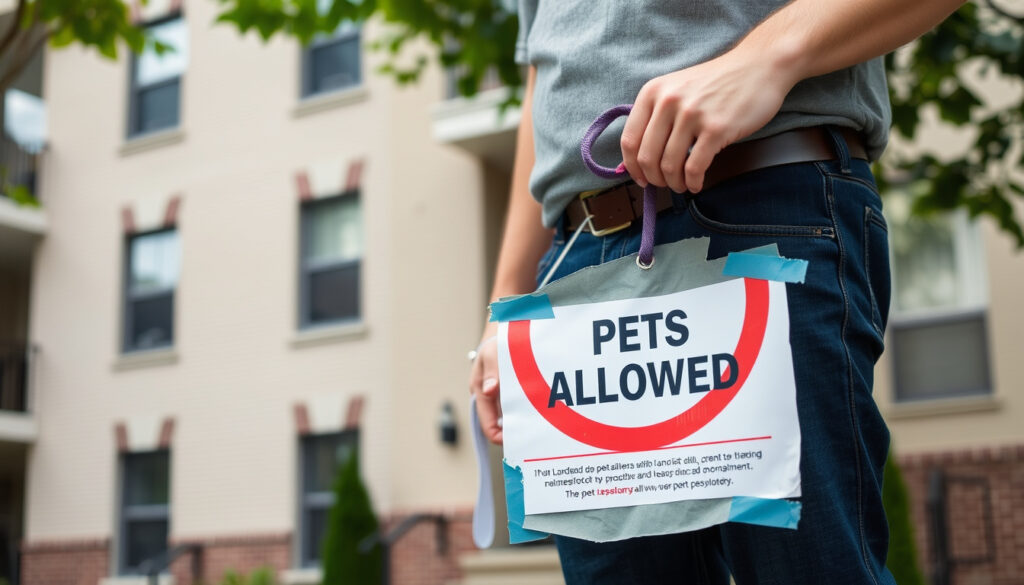
Landlords Ignoring New Pet Rules: Tenant Options & Penalties
When Kate moved into her Wellington flat in March 2025, her landlord’s reply to a pet request was blunt: “No pets allowed.” That should have been illegal by then. New Zealand’s new pet rules, effective 1 December 2025, ended blanket bans and forced landlords to give valid reasons for refusal, yet as Tenancy Services data and renter stories show, compliance has been spotty at best.
Pet rule effective date: 1 December 2025 ·
Tenancy Services complaints about pet refusals (2024–2025): over 250 ·
Max financial penalty for invalid refusal: up to $1,500 ·
UK Section 21 pet-related reform: 1 May 2026
Quick snapshot
- Blanket pet bans are illegal from 1 December 2025 (Tenancy Services (NZ government))
- Landlords must provide a valid written reason to refuse a pet (Tenancy Services)
- Penalty for invalid refusal: up to NZ$1,500 (Tenancy Services)
- Whether the $1,500 penalty is enough to deter large portfolio landlords
- Exact number of non‑compliance complaints filed in 2025
- How many landlords will actually change behaviour after enforcement actions
- Oct 2024 – Residential Tenancies Amendment Act passed
- 1 Dec 2025 – New pet rules take effect
- Jan 2026 – Reports of landlords ignoring rules emerge
- 1 May 2026 – UK Section 21 abolition for pet‑related no‑fault evictions
- Tenancy Tribunal cases expected to rise as tenants push back
- Policy review possible if non‑compliance continues
- Other jurisdictions (UK, Ireland) follow NZ enforcement approach
Five key facts, one pattern: the law is clear, but real‑world enforcement still has gaps.
| Fact | Value |
|---|---|
| Effective date of new NZ pet rules | 1 December 2025 (Tenancy Services) |
| Maximum penalty for invalid refusal | NZ$1,500 (Tenancy Services) |
| Landlord response deadline for pet request | 21 days (LawFirm.co.nz (legal analysis)) |
| Maximum pet bond | Up to 2 weeks’ rent (ANZ (bank guidance)) |
| Standard bond cap | Up to 4 weeks’ rent (ANZ) |
| Pre‑existing pets (approved before 1 Dec 2025) | Not subject to new pet bond rules (Tenancy Services – Pet rules before Dec 2025) |
What are the new pet rules for renters?
Key provisions of the pet rule changes
- Tenants must request written consent; landlords must respond in writing within 21 days (LawFirm.co.nz).
- Blanket “no pets” clauses are now illegal (Birds Nest Property Management (industry advisory)).
- Refusal must be grounded in a valid, evidence‑based reason (Tenancy Services).
The implication: what looks like a simple permission process actually shifts the burden of proof onto landlords.
“If a landlord has a genuine concern — say the property size doesn’t suit a large dog or the body corporate bans pets — they can say no. But they can’t just tick ‘no pets’ on a form.”
— Tenancy Services representative, quoted in guidance documents
Which tenancy types are covered?
- All residential tenancies under the Residential Tenancies Act 1986 are covered from 1 December 2025.
- Boarding houses and some council housing may have separate rules.
- Assistance dogs are treated differently: they do not require pet consent or a pet bond (ANZ).
The new regime replaces blanket bans with a case‑by‑case assessment. For tenants, the process now has a legal backbone; for landlords, the burden is on them to justify every refusal.
What are reasonable grounds to refuse a pet?
Examples of valid reasons
- Property layout is unsuitable for the animal (e.g., no outdoor space for a dog).
- Local bylaws or body corporate rules prohibit the type of pet (NZ Property Investors Federation).
- The pet is dangerous or has a history of disruptive behaviour.
- Tenant refuses reasonable conditions (e.g., flea treatment, damage cover).
What does not count as reasonable?
- Personal dislike of animals or blanket “no pets” policy is explicitly invalid (LawFirm.co.nz).
- Claims about potential damage without evidence are not sufficient.
- Vague phrases like “property unsuitable” without specifics don’t pass muster.
The law’s language is broad. A landlord can say “the flat is too small” without providing square‑metre evidence. Tenancy Services notes this is a recurring grey area in complaints.
Why are some landlords ignoring the new pet rules?
Reported cases of non‑compliance
Despite the legal change, renters continue to hear “no pets” without explanation. A renter quoted in the NZ Herald (Jan 2026) said her landlord simply responded “We don’t allow pets” — no reason given, no mention of the new law. Social media groups and property manager forums still carry ads that say “no pets” without any qualifying clause.
“I told the property manager the law changed. She said her client doesn’t care. What can I do?”
— Renters quoted in NZ Herald (Jan 2026)
Enforcement challenges
- Low penalty deterrent: The maximum fine of NZ$1,500 is less than a month’s rent for many properties in Auckland or Wellington (NZPIF).
- Landlord inertia: Many property owners are unaware of the exact requirements or simply rely on old clauses in tenancy agreements.
- Hard to prove: A verbal refusal leaves no paper trail; tenants who don’t request in writing have little to bring to the Tenancy Tribunal.
When a month’s rent on a median Auckland property is around $600–$700, a one‑time $1,500 fine looks like a manageable cost of doing business — not a real deterrent.
What’s known and what’s still unclear
Confirmed facts
- Blanket pet bans are illegal under the new regime (Tenancy Services)
- Landlords must respond in writing within 21 days of a pet request
- Tenants can apply to the Tenancy Tribunal for a compliance order
- Maximum penalty for invalid refusal is NZ$1,500
- Existing pets approved before 1 Dec 2025 are exempt from new bond rules
Rumored / still unclear
- Whether some landlords are deliberately ignoring the law to maintain “investment‑grade” tenant profiles
- Actual number of Tribunal cases filed in 2025 – not yet published
- Effectiveness of the 21‑day response rule in practice
- How many landlords will change their advertising wording
Frequently asked questions
Do I need a pet bond in New Zealand?
Yes, if your landlord approves a new pet they can request a pet bond of up to two weeks’ extra rent, on top of the standard bond. Pre‑existing pets approved before 1 December 2025 are not subject to a pet bond (Tenancy Services).
What is a pet agreement template and where can I get one?
Tenancy Services provides a model pet agreement on its website. It covers conditions, damage liability, and bond arrangements. Tenants and landlords can download it from the official site.
Can my landlord evict me for having a pet under the new law?
Not for having a pet if you obtained consent or if the pet was already approved. If you keep a pet without permission, the landlord may apply to the Tenancy Tribunal. However, a pet that was approved before the law change is protected (Tenancy Services – old rules).
How do I know if a landlord’s reason to refuse my pet is reasonable?
Reasons must be specific and evidence‑based: property suitability, local rules, animal behaviour history, or tenant unwillingness to accept conditions. Personal preference or a blanket policy is not reasonable. Tenancy Services publishes guidance (Tenancy Services).
Is the landlord allowed to charge extra rent for having a pet?
No. The law only allows a pet bond (up to two weeks’ extra rent) as a separate payment. Landlords cannot increase the regular rent because of a pet (ANZ).
What should I include in a written pet consent request?
Your request should state the type, size, and age of the pet, mention that you agree to reasonable conditions, acknowledge liability for damage, and ask for a reply within the statutory 21 days. Keep a copy for your records.
What happens if a landlord says no to a pet without a valid reason?
You can file a complaint with Tenancy Services or apply directly to the Tenancy Tribunal for a compliance order and/or a fine of up to $1,500 (NZPIF). Documentation is key – keep all written correspondence.
For tenants in New Zealand, the choice is clear: always request in writing, collect evidence, and escalate to Tenancy Services or the Tribunal when a landlord refuses without a valid reason – or expect the $1,500 cap to remain a weak deterrent for those who break the rules.
More related posts
 National Animal of Scotland: Unicorn and Duck Mascot
 Rental Cars Queenstown Airport – Prices Companies Booking Guide
 Diva Exhibition Auckland Museum: Dates, Tickets & Highlights
 Bane of My Existence: Meaning, Origin & Bridgerton Connection
 Cast of The Conjuring: Last Rites (2025) Full Cast List
 Wales vs South Africa 2026: Score, TV, Etzebeth Ban & More
 Focu Fitne New Lynn: 24/7 Gym from $10/Week
 10,000 USD to NZD: Complete Conversion & Exchange Guide