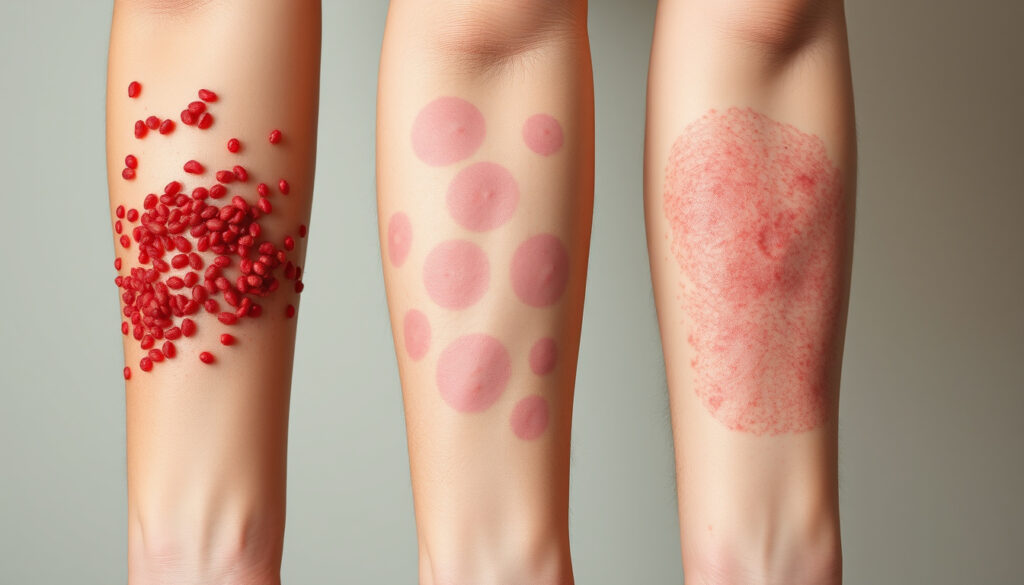
Pictures of Skin Rashes: Types, Causes & Identification Guide
If you’ve ever spotted an unfamiliar mark on your skin and immediately wondered whether it warrants a doctor’s visit, you’re not alone. This guide brings together pictures of skin rashes across four major categories—bacterial, fungal, viral, and allergic—to help you recognize what you’re looking at and when to take action.
Common Skin Rashes Illustrated: 22 types (Healthline) · Rash Photos Available: 71 symptoms (MedicalNewsToday) · Skin Rash Images: A-Z directory (DermNet NZ) · Rash Pictures Listed: 32 examples (Prevention)
Quick snapshot
- Pictures match clinical descriptions from Healthline and DermNet NZ
- Ringworm spreads via direct contact with infected skin (GoHealth Urgent Care)
- Self-diagnosis accuracy without professional evaluation
- Exact cause determination from photo alone
- Measles rash spreads to entire trunk within 24-36 hours (Pymble Dermatology)
- Chickenpox follows three-stage cycle: raised bumps, fluid-filled blisters, then scabbing (GoHealth Urgent Care)
- Bacterial infections respond to antibiotics; fungal infections require antifungal treatment (Knya Medical)
- Skin fold rashes often signal candidiasis; moist environments are the culprit (Medical News Today)
The table below summarizes key rash identifiers sourced from medical dermatology references.
| Label | Value |
|---|---|
| Most Common Rash | Contact dermatitis (GoHealth Urgent Care) |
| Image Directory Source | DermNet A-Z (dermnetnz.org) |
| Rash Types Covered | 22 (Healthline) |
How Do I Identify the Rash I Have?
Visual identification is a starting point, not a final verdict. Doctors train for years to distinguish subtle variations—something a photograph can only partially capture.
Key characteristics to check
Before reaching for your phone to search “pictures of skin rashes,” examine these five features: color, shape, texture, location, and how it feels (itchy, painful, or silent). Bacterial rashes from Staphylococcus and Streptococcus species often appear red, swollen, and warm to the touch, sometimes with visible pus. Fungal rashes tend toward circular patterns with scaly, defined edges that spread gradually. Viral rashes frequently arrive alongside fever or fatigue—systemic signals that something bigger is happening.
- Color: red, pink, purple, or skin-toned changes
- Shape: circular rings, irregular blotches, raised bumps
- Texture: smooth, scaly, crusty, or blistered
- Location: skin folds, extremities, face, or widespread
- Sensation: intense itching, pain, numbness, or nothing at all
Ringworm looks distinctive in pictures—a circular rash with a clear center—but identical patterns can appear in granuloma annulare and other non-contagious conditions. Photo matching narrows options but doesn’t close the diagnosis.
When to see a doctor
Consult a healthcare professional if the rash appears suddenly, spreads rapidly, is accompanied by fever above 38°C, shows signs of infection (increasing redness, warmth, pus), or doesn’t improve within two weeks of self-care. According to Liv Hospital, bacterial infections progress rapidly with possible severe symptoms—don’t wait if you’re seeing fast changes.
The implication: what you see in a photo is a starting hypothesis, not a clinical conclusion.
What Does a Bacterial Rash Look Like?
Bacterial skin infections often announce themselves with urgency. They’re caused primarily by Staphylococcus aureus and Streptococcus pyogenes, according to research published in PMC/NIH.
Impetigo features
Impetigo is a contagious bacterial skin disease usually resulting from streptococcal bacterial infection, explains Pymble Dermatology. It shows up as red sores or blisters that burst and develop honey-colored crusts. In pictures of skin rashes, impetigo lesions are unmistakable once you know to look for that characteristic golden crust.
Cellulitis images
Cellulitis is an inflammation of cellular tissue caused by bacterial infection. The affected skin becomes red, swollen, warm, and tender—often with clear borders between infected and healthy tissue. Unlike a simple irritation, cellulitis typically affects one limb and may include systemic symptoms like fever and chills. This is one rash that practically demands medical attention.
Boils are painful circular and raised skin inflammations caused by bacterial infection—these occur when Staphylococcus aureus invades a hair follicle or oil gland — Pymble Dermatology
The pattern: bacterial infections like these demand faster action than most people expect.
What Does a Fungal Rash Look Like?
Fungal infections thrive where skin meets moisture—between toes, in the groin, under breasts. They’re caused by dermatophytes, yeasts like Candida, and related organisms that feed on keratin.
Ringworm patterns
Ringworm is caused by direct contact with an infected individual’s skin and triggers an itchy, circular, or ring-shaped rash. Despite the name, no worm is involved—just a fungus that creates that distinctive ring pattern with a clearer center. The same fungus that causes ringworm causes athlete’s foot (between the toes) and jock itch (groin region), according to GoHealth Urgent Care. In picture galleries, ringworm lesions stand out because they maintain that almost-perfect circle.
Athlete’s foot photos
Athlete’s foot typically starts between the fourth and fifth toes, where moisture gets trapped. The skin becomes itchy, peeling, and may crack. In more advanced cases, small blisters appear. Because it lives on floors, towels, and clothing, the fungus spreads easily in communal areas like locker rooms and pools.
Ringworm is very contagious and can live on skin as well as on floors, countertops, clothing, towels, and bedsheets. Treating one outbreak without disinfecting shared surfaces often leads to recurrence, according to WebMD.
The catch: the same fungus causing ringworm on your body may be living on your bathmat right now.
What Do Cancerous Rashes Look Like?
Most rashes aren’t cancer. But certain persistent skin changes warrant closer attention, especially in adults over 50 or those with significant sun exposure history.
Skin lymphoma signs
Cutaneous T-cell lymphoma (CTCL), the most common type of skin lymphoma, often begins as a persistent itchy, scaly patch that mimics eczema. Unlike common rashes, these patches don’t respond to standard treatments and may slowly enlarge or thicken over months or years.
Mycosis fungoides images
Mycosis fungoides, a form of CTCL, typically appears as reddish-brown patches that may later evolve into raised plaques or tumors. In photographs, these lesions often show a slightly raised, velvety surface with irregular borders. The patches commonly appear in areas not typically exposed to sunlight—think lower back, buttocks, or upper thighs. UVA Health dermatologists note that persistent itchy patches that don’t resolve with typical eczema treatments should prompt a dermatologist evaluation.
Self-diagnosis accuracy without professional evaluation remains limited. Even experienced dermatologists often require a biopsy to confirm whether a persistent rash represents cancer or something benign. If a skin change is new, changing, or won’t heal, book that appointment.
What this means: the longer a rash defies treatment, the stronger the case for biopsy.
What Kind of Rashes Are Concerning?
Not every rash needs urgent care, but some signals shouldn’t be ignored. Here’s a practical framework from the evidence.
Warning signs
- Rash that spreads rapidly over hours or days
- Fever accompanying the skin eruption
- Pain disproportionate to appearance
- Blisters covering large areas or mucous membranes
- Rash resembling target spots (possible Lyme disease)
- Skin that feels warm and tender to touch
- Any rash with pus, foul odor, or increasing redness at margins
Rash locations matter
Where a rash appears offers diagnostic clues. Rashes in skin folds often point toward fungal infections like candidiasis—an itchy rash that generally appears in skin folds. Rashes concentrated on sun-exposed areas might suggest a photosensitive reaction or, rarely, cutaneous lupus. A widespread rash that starts on the face and moves downward could indicate a systemic viral infection like measles.
The measles rash begins on the face and behind the ears, spreading to the entire trunk and extremities within 24-36 hours—this distinctive progression pattern helps differentiate it from other viral rashes — Pymble Dermatology
The pattern: where a rash starts often predicts where it’s headed next.
Common Skin Rashes: Pictures and Causes
Beyond the categories above, several other rash types frequently appear in picture guides. Here’s a practical breakdown of common presentations.
Allergic reactions
Contact dermatitis occurs when skin encounters an allergen or irritant—poison ivy, nickel jewelry, certain soaps. Hives (urticaria) appear as raised, itchy welts that can pop up anywhere and often resolve within 24 hours. Eczema (atopic dermatitis) presents as dry, scaly patches that may weep or crust, commonly affecting the inner elbows and behind the knees. Rosacea, often confused with acne, creates persistent facial redness and tiny visible blood vessels.
Viral rashes on face and legs
Chickenpox is a highly contagious viral infection that causes an itchy, blistering rash. The blisters tend to be small, round, and fluid-filled, appearing in successive crops so that lesions at different stages coexist. The chickenpox rash follows a three-stage cycle: raised red bumps, fluid-filled blisters that burst, then scabbing and healing. Chickenpox appears as marks resembling “dew drops on a rose petal” or like blisters on a red bump, according to Prevention.
Fifth disease typically goes away on its own in 5-10 days, but the rash could return for a few weeks afterward if triggered by sunlight, heat, or exercise—this creates real uncertainty for adults trying to determine when they’re no longer contagious.
Upsides
- Visual comparison narrows possibilities before the doctor’s visit
- Pictures from verified medical sources (Healthline, DermNet) match clinical descriptions
- Location and pattern clues help prioritize urgency
- Distinguishing bacterial vs fungal vs viral guides appropriate self-care
Downsides
- Self-diagnosis accuracy without doctor evaluation remains uncertain
- Exact cause from photo alone often cannot be determined
- Similar-looking rashes may have very different causes and treatments
- Delay in seeking care if image-based conclusion is wrong
How to Use Rash Pictures for Identification: A Practical Process
Follow these steps to move from “I found a rash picture online” to “I have a plan.”
- Photograph the rash clearly – Use good lighting, capture the full affected area, and include a reference point (ruler or coin) if possible. Date-stamp the photos to track progression.
- Check for systemic symptoms – Fever, fatigue, joint pain, or swollen lymph nodes suggest the rash is part of something larger. These require faster medical evaluation.
- Match against the four-category framework – Is it bacterial (pus, warmth, rapid spread)? Fungal (circular, scaly, in skin folds)? Viral (fever-linked, widespread)? Allergic (localized, intensely itchy, appeared after exposure)?
- Assess the timeline – How long has it been present? Bacterial infections typically worsen over hours; fungal infections develop over days to weeks; viral rashes often resolve within two weeks.
- Apply the warning signs checklist – Rapid spread, fever above 38°C, pain disproportionate to appearance, involvement of mucous membranes, or no improvement after two weeks of self-care mean it’s time to call a doctor.
- Prepare for the appointment – Bring your photographs (dated), a list of when the rash appeared, any treatments tried, and your medical history. This information helps dermatologists narrow the differential diagnosis faster.
Skin infections can be caused by four main pathogen types: bacteria, viruses, fungi, and parasites. Each category has distinctive visual features that emerge when you know what to look for. But picture-based identification is a compass, not a map—it’s most useful for deciding whether to monitor at home or seek professional care, not for replacing that professional evaluation.
The implication: patients who bring dated photos and symptom histories give dermatologists a significant head start.
Related reading: Moisturizer for Dry Skin
Visual identification begins with recognizing patterns shown in pictures of skin rashes, as detailed in this visual guide to common types that highlights distinct textures across conditions.
Frequently asked questions
What are skin rashes on legs?
Rashes on legs have many causes including contact dermatitis, fungal infections like athlete’s foot (especially between toes spreading to the foot), eczema, psoriasis, and insect bites. Skin folds behind the knee create warm, moist conditions where fungal infections can develop. Bacterial infections may occur where skin integrity is compromised by cuts, scratches, or underlying conditions like venous stasis dermatitis.
How to treat skin allergy rashes?
Treatment depends on the type of allergic rash. Contact dermatitis responds to identifying and removing the allergen, combined with topical corticosteroids. Hives often resolve with oral antihistamines. Eczema requires moisturizers, topical anti-inflammatories, and avoiding triggers. In all cases, avoiding scratching prevents secondary bacterial infection. If the rash persists beyond two weeks or spreads, consult a doctor for prescription-strength treatments.
What causes rashes on face?
Facial rashes may result from rosacea (chronic redness and flushing), acne, contact dermatitis (from skincare products), seborrheic dermatitis (dandruff-like scaling), lupus (butterfly-shaped malar rash), perioral dermatitis, or viral infections like fifth disease. The location and pattern offer clues: rosacea affects the central face; lupus spares the nasolabial folds; contact dermatitis often follows a new product introduction.
Are all itchy rashes cancerous?
No. Most itchy rashes are benign—eczema, psoriasis, fungal infections, allergic reactions, and insect bites are far more common than cutaneous lymphoma or other skin cancers. However, persistent itchy patches that don’t respond to standard treatments, change in appearance over time, or develop raised or thickened areas should be evaluated by a dermatologist. Early evaluation provides both reassurance and appropriate treatment.
What is ringworm rash?
Ringworm is a fungal infection—not a worm at all—that creates circular, itchy rashes with clear centers. It’s caused by dermatophytes and spreads through direct contact with infected people, animals, or contaminated surfaces. Despite its name, ringworm can appear anywhere on the body. Antifungal creams, sprays, and pills can treat ringworm, but it sometimes returns in problem areas, especially if environmental sources aren’t eliminated.
How long do viral rashes last?
Duration varies by virus. Chickenpox typically resolves within 7-10 days, with new blisters appearing during the first few days. Fifth disease usually clears in 5-10 days, though the facial rash may return for weeks afterward if triggered by heat or sunlight. Measles rash generally resolves within a week after the acute illness subsides. Most viral rashes are self-limiting and resolve without specific treatment beyond supportive care.
When is a rash an emergency?
Seek emergency care for: rashes covering the entire body with breathing difficulty (possible anaphylaxis); purple or blood-red spots that don’t blanch under pressure (possible meningococcemia); rashes with fever above 40°C and severe headache (possible meningitis); burns-like rashes covering large areas; or any rash on the face involving mucous membranes (mouth, eyes, genitals). Cellulitis spreading rapidly also warrants urgent evaluation.
Molluscum contagiosum appears as about 15 pinkish-red bumps with a dimple in the middle and white gunk inside—this viral infection is common in children but can affect adults, especially those with compromised immune systems — WebMD
Candidiasis, a common fungal infection, causes an itchy rash that generally appears in skin folds—the warm, moist environment creates ideal conditions for yeast overgrowth — Medical News Today
For anyone examining pictures of skin rashes while worried about a new mark on their body, the path forward is straightforward: use visual identification as a filter to decide whether monitoring at home is reasonable or whether professional evaluation is necessary. Bacterial infections demand antibiotics, fungal infections require antifungals, and self-treating the wrong category wastes time and prolongs discomfort. The pictures in this guide represent thousands of clinical cases documented by dermatologists, but they serve as a starting conversation with your healthcare provider, not a substitute for it. If your rash is changing, spreading, painful, or accompanied by fever—book that appointment and bring your photographs.
More related posts
 Canva AI Image Generator: Free Limits & How to Use
 Briscoes Sales This Weekend: Deals, Promo Codes & Free Delivery
 House for Sale Palmerston North: Prices & Suburbs Guide
 Men’s New Balance Tennis Shoes: Best Picks for 2025
 How Many Tablespoons in a Cup? Conversion Guide (US & UK)
 Places to Stay in Auckland: Best Districts for 2026
 10,000 USD to NZD: Complete Conversion & Exchange Guide
 Basal Cell Carcinoma Stages Pictures: Stage-by-Stage Guide