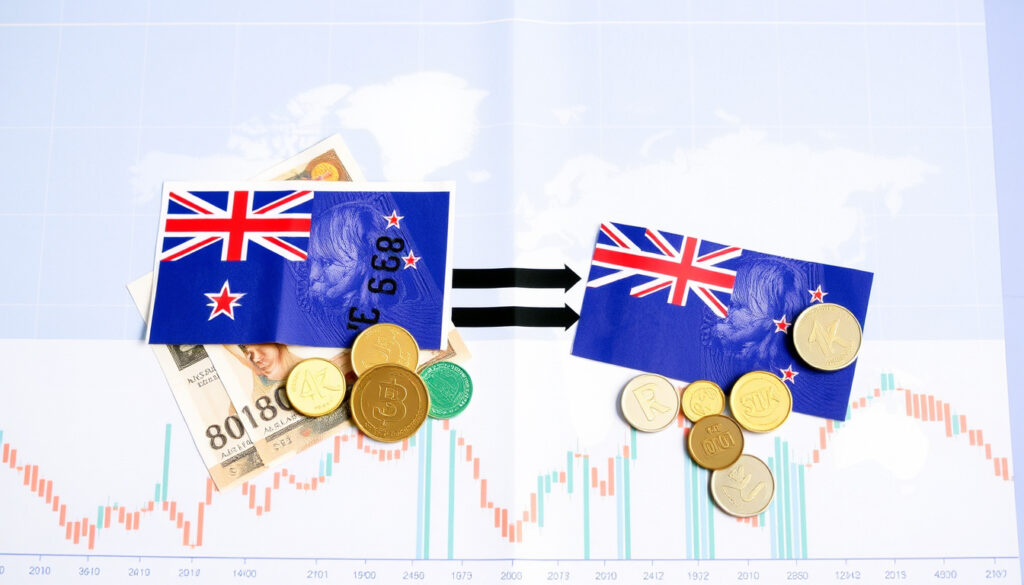
AUD to NZD Exchange Rate Today: Convert Australian Dollars
The AUD/NZD rate has been sitting comfortably above parity for years, meaning one Australian dollar buys more than one New Zealand dollar — a small but meaningful edge for travelers and businesses alike. Below is a practical guide covering the current rate, how to convert your money, which providers offer the best deals, and what to watch for when exchanging AUD to NZD.
1 AUD: 1.22 NZD ·
100 AUD: 122 NZD ·
1,000 AUD: 1,220 NZD ·
Mid-market source: XE.com ·
Wise inverse: 1 NZD = 0.82 AUD
Quick snapshot
- Mid-market rate sourced from XE and Wise (Pound Sterling Live)
- 2026 high: 1.2184 on April 17, 2026 (Pound Sterling Live)
- 2026 low: 1.1536 on February 2, 2026 (Pound Sterling Live)
- Exact future forecasts — rates shift daily
- Bank-specific margins and fees
- Regional rate variations across Australian states
- 2026 average: 1.1862 — current rate above this (S Money Australia)
- Best historical rate: 1.1148 on June 30, 2024 (S Money Australia)
- Worst historical rate: 1.0579 on February 24, 2024 (S Money Australia)
- CoinCodex forecasts 1.36 by end of 2026
- Watch RBNZ and RBA policy updates
- Technical indicators suggest bullish momentum
How much is $100 Australian in NZ dollars today?
The short answer is straightforward: at the current mid-market rate of roughly 1.22 NZD per Australian dollar, 100 AUD converts to approximately 122 NZD. That rate — the one you’ll see on Google, XE, or most currency converters — is the wholesale rate banks use between themselves, and it serves as the fair baseline before any provider adds their margin. Most currency converters including Google, XE, and Yahoo use the same wholesale mid-market exchange rate, so you’re seeing the same number across platforms S Money Australia.
The table below shows common conversion amounts based on the current mid-market rate to help you quickly estimate what you’ll receive.
| Amount (AUD) | NZD equivalent (approx.) | Rate source |
|---|---|---|
| 1 AUD | 1.22 NZD | Mid-market |
| 20 AUD | 24.40 NZD | Mid-market |
| 50 AUD | 61 NZD | Mid-market |
| 100 AUD | 122 NZD | Mid-market |
| 350 AUD | 427 NZD | Mid-market |
| 1,000 AUD | 1,220 NZD | Mid-market |
The actual amount you receive depends on which provider you use. During the week ending April 18, 2026, the AUD/NZD rate fluctuated between a high of 1.21874 and a low of 1.21088 Wise. That small spread shows how the rate moves hourly. For larger transfers, even a 0.5% difference in the rate can mean losing or gaining several dollars — worth checking before you commit.
The mid-market rate is the reference point, not the rate you’ll actually get. Providers like Wise, XE, and OFX get closer to it than banks or airport exchange desks, which typically mark up the rate by 3–7%.
Live rate calculator tip
Rather than guessing, use a live converter from a trusted provider. The Wise inverse rate shows 1 NZD = 0.82 AUD, which tells you exactly how many Australian dollars you’d need to buy one New Zealand dollar. Cross-reference between XE and Wise to spot the best timing window for your conversion.
What is a good AUD to NZD exchange rate?
A “good” rate means getting as close to the mid-market rate as possible. The best AUD to NZD exchange rate for cash as of the latest update was 1.2148 S Money Australia — that’s about 98.5% of the mid-market rate, which is excellent for a cash transaction. Online transfers through Wise and OFX typically beat that, sometimes reaching within 0.5% of mid-market.
Wise and XE consistently offer rates nearest the mid-market benchmark. For Australian travelers, ordering foreign currency online before your trip typically yields better rates than walking into a bank branch or airport exchange.
Best rates for cash exchange
- Wise: Near mid-market, low transparent fees
- XE: Competitive rates, good for large transfers
- OFX: No flat fees, rate slightly below mid-market
- Australia Post: Accessible across bank branches and currency exchange services Australia Post
Mid-market vs bank rates
Banks typically add a margin of 3–5% to the mid-market rate. That means on a 1,000 AUD transfer, you could lose 30–50 NZD compared to using a specialist provider. The difference is pure cost — the same money, fewer New Zealand dollars in your pocket. Airport exchanges are worse, often adding 5–7%, which makes them the most expensive place to buy NZD.
Why is NZD strong against AUD?
Several economic forces keep the New Zealand dollar elevated relative to its Australian counterpart. New Zealand’s commodity-driven economy, particularly dairy exports, creates consistent demand for NZD on global markets. The Reserve Bank of New Zealand’s (RBNZ) monetary policy decisions also influence the rate — when New Zealand interest rates rise relative to Australian rates, capital flows toward NZD, pushing its value up.
Economic factors at play
The Australian and New Zealand economies are closely linked but not identical. Australia has a more diversified export base including iron ore and coal, while New Zealand’s smaller economy is more sensitive to dairy and agricultural commodity cycles. When global dairy prices rise, NZD often strengthens against AUD. Conversely, disruptions in Australian mining output can weaken the AUD relative to NZD.
New Zealand’s economy is smaller and more volatile, meaning NZD can swing more dramatically than AUD. Travelers benefit when NZD is strong, but exporters and businesses in New Zealand face greater currency uncertainty.
Interest rate differences
The RBNZ and the Reserve Bank of Australia (RBA) set their respective overnight rates independently. When New Zealand rates exceed Australian rates, the interest rate differential attracts capital into NZD-denominated assets, supporting the currency. Technical analysis shows the current AUD/NZD rate sits above both the 50-day simple moving average at $1.21 and the 200-day simple moving average positioned at $1.17 CoinCodex, suggesting bullish momentum in the near term.
Commodity impacts
New Zealand’s heavy reliance on dairy exports means the Global Dairy Trade auction results can move NZD in either direction. A strong auction result typically pushes NZD higher against AUD. In the last 30 days, the volatility of AUD/NZD has been 0.58% CoinCodex, indicating relatively calm market conditions — good news for travelers locking in a rate.
Is it better to take cash or card to New Zealand?
For most travelers heading to New Zealand, cards beat cash over the long run. Credit and debit cards from providers like Wise or Revolut offer exchange rates very close to mid-market, with flat transaction fees that are often lower than the margin you’d pay exchanging physical cash. The exception is rural New Zealand, where some smaller towns still prefer cash, and some operators may charge foreign transaction fees on card payments.
Upsides
- Cards offer near mid-market rates
- No physical cash to lose or theft risk
- Contactless payments widely accepted
- Easy to track spending digitally
Downsides
- Foreign transaction fees may apply
- Rural areas can have limited acceptance
- ATM withdrawal fees from your home bank
- Some merchants add card surcharges
ATM strategies
If you need cash, use ATMs attached to New Zealand banks rather than standalone ATMs in tourist areas. Bank ATMs typically offer fair exchange rates and lower withdrawal limits. Withdraw larger amounts less frequently to minimize per-transaction fees. Before traveling, notify your bank to avoid having your card blocked for suspicious foreign activity.
Should I exchange money before traveling to New Zealand?
Ordering NZD online before your trip is usually the smart move. Providers like Wise, OFX, and Australia Post allow you to order foreign currency for home delivery or pickup. The rates are typically better than what you’ll find at airport kiosks or bank branches, and you lock in your rate before market movements affect it. Just plan ahead — delivery can take 3–5 business days.
Pre-trip exchange options
- Order online: Wise or OFX typically offer the best rates
- Bank branch: Decent rates but often charge flat fees
- Airport exchange: Convenient but overpriced — avoid for large amounts
- Arrival in New Zealand: ATMs at airports work, but rates may be less favorable
If the NZD weakens before your trip, ordering early locks in a better rate. If NZD strengthens, you miss out — but you can always adjust your plans if the move is substantial.
In-country alternatives
Once in New Zealand, bank ATMs are the easiest way to get cash at reasonable rates. Major banks like ANZ, ASB, and BNZ operate nationwide, and their ATMs accept most international cards. For card payments, contactless options like Apple Pay and Google Pay work everywhere tap-and-go is accepted, which is most urban and tourist areas.
Timing tips
Watch the RBNZ and RBA calendars for interest rate announcements — these tend to move markets. If you’re exchanging a large amount, spreading your conversion over several days can reduce timing risk. One model suggests the rate could reach 1.36 by the end of 2026, up from current levels CoinCodex, though medium-confidence forecasts warrant caution.
Historical performance and 2026 data
Looking back at 2026 so far, the AUD/NZD rate has shown notable swings. The highest level recorded in 2026 hit 1.2184 on April 17 Pound Sterling Live, while the lowest was 1.1536 on February 2 Pound Sterling Live. The average AUD/NZD level for 2026 has been 1.1862 Pound Sterling Live, and current rates are trading above that baseline.
The pattern from monthly OFX data shows a gradual recovery: from 1.161444 on January 31 OFX, to 1.17471 on February 28 OFX, to 1.200187 on March 31 OFX. That upward trajectory suggests the rate found support and climbed as the year progressed.
The worst time to exchange AUD to NZD in the past 12 months was on February 24, 2024, when the rate plunged to 1.0579 S Money Australia. By contrast, the best time was June 30, 2024, when the rate reached 1.1148 S Money Australia. That 5.4% swing between the year’s worst and best rates illustrates why timing matters for larger conversions.
If you’re converting $10,000 AUD, that 5.4% range between the worst and best rates over the past year represents roughly 540 NZD in difference — a significant cost for poor timing. Monitoring the rate before your conversion window can save real money.
AUD to NZD forecast: where is the rate heading?
Forecasts offer a range of outlooks for the AUD/NZD pair through the rest of 2026 and beyond. CoinCodex projects AUD/NZD to hit $1.36 by the end of 2026, representing an 11.96% increase compared to current rates CoinCodex. For the longer term, AUD/NZD is forecasted to reach $1.33 by the end of 2030 CoinCodex, representing a 9.29% increase.
Long Forecast anticipates July 2026 to begin at 1.230 NZD with a high of 1.281 and low of 1.230, averaging 1.251 Long Forecast. Short-term projections from Pound Sterling Live suggest the rate at 1.2151 in one month, 1.2123 in three months, and 1.2071 in six months from the forecast date Pound Sterling Live.
The inverse NZD/AUD forecasts also tell the story: Traders Union projects the rate may reach 0.7758 by the end of 2026 Traders Union and 0.846 by the end of 2029 Traders Union.
The current AUD/NZD sentiment is estimated as bullish with a 14-day RSI reading of 59.17 suggesting neutral conditions CoinCodex. The rate remains above key moving averages, which technically supports the bullish case — but forecasts are not guarantees.
The pattern from multiple forecast sources shows the AUD/NZD pair is expected to maintain its bullish trajectory through 2026, with the OFX historical data confirming the upward trend from January to March 2026 OFX. The implication: forecasts cluster around continued modest gains through 2026, with potential for more significant moves if New Zealand’s commodity cycle or interest rate differential shifts. Travelers should treat forecasts as directional signals, not precise predictions.
Steps: how to convert AUD to NZD
Whether you’re converting for travel, business, or investment, here’s a practical step-by-step process to get the best AUD to NZD rate.
- Check the mid-market rate — Start at XE.com or Wise to see the current wholesale rate
- Compare provider rates — Get quotes from at least three providers: Wise, OFX, and your bank
- Factor in fees — Some providers charge flat fees, others mark up the rate. Calculate the total cost for your amount
- Time your conversion — If not urgent, monitor the rate for 3–5 days to pick a favorable window
- Place your order — For online transfers, set up an account and verify your identity; for cash, order ahead for pickup
- Confirm the rate — Some providers let you lock in the rate at order time; others use the rate at execution
- Track delivery — For physical currency, confirm delivery times; for transfers, monitor your NZD account or recipient
For Australian travelers converting $1,000 or more, the difference between the best and worst providers can exceed 50 NZD. Spending 10 minutes comparing rates is a worthwhile investment.
What affects the AUD to NZD exchange rate?
The AUD/NZD rate responds to a handful of major drivers. Interest rate differentials between the RBA and RBNZ set the baseline tone — when New Zealand rates rise faster than Australian rates, NZD typically appreciates. Commodity cycles, particularly dairy, add volatility since New Zealand’s export mix is narrower than Australia’s.
Geopolitical events and risk sentiment also play a role. During periods of global uncertainty, the New Zealand dollar sometimes acts as a risk currency, weakening against the Australian dollar. Conversely, strong Chinese demand for Australian iron ore can boost AUD against NZD since Australia exports more to China proportionally than New Zealand does.
RBNZ interest rate decisions, dairy auction results, and Chinese economic data are the three most accessible indicators for AUD/NZD direction. Monitoring these signals weekly helps you time conversions better than guessing randomly.
The pattern: Australia’s more diversified economy gives AUD structural stability, while NZD’s commodity sensitivity creates both upside and downside opportunities. For travelers, that means the rate will likely stay above parity — but the exact level depends on which way these economic forces lean in any given quarter.
Summary
The AUD/NZD rate currently sits above its 2026 average, offering favorable conditions for Australians converting to NZD. Wise, XE, and OFX consistently outperform banks and airport exchanges by staying closest to the mid-market rate. For travelers, cards generally beat cash for convenience and cost, with cash as a backup for rural areas. Online pre-ordering before your trip locks in better rates than waiting until arrival.
For Australian travelers heading to New Zealand, the calculation is clear: compare at least two providers online before converting, avoid airport exchanges for large amounts, and consider timing your conversion around RBNZ announcements if your amount exceeds $1,000 AUD. Those small steps can mean keeping an extra 30–50 NZD in your pocket — enough for a decent meal in Auckland or Wellington.
Related reading: $100 USD to NZD: Live Exchange Rate & Converter Today · 230 USD to NZD – Live Rate, Trends and Conversion Guide
moneytransfer.com.au, poundsterlinglive.com, ofx.com, tradingview.com
Current AUD to NZD rates hover near 1.22, and live AUD/NZD rate charts provide essential trends for travelers and investors alike.
Frequently asked questions
What is the current AUD to NZD exchange rate?
The current mid-market rate is approximately 1 AUD = 1.22 NZD as of mid-2026. For the exact live rate, check XE.com or Wise. Remember that the rate you actually receive when converting will be slightly lower due to the provider’s margin.
How to convert AUD to NZD?
Multiply your AUD amount by the current rate. For example, 100 AUD × 1.22 = 122 NZD. For actual conversions, use an online provider like Wise, XE, or OFX for transfers, or order cash from Australia Post for physical currency.
What is the AUD to NZD forecast?
CoinCodex forecasts 1.36 by end of 2026, while Pound Sterling Live’s short-term models project modest gains to around 1.2151 in one month. Forecasts are not guarantees — treat them as directional indicators with medium confidence.
Where to get the best AUD to NZD rate?
Wise and XE consistently offer rates closest to the mid-market benchmark. OFX is also competitive for larger transfers with no flat fees. Avoid airport exchanges and high-street banks for large amounts due to their higher margins.
How has the AUD to NZD rate changed historically?
The rate has ranged from 1.0579 (February 2024, worst) to 1.1148 (June 2024, best) over the past 12 months. In 2026, it has ranged from 1.1536 (February 2) to 1.2184 (April 17) with an average of 1.1862.
Is 1 AUD worth more than 1 NZD?
Yes, currently 1 AUD buys approximately 1.22 NZD, meaning the Australian dollar is worth more than the New Zealand dollar. This has been the case for several years, though the exact premium fluctuates daily.
What affects the AUD to NZD exchange rate?
Key drivers include interest rate differentials between the RBA and RBNZ, New Zealand dairy export prices, Chinese economic data (since both countries export heavily to China), and global risk sentiment. Technical factors like moving averages also influence short-term movements.
More related posts
 1000 AUD to NZD: Exchange Rate, Fees, and Tax Guide
 Ziwi Peak Dog Food: Facts on Cost, Safety & Ownership
 Smith and Smith Christchurch – No Law Firm, Auto Glass Facts
 Gamefallout.com Author Jeffery Williams: Verified Facts
 Air New Zealand Complaints: How to File & Escalate (2024 Guide)
 Asma al-Assad: Where is she now in 2025? Regime fall and exile
 New Zealand Dollar Price in India: Live NZD to INR Rate
 181 cm in Feet and Inches: Exact Conversion, Not 6 ft