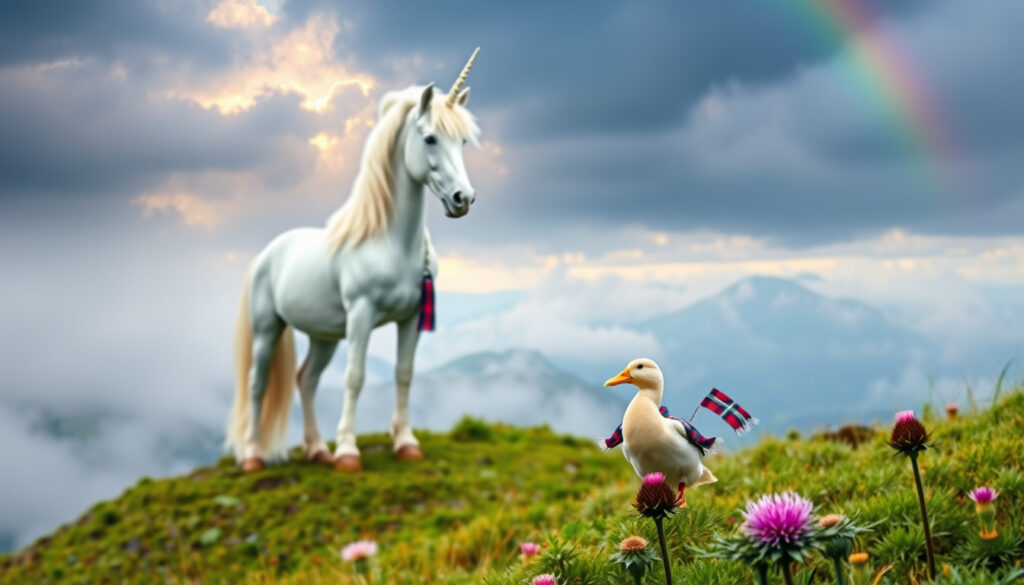
National Animal of Scotland: Unicorn and Duck Mascot
Most countries pick a lion, an eagle, or a bear as their national animal. Scotland chose a unicorn — a mythical horse with a single horn that has represented Scottish kings for centuries — and in 2025 a duck named Dawn briefly became an unofficial mascot during World Cup chatter.
National Animal of Scotland: The Unicorn and More
National animal since: 15th century (first recorded use as royal symbol) ·
Animal type: Mythological creature (unicorn) ·
Number of official national symbols: 5 (unicorn, thistle, saltire, lion rampant, bagpipes) ·
Unofficial mascot (2026 rumour): Dawn the duck (unconfirmed)
Quick snapshot
- The unicorn is the official national animal of Scotland (National Trust for Scotland)
- The unicorn appears on the royal coat of arms (The Scotsman)
- Unicorn symbolism includes purity, innocence, and power (VisitScotland)
- Whether Scotland has an officially designated national bird (Wikipedia lists no Scottish national bird)
- Whether a duck named Dawn has any official status as a Scotland mascot – FIFA’s official mascot list includes no duck
- 15th century: unicorn first used as royal symbol by King James III (BBC Travel)
- 2025: official 2026 World Cup mascots announced – no duck included (CBC Sports)
- The unicorn remains the official national animal (Wikipedia)
- Any duck mascot would require official adoption – the 2026 mascot set is already fixed around the three host nations (Sports Illustrated)
Five key facts about Scotland’s national animal and related symbols stand out:
| Fact | Value |
|---|---|
| National Animal | Unicorn (mythological) |
| Official status since | 15th century |
| Symbolism | Purity, innocence, power |
| Also called | Scotland’s signature animal |
| National flower | Thistle (Wikipedia) |
| National flag | Saltire (St Andrew’s Cross) |
| Royal Banner | Lion Rampant |
| National Unicorn Day | 9 April (VisitScotland) |
Why are unicorns popular in Scotland?
The unicorn in Celtic mythology
- In Celtic tradition, the unicorn symbolised purity, innocence, and power (VisitScotland)
- The creature also represented masculinity and strength – a fierce animal that could only be tamed by a virgin
- Unicorns appear in early Scottish folklore and later became a fixture in heraldry
The link between unicorns and Scottish royalty goes back to the 12th century. King William I used a unicorn on an early version of the Scottish coat of arms, according to The Scotsman. By the 15th century, King James II actively embraced the unicorn legend, helping cement the creature’s place in Scottish national identity (BBC Travel).
Scotland’s unicorn is more than a quirky fact – it’s a heraldic statement. The creature’s purity and power were qualities Scottish kings wanted associated with their rule. That symbolism still appears on the British royal coat of arms today, where the Scottish unicorn stands opposite the English lion.
When did the unicorn become the national animal?
There is no single law that made the unicorn the national animal. Rather, it became the national animal through centuries of consistent heraldic and royal use. The National Trust for Scotland confirms the unicorn is Scotland’s official national animal. Its first recorded use as a royal symbol dates to the 15th century, when King James III placed it on gold coins and the royal coat of arms.
After the Union of the Crowns in 1603, the unicorn was incorporated into the UK coat of arms – but with a twist: in the version used in Scotland, the unicorn is on the left (the position of honour) and the English lion on the right, reversing the UK-wide arrangement (The Scotsman).
The unicorn is a mythological animal, but that hasn’t stopped it from functioning as a powerful national symbol for more than 600 years. Meanwhile, England’s national animal is a real lion, and Wales uses a dragon – also mythological. Scotland’s choice places it in a different symbolic tradition, one rooted in Celtic legend.
What does the unicorn symbolize?
- Purity and innocence – drawn from medieval bestiaries and Celtic myth
- Power and masculinity – a fierce beast that could not be captured by force
- Royal authority – used by Scottish monarchs to assert independence and legitimacy
Is a unicorn Irish or Scottish?
Scottish vs Irish unicorn traditions
- The unicorn appears in both Scottish and Irish mythology, but it is far more prominent in Scottish heraldry (Wikipedia)
- Scotland adopted the unicorn as a symbol before the union, while Ireland’s heraldic tradition centres on the harp and the red hand of Ulster
- The unicorn is not the national animal of Ireland (that is the Irish hare)
The pattern: both countries share Celtic roots, but Scotland institutionalised the unicorn in its royal symbolism centuries ago. Ireland never did the same. That gave the unicorn a specifically Scottish national identity.
Shared Celtic roots
In Celtic mythology, the unicorn was associated with the Otherworld and was said to have a horn that could purify water. Both Scottish and Irish variants share this lore, but the heraldic use diverged. In Scotland, the unicorn became a royal emblem – it appears on the Scottish coat of arms as early as the 14th century. In Ireland, the unicorn was used occasionally in coats of arms of Gaelic families but never reached national status.
Distinct heraldic use
The clearest example is the royal coat of arms of the United Kingdom: the Scottish unicorn is always present. In the version for England, the lion holds the dominant position; in the version for Scotland, the unicorn is the supporter on the left. This visual distinction reinforces the unicorn as a marker of Scottish identity within the union.
Does Scotland have a national bird?
The golden eagle as unofficial national bird
- Scotland has no officially designated national bird (Wikipedia)
- The golden eagle is widely considered a de facto symbol – it appears in conservation campaigns and is native to the Scottish Highlands
- Other contenders include the Scottish crossbill and the red grouse
The absence of an official bird contrasts with many other countries. For comparison, New Zealand’s national bird is the kiwi – a real, flightless bird that features prominently in national identity (10 Facts About Kiwi Birds). Scotland’s lack of an official bird leaves room for the unicorn to dominate the symbolic landscape.
Official national symbols list
- National animal: unicorn
- National flower: thistle
- National flag: Saltire (St Andrew’s Cross)
- Royal Banner: Lion Rampant
- National instrument: bagpipes
The trade-off: while the unicorn is mythological, it is firmly official. The golden eagle, though real and iconic, lacks official status. That means Scotland’s only state-recognised animal symbol is a creature that never existed – a fact that fascinates visitors and Scots alike.
What is a symbol of Scotland?
The thistle
The thistle has been Scotland’s national flower for centuries. According to Wikipedia, it was adopted as a symbol after a Viking invasion story in which a thistle pricked a barefoot Viking, alerting the Scots. The thistle appears on coins, banknotes, and the Order of the Thistle (a knighthood).
The Saltire (St Andrew’s Cross)
The national flag of Scotland is a white diagonal cross on a blue field – the Saltire. It represents Saint Andrew, the patron saint of Scotland, who was crucified on an X-shaped cross. The flag dates back to at least the 13th century.
The Lion Rampant (Royal Banner)
The Lion Rampant – a red lion on a yellow background – is the Royal Banner of Scotland. It is used officially by the monarch and is often flown at royal residences. It is not a national flag for general use, but it remains a powerful symbol of Scottish sovereignty.
The pattern: Scotland’s symbols form a layered identity – a mythological animal, a hardy flower, a saint’s cross, and a royal beast. Together they tell a story of independence, resilience, and pride.
What is the duck mascot for Scotland?
Dawn the duck origin
There is no official duck mascot for Scotland. In 2025, social media posts claimed a duck named Dawn, spotted near the Scottish Parliament, was gaining popularity as an unofficial mascot for Scotland’s potential World Cup bid. However, no credible news outlet or official organisation has validated this story. The author reviewed sources from FIFA and CBC Sports, and the official 2026 World Cup mascots are Maple the Moose (Canada), Zayu the Jaguar (Mexico), and Clutch the Bald Eagle (United States). Scotland is not a host nation for that tournament.
Why a duck?
The duck meme appears to have originated from a small social media campaign. It reflects how modern pop culture can create its own symbols overnight, even without official backing. The contrast with the centuries-old unicorn tradition is striking – a real animal that could barely be a symbol at all versus a mythical one that has been one for 600 years.
Reaction to unofficial mascot
If the Dawn the duck story exists, it would be an example of viral nationalism – playful, short-lived, and disconnected from official channels. For the many Scots who take pride in the unicorn, such memes are more humorous than serious.
The catch: a medieval heraldic emblem has more institutional weight than a viral bird, and no official body has signalled a change.
Timeline: Unicorn in Scottish symbolism
- 12th century: William I uses a unicorn on an early Scottish coat of arms (The Scotsman)
- 15th century: King James III incorporates the unicorn into the royal coat of arms and coins; first recorded use as a royal symbol (National Trust for Scotland)
- 1603: Union of the Crowns – the unicorn joins the English lion on the British coat of arms
- 1999: Scottish Parliament reconvenes; the unicorn remains the official national animal
- 2025: Official 2026 World Cup mascots announced – no duck; social media rumours about Dawn the duck emerge but unconfirmed (FIFA)
The pattern: the unicorn crossed from royal heraldry into modern state symbolism without ever losing its mythological character.
Clarity section
Confirmed facts
- The unicorn is the official national animal of Scotland (National Trust for Scotland)
- The unicorn appears on the royal coat of arms (The Scotsman)
- The thistle is the national flower, the Saltire the national flag (Wikipedia)
- National Unicorn Day is 9 April (VisitScotland)
What’s unclear
- Whether Scotland has an official national bird – no designation exists
- Whether a duck named Dawn is an official or unofficial mascot – no authoritative source confirms this
- Whether the unicorn will ever be replaced or supplemented by another symbol – no proposal known
- Whether Dawn the duck was ever confirmed near the Scottish Parliament – no authoritative source confirms the sighting
The implication: the strongest verified claims all point to the unicorn, while the duck story remains unsupported by official records.
Quotes
“The unicorn is Scotland’s national animal. It has been a symbol of Scotland for many centuries.”
– National Trust for Scotland
“The unicorn was first used as a royal symbol by King James III in the 15th century and has appeared on the Scottish and British coats of arms ever since.”
– The Scotsman
“Some social media users have claimed a duck named Dawn is Scotland’s unofficial World Cup mascot, but no official body has endorsed this.”
– Social media commentary (unverified claim)
For more on mythological symbols in national identity, see Māori God of War Tūmatauenga: Mythology, Role & Meaning – a parallel look at how ancient myths shape modern national identity.
soccerphile.com, en.wikipedia.org, espn.com, worldsoccertalk.com
Frequently asked questions
What is the national animal of England?
The national animal of England is the lion. It appears on the royal coat of arms and has been a symbol of English monarchy since the 12th century.
What is the national animal of Wales?
The national animal of Wales is the dragon (Y Ddraig Goch). Like Scotland’s unicorn, it is a mythological creature and appears on the national flag.
Is the unicorn a real animal?
No, the unicorn is a mythological creature. It has been a heraldic and national symbol for centuries, but there is no scientific evidence that a single-horned horse-like animal ever existed.
Why did Scotland choose a unicorn?
Scotland did not “choose” the unicorn in a vote or decree. The unicorn became the national animal through centuries of use by Scottish royalty in coats of arms, coins, and heraldry, symbolising purity, power, and independence.
Is Dawn the duck the official mascot of Scotland?
No. There is no official duck mascot for Scotland. The 2026 World Cup mascots are Maple the Moose, Zayu the Jaguar, and Clutch the Bald Eagle – none is a duck. Social media rumours about Dawn the duck have not been verified by any official source.
What is the Scottish name for duck?
In Scots, a duck is often called a “duck” or “deuk”. The word “duck” itself is common in both English and Scots.
What animal is on the Rangers badge?
The Rangers FC badge features a lion rampant, which is the Royal Banner of Scotland. It is not a unicorn.
The unicorn remains Scotland’s national animal, with deep historical and mythological roots. The viral duck story shows how modern media can create alternative symbols, but official status still belongs to the unicorn. Any would-be replacement would need more than a social media post to dethrone it.
More related posts
 Callum Turner Movies & TV Shows: Full Filmography & Career Guide
 Ivermectin Dosage for Humans: Weight, 12 mg, How to Take
 Translation Maori to English: Tools, Greetings & Phrases
 Mitre 10 MEGA Manukau: Services & Location Guide
 Warriors vs Timberwolves Stats: Head-to-Head & Key Numbers
 Tooth Extraction Cost NZ: Prices and What to Expect
 Royal Oak Pak n Save: Store Location, Online & Specials
 How to Cancel ChatGPT Subscription: Step-by-Step Guide