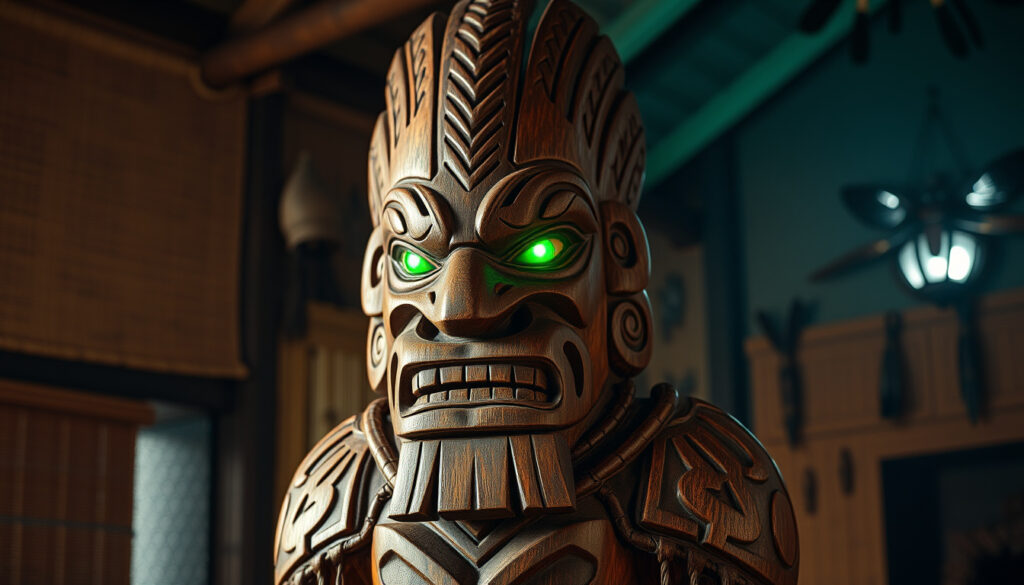
Māori God of War Tūmatauenga: Mythology, Role & Meaning
There’s a reason the Māori god of war is still remembered today. Tūmatauenga wasn’t just about battle — he oversaw hunting, fishing, and cooking, too.
Primary deity of war: Tūmatauenga ·
Number of major gods: 7 ·
Domain: War, hunting, fishing, cooking ·
Pronunciation: Too-mah-tow-EN-gah
Quick snapshot
- God of war, hunting, fishing, cooking (Te Ara Encyclopedia of New Zealand)
- Son of Rangi and Papa (Te Ara)
- Brother to Tāne, Rongo, Tangaroa, etc. (Te Ara)
- God of peace and agriculture (Te Ara)
- Opposes Tūmatauenga in mythology (Te Ara)
- God of the sea (Te Ara)
- Father of all fish and reptiles (Te Ara)
- God of wind and storms (Te Ara)
- Declared war on his brothers after separation of parents (Te Ara)
One pattern: Tūmatauenga’s identity spans far beyond warfare, covering the everyday activities that keep communities alive.
Here is a quick reference table for Tūmatauenga’s core details.
| Label | Value |
|---|---|
| Name | Tūmatauenga |
| Domain | War, hunting, fishing, cooking |
| Parents | Rangi (sky) and Papa (earth) |
| Pronunciation | Too-mah-tow-EN-gah |
Who is the god of war in Māori mythology?
What is Tūmatauenga’s role?
- Tūmatauenga is widely identified as the primary Māori god of war (Te Ara Encyclopedia of New Zealand).
- He is also the god of mankind and human activities like hunting, fishing, and cooking (Te Ara).
- One common interpretation of his name is “Tū of the angry face” (Wikipedia).
How is Tūmatauenga worshipped?
- South Waikato District Council notes that Tūmatauenga was treated with great respect and admiration (South Waikato District Council).
- Traditional warfare (riri) was deeply tied to his cosmology, with rituals performed to invoke his mana (Te Ara).
What is the story of Tūmatauenga?
- In the creation narrative, Tūmatauenga wanted to kill his parents Rangi (sky) and Papa (earth) to bring light into the world (Te Ara).
- A Te Arawa version says he advised his brothers to kill their parents so that light could enter (South Waikato District Council).
- After the separation of his parents by Tāne, Tāwhirimātea (god of winds) attacked his brothers for their betrayal. Tūmatauenga alone stood firm and eventually defeated all his brothers (Te Ara).
The implication: Tūmatauenga’s role as warrior deity is inseparable from his responsibility for the daily acts that sustain life.
Tūmatauenga’s victory over his brothers gave him authority over their domains — so he controls not just war but also hunting, fishing, cultivation, and cooking. Without that battle, human survival would lack a divine patron.
Who are the seven Māori gods?
Who is Rangi?
- Rangi (Ranginui) is the sky father, one of the primordial parents (Te Ara).
Who is Papa?
- Papa (Papatūānuku) is the earth mother, counterpart to Rangi (Te Ara).
Who are the children of Rangi and Papa?
- The seven major gods are their children: Tāne (forest), Tūmatauenga (war), Tāwhirimātea (wind), Rongo (peace/agriculture), Tangaroa (sea), Haumia (wild food), and either Rūaumoko (earthquakes) or Whiro (darkness) depending on the iwi (Te Ara).
- The exact number and identity can vary by tribal tradition (Te Ara).
The classic “seven gods” framework is a useful shorthand, but Māori cosmology is fluid — different iwi recognise different rankings. The core idea remains: the children of Rangi and Papa represent the fundamental forces that shape human experience.
Who is the Māori god of peace?
What is Rongo’s domain?
- Rongo is the god of peace and agriculture (Te Ara).
- He oversees cultivated foods, especially kūmara (sweet potato) (Te Ara).
How is Rongo related to Tūmatauenga?
- Rongo is a brother of Tūmatauenga (Te Ara).
- In the creation story, Rongo sided with the brothers who wanted to separate their parents rather than kill them, placing him in opposition to Tūmatauenga’s aggressive stance (Te Ara).
Who is the Māori god of death?
Who is Whiro?
- Whiro is the god of darkness, evil, and death in some traditions (Te Ara).
- He is sometimes listed as one of the seven children, replacing Rūaumoko (Te Ara).
What is the role of Hine-nui-te-pō?
- Hine-nui-te-pō is the goddess of death, who guides souls to the underworld (Te Ara).
- She is often considered the daughter of Tāne and later became the guardian of the afterlife (Te Ara).
Who is the Māori god of the sea?
Who is Tangaroa?
- Tangaroa is the god of the sea, the father of all fish and reptiles (Te Ara).
- He is one of the seven children of Rangi and Papa (Te Ara).
What is Tangaroa’s relationship with Tāwhirimātea?
- After the separation of their parents, Tāwhirimātea attacked Tangaroa’s domain, causing the sea to rage (Te Ara).
- Tangaroa fled to the ocean depths, and his descendants (fish and reptiles) scattered, some taking refuge in the sea and others on land (Te Ara).
The trope of a single “god of the sea” oversimplifies Māori cosmology. Tangaroa rules the ocean, but his authority is challenged by Tāwhirimātea’s storms, and traditions vary on his exact rank. The gods are not static — their relationships shift with the story.
What’s Confirmed and What’s Unclear
Confirmed facts
- Tūmatauenga is the Māori god of war (Te Ara).
- He is a son of Rangi and Papa (Te Ara).
- He is associated with human activities like hunting and fishing (Te Ara).
What’s unclear
- Exact number of major gods varies by iwi (tribe) (Te Ara).
- Whether Whiro or Rūaumoko is considered the seventh god depends on the tradition (Te Ara).
“Tūmatauenga is the primary atua of war, human activities such as hunting, food cultivation, fishing, and cooking.”Wikipedia – Tūmatauenga entry
“South Waikato District Council describes Tūmatauenga as the god of war in Māori mythology and one of the great gods, treated with great respect and admiration.”South Waikato District Council
“The Te Ara article on traditional Māori warfare presents Tūmatauenga as part of a broader cosmological explanation for war and human activity.”Te Ara Encyclopedia of New Zealand
For anyone exploring Māori culture, the lesson is clear: Tūmatauenga represents the raw forces that sustain life, not just destroy it. The choice for modern readers is to see him as a war god alone, or to appreciate the full breadth of his domain — and that breadth changes how we understand Māori cosmology.
Related reading: Moana Pasifika Game Cancelled in Tonga · 10 Facts About Kiwi Birds: Flightless, Giant Eggs & More
fr.wikipedia.org, ru.wikipedia.org, uk.wikipedia.org, tuwharetoabone.com, de.wikipedia.org, twinkl.com, youtube.com, youtube.com, youtube.com
Frequently asked questions
Who is the Māori god of the sun?
Who is the Māori god of the moon?
Who is the Māori god of rain?
Who is the Māori god of volcanoes?
Who is the Māori god of nature?
How do you pronounce Tūmatauenga?
What is the story of Tūmatauenga?
More related posts
 When Do Babies Start Smiling? Timeline, 3-6-9 Rule & Signs
 Mortgage Rate Predictions NZ 2026: Expert Forecasts & What to Do
 Blox Fruits Trading Values: Check Prices & Trade Fairly
 Auckland Motorway Crash Today Live Camera – Check Traffic Now
 NZ Tax Brackets 2025: Rates & Thresholds Explained
 Demon Slayer Infinity Castle Movie Release Dates Guide
 How to Cork a Wine Bottle: 5 Easy Methods for Home Bottling