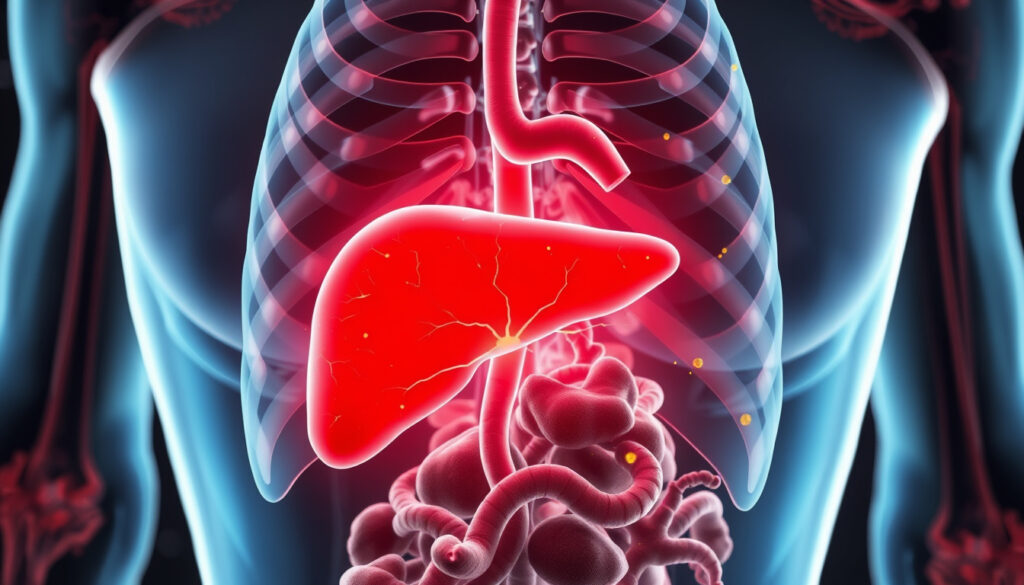
Where is the liver located? Anatomy, pain, and repair
Right beneath your lower ribs on the right side, a dull ache can make you wonder whether to worry or wait. That area is home to the liver, a wedge-shaped organ that weighs about 1.5 kg and usually hides behind the rib cage rather than announcing itself to the world. Prakash ILBS (hospital anatomy teaching PDF) describes the liver as a wedge-shaped organ, and that shape is part of why pain there can feel like a band across your upper belly.
Liver at a glance: Location: right upper abdomen, under the ribs · Weight: about 1.5 kg · Shape: wedge-shaped · Pain origin: capsule stretch, not liver tissue itself · Repair capacity: can regrow after large resections.
Location
Right upper abdomen, tucked under the lower ribs. Ramsay Health Care (UK private hospital group)
Shape
Wedge-shaped, with the broad part on the right. Prakash ILBS (hospital anatomy teaching PDF)
Weight
About 1.5 kg in an average adult. Prakash ILBS (hospital anatomy teaching PDF)
Pain mechanism
The liver itself has no pain fibers; discomfort comes from stretching of the liver capsule. Bottom Line Inc. (consumer-health publisher)
Where exactly is your liver located?
Your liver sits mainly in the right upper quadrant of your abdomen, just below the diaphragm and behind the lower ribs. That means it is more of a “front-and-side” organ than a back structure. Prakash ILBS (hospital anatomy teaching PDF) describes it as wedge-shaped, with the thicker part on the right.
Because the rib cage covers the liver, you usually cannot feel a normal liver through the belly wall. The liver sits behind the ribs, not in the back. If you feel tenderness right under the front edge of the right ribs, that is the more typical location for liver-related discomfort.
If someone points to the middle of the low back and asks, “Is that my liver?” the more common answer is no — unless the liver is enlarged enough to push past its usual sheltered spot.
What does liver pain actually feel like?
A common surprise is that the liver itself does not feel pain. Bottom Line Inc. (consumer-health publisher) explains that discomfort comes from stretching of the liver capsule as the organ swells or grows.
People often describe that type of pain as a dull ache, pressure, or fullness in the right upper abdomen rather than a sharp, stabbing pain. The pain can also spread to the right shoulder, upper back, or neck. Ramsay Health Care (UK private hospital group) points out that liver-related pain is not always right under the ribs — it can travel along the same nerve pathways.
That is why location alone is not a perfect clue. The pain can be in the right upper abdomen, but it can also be felt higher up near the shoulder blade.
Why can liver pain be confused with something else?
Right upper quadrant pain is not always the liver. Bottom Line Inc. (consumer-health publisher) notes that several nearby structures can produce similar pain. The gallbladder, bile ducts, and even the lower right rib cage can all create discomfort in the same general region.
Because the liver sits next to the diaphragm, irritation of the diaphragm can send pain toward the right shoulder or neck. Ramsay Health Care (UK private hospital group) describes liver-related pain as something that can be felt in the right upper part of the belly and sometimes spread upward or backward.
This overlap is why doctors do not rely on location alone. Tenderness in the upper right quadrant raises the question, but it does not prove the liver is the cause.
How does the liver repair itself?
The liver has an unusual ability: it can regrow. Bottom Line Inc. (consumer-health publisher) reports that a liver can return to normal size even after a large portion has been removed. This regeneration capacity is part of why surgeons can plan operations that remove part of the liver.
But regeneration has limits. Healing works best when the thing causing the injury is removed — whether that means stopping alcohol, managing metabolic stress, or treating an infection. The liver’s ability to regrow is not a license to ignore pain; it simply explains why the organ is so resilient.
When should you worry about liver pain?
Mild, brief discomfort under the right ribs may not be an emergency, but it deserves attention if it is new, constant, or getting worse. See a clinician if the pain is severe, keeps returning, or comes with nausea, vomiting, fever, yellowing of the skin or eyes, dark urine, or pale stools.
Only a doctor can tell whether right upper quadrant pain is coming from the liver, gallbladder, bile duct, or rib cage. Ramsay Health Care (UK private hospital group) recommends taking right-upper-abdominal pain seriously, especially when it moves to the shoulder or back.
This guide is educational, not a diagnosis. If you are unsure about your own symptoms, a medical exam and imaging can answer the question more safely than guessing.
Confirmed facts and common mix-ups
- Confirmed: The liver sits in the right upper abdomen, behind the lower ribs. Ramsay Health Care (UK private hospital group)
- Confirmed: The liver is wedge-shaped and weighs about 1.5 kg. Prakash ILBS (hospital anatomy teaching PDF)
- Confirmed: Liver-related pain can spread to the right shoulder, upper back, or neck. Ramsay Health Care (UK private hospital group)
- Confirmed: The liver can regrow to normal size after large portions are removed. Bottom Line Inc. (consumer-health publisher)
- Needs context: Not every right upper quadrant pain is from the liver; nearby organs can produce similar pain. Bottom Line Inc. (consumer-health publisher)
- Needs context: The liver does not normally extend into the back unless it is enlarged.
What the sources say
Liver-related pain can be felt in the right upper abdomen and can spread to the right shoulder or back.
— Ramsay Health Care (UK private hospital group)
When the liver swells or grows, it can stretch the capsule and cause pain.
— Bottom Line Inc. (consumer-health publisher)
What this means for you
The liver sits high on the right, behind the ribs, and pain from it can be surprisingly indirect. The good news is that the organ has real repair capacity. The more practical point is that a tender right upper quadrant is worth getting checked before you assume it is just muscle, posture, or stress. If that ache is yours, the next step is not another internet search — it is a medical appointment.
webmd.com, nih.gov, vinmec.com, medicalnewstoday.com, mayoclinic.org, thomsonmedical.com, ubiehealth.com, sciencedirect.com, ubiehealth.com
Frequently asked questions
Can liver pain be felt in the back?
Yes. Liver-related pain is usually in the right upper abdomen, but it can spread to the right shoulder, upper back, or neck. Ramsay Health Care (UK private hospital group) describes this as a possible pattern of liver-related discomfort.
How do I know if the pain is from my liver or something else?
You cannot reliably tell without an exam. Bottom Line Inc. (consumer-health publisher) notes that right upper quadrant pain can also come from nearby structures such as the gallbladder or bile ducts.
Is liver pain always serious?
Not always, but it deserves attention. The liver itself has no pain fibers; pain usually means the liver capsule is being stretched. That makes pain a useful warning sign, even if the cause is treatable.
Can the liver repair itself?
Yes. A liver can regrow to normal size even after large portions have been removed, according to Bottom Line Inc. (consumer-health publisher).
Why do I feel pain in my shoulder if my liver hurts?
The liver sits near the diaphragm, and diaphragm irritation can refer pain along shared nerve pathways to the right shoulder or neck. That is why liver pain is not always felt directly under the rib cage.
How can I tell where the liver is without a scan?
A normal liver is usually underneath the right rib cage and is not easy to feel through the belly wall. If the liver is enlarged, a doctor may be able to feel its edge below the ribs. Imaging is the more reliable way to map organ size and location.
More related posts
 Seoul Roastery 1946 Photos: Menu, Prices & Reviews
 Water Play Tables NZ – Best 2025 Picks for Toddlers
 Australia Arrival Card Online: Digital Incoming Passenger Card
 St Clair Golf Club: Fees, Address, Scorecard & Reviews
 Plantar Fasciitis Insoles NZ: Evidence & Practical Guide
 Jon-Michael Ecker: Marine Biologist Turned Chicago Fire Actor
 26 USD to NZD: Convert US Dollars to NZ Dollars Today
 Car Loan Calculator NZ – Get Accurate Repayment Estimates