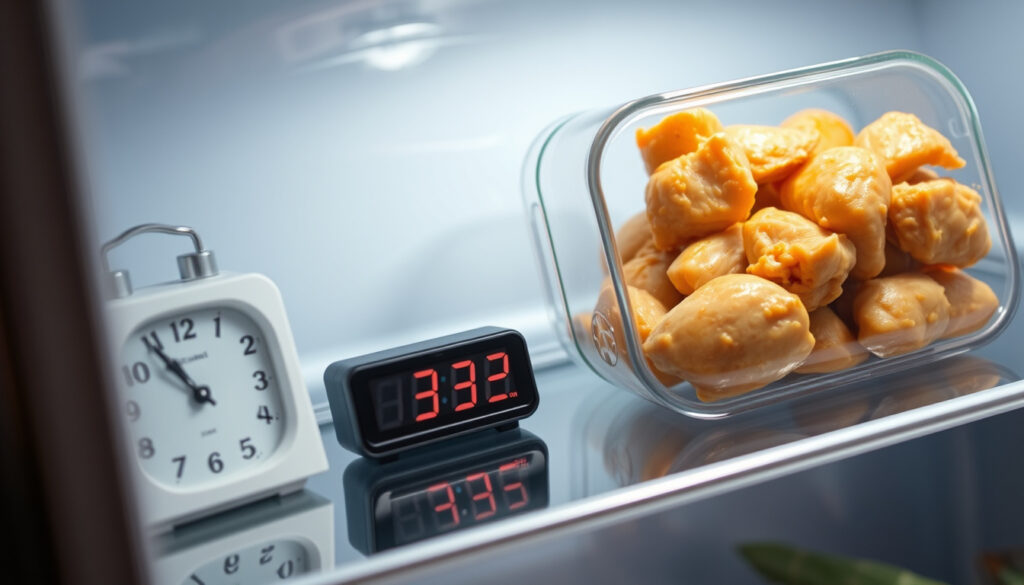
How Long Does Cooked Chicken Last in Fridge
You pull last night’s chicken from the fridge, peel back the foil, and stop. Is it still safe? If you’ve ever hovered over a container wondering whether day 4 or day 5 means the trash or the plate, you’re not alone. This guide uses the official USDA storage window of 3 to 4 days, unpacks why 5-day-old chicken can be risky even when it looks fine, and gives you clear spoilage checks so you can make the call with confidence.
USDA safe storage limit for cooked chicken: 3 to 4 days ·
Maximum freezer storage for cooked chicken: 4 to 6 months ·
Safe fridge temperature threshold: below 40°F (4°C) ·
Risk window for foodborne illness after 4 days: increases significantly ·
Room temperature danger zone cutoff: 2 hours
Quick snapshot
- USDA recommends eating cooked chicken within 3–4 days (Food Network)
- FDA storage chart lists cooked poultry at 3–4 days in refrigerator (U.S. Food and Drug Administration)
- Canada’s leftovers guidance matches 3–4 days (Government of Canada)
- Whether 5-day-old chicken that looks and smells normal is always unsafe — individual fridge temperature and storage method matter (Healthline)
- Day 0–3: safest window. Day 4: final recommended day. Day 5+: risk climbs sharply (USDA Food Safety)
- Freeze leftovers within 3–4 days or discard — reheating to 165°F kills bacteria but not heat-stable toxins (USDA Food Safety)
Five numbers from three health authorities reveal one pattern: 3 to 4 days is the consensus across the U.S., Canada, and the U.K. for refrigerator storage of cooked chicken.
| Guideline | Value | Source |
|---|---|---|
| USDA recommended fridge limit | 3 to 4 days | Food Network (citing USDA) |
| UK NHS recommended fridge limit | up to 3 days | NHS website |
| Canada FSAI recommended limit | 3 to 4 days | Government of Canada |
| Freezer safe storage | 4 to 6 months | U.S. Food and Drug Administration |
| Room temperature safe window | 2 hours | Food Network |
| Safe reheating internal temperature | 165°F (74°C) | FoodSafety.gov |
How long does cooked chicken last in the fridge?
The short answer, backed by the USDA Food Safety and Inspection Service and the U.S. Food and Drug Administration, is 3 to 4 days when the fridge operates at or below 40°F (4°C). This applies to all cooked chicken: breasts, thighs, rotisserie birds, shredded meat, and restaurant leftovers.
USDA guideline: 3 to 4 days
- The USDA explicitly says cooked chicken should be refrigerated at 40°F (4°C) or below and used within 3 to 4 days.
- The FDA’s refrigerator and freezer storage chart lists cooked poultry and leftover fried chicken in the same window.
- Canada’s official leftovers guidance (Government of Canada) repeats 3 to 4 days at 4°C (40°F) or lower for cooked fish and poultry.
Factors that affect shelf life: fridge temperature, container type, chicken cut
- A fridge that stays consistently at 40°F or below is non-negotiable. Temperature swings above 40°F shorten the safe window.
- Airtight containers or vacuum sealing can slow spoilage by limiting oxygen exposure.
- Chicken with sauce or broth may spoil faster because of the additional moisture — though the FDA chart lists covered pieces with broth as safe for the same 3–4 days.
The implication: The 3–4 day window is not a suggestion — it’s a food-safety floor built on how quickly pathogenic bacteria like Salmonella and Listeria can multiply at fridge temperatures. After day 4, your margin of safety narrows fast.
Can I eat chicken 5 days after cooked?
The honest answer: the USDA says no. Even if the chicken looks, smells, and tastes fine, bacteria may have grown to unsafe levels without producing obvious spoilage signals.
Risk of foodborne illness after 4 days
- One food safety blog notes that unsafe bacteria can multiply without creating visible spoilage (Well Stockd).
- A Southern Living guide points out that a well-chilled fridge (below 40°F) may extend safety slightly, but the official recommendation stays 3–4 days.
Signs of spoilage to check
- If the chicken was stored beyond 4 days, look for any off odor, slime, or discoloration. These are advanced spoilage indicators.
- Even without these signs, discard it. The Well Stockd article emphasizes that “the 3–4 day window is a safety limit, not a quality suggestion.”
Eating chicken on day 5 might feel like a frugal move, but the cost of a single foodborne illness episode — emergency room visits, lost work, days of misery — far outweighs the cost of tossing a container. The USDA stance is conservative by design: it’s built on worst-case temperature abuse, not best-case fridge optimization.
The catch: Reheating won’t fix this. Even a blast to 165°F kills active bacteria but leaves heat-stable toxins that can still make you sick. Day 5 chicken belongs in the trash, not the microwave.
How to tell if chicken is spoiled?
Three sensory checks — smell, feel, look — work together, though none is foolproof. The Food Network guide confirms that “off smell” and “slimy texture” are reliable spoilage signs.
Sight: color and mold
- Fresh cooked chicken is white or light beige. Grayish, greenish, or spotted discoloration indicates spoilage.
- Any visible mold — fuzzy green, white, or black patches — means the chicken must be discarded immediately.
Smell: sour or sulfur-like odor
- A sour or ammonia-like smell is a classic sign that bacteria have broken down proteins. The Healthline guide describes it as “sour or sulfur-like.”
- If the chicken has any off odor at all, don’t risk it.
Texture: slimy or sticky
- A slippery or tacky film on the surface — even after rinsing — means spoilage bacteria have colonized the meat.
- Sliminess is a clear indicator according to the Southern Living editorial team.
Why this matters: Spoilage bacteria and pathogenic bacteria are not the same. Spoilage causes the smell and slime you can detect; pathogens cause illness often without any sensory warning. That’s why the 4-day rule is based on pathogen growth curves, not on spoilage detection.
Can I reheat cooked chicken after 4 days?
Technically yes — but only if the chicken is still within its 4-day window. Reheating to 165°F (FoodSafety.gov) kills active bacteria. However, if the chicken is already on day 5 or beyond, reheating does not undo toxin accumulation.
Reheating does not kill all bacteria from prolonged storage
- Heat-stable toxins produced by Staphylococcus aureus and Bacillus cereus survive 165°F.
- The USDA recommends freezing within the 3–4 day window if you won’t use it in time, rather than relying on later reheating.
What temperature to reheat to: 165°F (74°C)
- Use a food thermometer to verify the internal temperature reaches 165°F throughout.
- Reheat only the portion you’ll eat — repeated cooling and rewarming increases risk.
Reheating is a safety net for chicken stored 1–3 days, not a rescue tool for chicken on day 5. If you’re reheating day-old leftovers to 165°F, you’re fine. If you’re reheating chicken that sat in the fridge for six days, you’re gambling — and the house always wins.
The pattern: “When in doubt, throw it out” works because pathogen growth does not pause at day 4. The 165°F reheating standard is designed for meat that was never allowed to cross unsafe time limits, not for meat that already spent extra days at bacterial risk levels.
How long does cooked chicken last at room temperature?
The safety cutoff is 2 hours — or 1 hour if the ambient temperature is above 90°F (32°C). The Food Network guide calls this the “danger zone” where bacteria double every 20 minutes.
The 2-hour rule
- Cooked chicken left out at room temperature for more than 2 hours should be discarded.
- If you’re serving at a picnic or buffet, keep hot chicken above 140°F or cold chicken below 40°F.
Ambient temperature above 90°F (32°C) reduces safe time to 1 hour
- Hot weather, a warm kitchen, or a sunny picnic table cuts the safe window in half.
- Bacteria multiply faster at higher temperatures, so the 1-hour rule applies to summer cookouts.
The 2-hour clock starts when the chicken finishes cooking, not when you remember to put it in the fridge. A roast that sits on the counter for 90 minutes while you eat is already halfway to the danger zone. For meal preppers: portion chicken into shallow containers immediately after cooking to speed cooling.
The implication: Leaving chicken on the counter to cool before refrigerating increases risk. Divide into smaller containers and refrigerate promptly — modern fridges can handle warm food without raising internal temperatures dangerously.
Step-by-step guide to storing cooked chicken safely
The following steps shift the odds in your favor — the 3–4 day window assumes proper storage from minute one.
- Cool quickly, then refrigerate. Portion into shallow containers (2 inches deep) within 2 hours of cooking. Place directly in the fridge — no need to cool completely first.
- Use airtight containers or vacuum seal. Reduce oxygen exposure to slow bacterial growth and prevent the chicken from absorbing fridge odors. The Southern Living guide recommends glass or BPA-free plastic with tight lids.
- Label with the date cooked. Write the date on a piece of tape or use a marker. This removes guesswork later.
- Keep the fridge at or below 40°F (4°C). Use an appliance thermometer to verify. A fridge running at 38°F extends your safety margin within the 3–4 day window.
- Freeze any chicken you won’t eat within 3 days. The USDA recommends freezing within the 3–4 day window for best quality, and the FDA says cooked poultry can be frozen for 4–6 months.
- Thaw frozen cooked chicken in the fridge, not on the counter. Plan ahead — a full thaw takes 24–48 hours. Once thawed, use within 3–4 days and never refreeze.
The pattern: Each step above shifts the odds in your favor. Speed of cooling, container seal, and fridge temp are the levers you control to stay inside the safe window.
Timeline: cooked chicken safety window
What’s confirmed and what’s unclear
Confirmed facts
- USDA says 3–4 days at 40°F or below (Food Network)
- FDA storage chart matches 3–4 days (U.S. Food and Drug Administration)
- Canada’s guidance aligns: 3–4 days (Government of Canada)
- Bacteria multiply above 40°F; room temperature limit is 2 hours (Food Network)
- Spoilage signs include off smell, slime, and color change (Healthline)
What’s unclear
- Whether a perfectly chilled fridge (near 34°F) can stretch the 4-day window safely — no official data validates this.
- Whether vacuum-sealed chicken lasts longer than 4 days in the fridge — the Southern Living guide notes it may slow spoilage but does not guarantee safety beyond USDA limits.
- Whether 5-day-old chicken that looks and smells fine is always safe — the Well Stockd article says bacteria can be present without sensory cues.
Expert perspectives on cooked chicken storage
“Cooked chicken should be refrigerated at 40°F (4°C) or below and used within 3 to 4 days.”
— USDA Food Safety and Inspection Service
“If you won’t use cooked chicken within 3 to 4 days, freeze it. That way you can still enjoy it later without the safety risk.”
— USDA Food Safety on freezing leftovers
“The 3 to 4 day refrigerator rule applies to homemade, store-bought, rotisserie, shredded, and restaurant leftovers.”
— Southern Living food team
“The best quality for cooked chicken pieces covered with broth or gravy is up to 6 months in the freezer.”
— U.S. Food and Drug Administration freezer chart
Between the USDA, FDA, and Canada’s health agencies, the 3–4 day rule is the most consistent data point in cooked chicken storage. The real test isn’t whether your chicken looks or smells okay — it’s whether you can track the clock from cooking time to fridge time to discard time. The home cook who meal preps on Sunday faces a clear choice: eat by Wednesday night, freeze by Thursday morning, or toss it. Thursday night chicken is a gamble no food thermometer can win.
larderlane.com, springermountainfarms.com, thelivinglook.com, usanalysis.org
Frequently asked questions
Can I freeze cooked chicken after 3 days in the fridge?
Yes. The USDA recommends freezing within the 3–4 day refrigerator window. Once thawed in the fridge, use within 3–4 days and do not refreeze.
Does cooked chicken with sauce last longer than plain chicken?
Not meaningfully. The FDA lists both plain cooked chicken and chicken with broth or gravy at 3–4 days in the refrigerator. The additional moisture can actually accelerate spoilage if not stored in an airtight container.
Can I eat cooked chicken that has been in the fridge for 6 days if it was vacuum-sealed?
The Food Network states that vacuum sealing can slow spoilage but does not change the food safety clock. The USDA 3–4 day limit remains the official guideline. Discard vacuum-sealed cooked chicken after day 4.
How should I store cooked chicken in the fridge to maximize shelf life?
Cool it quickly by portioning into shallow containers, seal with an airtight lid, set fridge at or below 40°F (4°C), and label with the date cooked. These steps help you stay within the safe 3–4 day window.
Is it safe to eat cold cooked chicken straight from the fridge?
Yes, as long as the chicken is within the 3–4 day storage window and has been kept at 40°F or below. Cold cooked chicken is safe to eat without reheating, but many prefer to reheat for flavor.
Can I cook raw chicken that was in the fridge for 4 days?
Raw chicken is also subject to the same 3–4 day refrigerator limit. The FDA chart lists raw chicken at 1–2 days in the fridge, so 4-day-old raw chicken should not be cooked and eaten. Discard it.
How long does cooked chicken last in the freezer?
The FDA says 4–6 months for best quality. The Government of Canada matches this. At 0°F (-18°C) the chicken stays safe indefinitely, but texture and flavor degrade over time.
More related posts
 Beauty Salon Near Me: Pricing, Differences, and Signs of Quality
 DJI Mini 5 Pro: Price, Specs & Mini 4 Pro Comparison
 MAFS Jamie and Dave: The Full Story of Their Split and Beyond
 Weather Auckland Cyclone Tam: Facts and Impact
 Blox Fruits Trading Values: Check Prices & Trade Fairly
 PSG vs Inter Milan Stats: Head-to-Head, Score & Analysis (2025)
 Smith & Smith Rotorua: Windscreen Replacement & Repair Guide
 Jon-Michael Ecker: Marine Biologist Turned Chicago Fire Actor