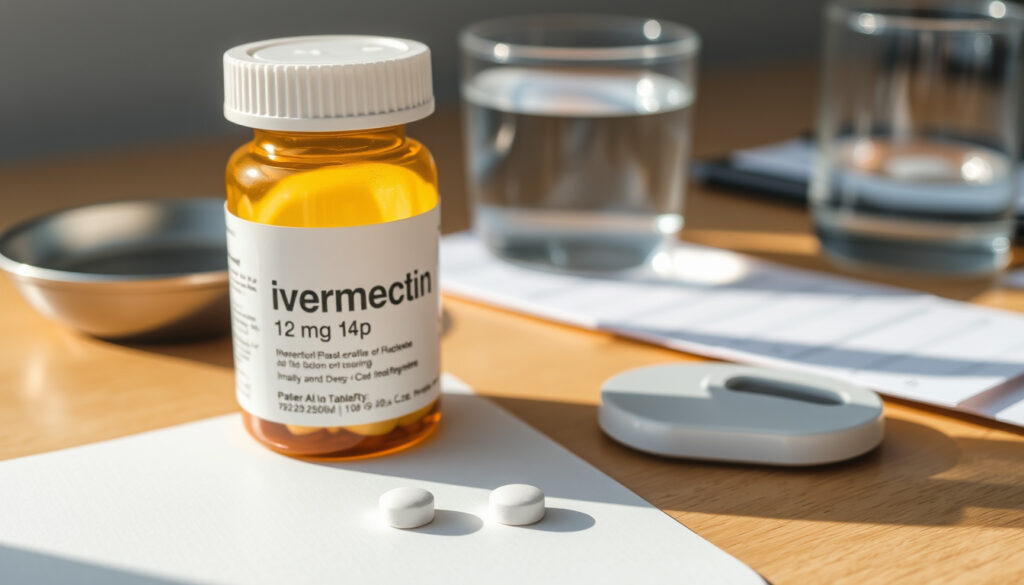
Ivermectin Dosage for Humans: Weight, 12 mg, How to Take
Getting the right ivermectin dose matters more than most people realize — a small difference in body weight can mean the difference between an effective treatment and a wasted tablet. For the millions who rely on this antiparasitic drug each year, understanding the weight-based calculation is the single most important step; this guide lays out the evidence-backed dosage ranges for FDA-approved uses, explains how to convert your weight into the correct milligram dose, and highlights the risks of straying from medical guidance.
Standard single dose: 150–200 mcg per kg of body weight ·
Common tablet strengths: 3 mg, 6 mg ·
Maximum approved daily dose: 200 mcg/kg (up to 12 mg) for up to 5 days ·
FDA-approved indications: Strongyloidiasis, onchocerciasis, scabies ·
Administration advice: Take on an empty stomach at least 1 hour before or 2 hours after a meal
Quick snapshot
- Standard dose is 150–200 mcg/kg as a single dose (Mayo Clinic drug database)
- Must be taken on an empty stomach (Drugs.com dosage guide)
- Repeat dosing required for scabies after 7–14 days (Medical News Today dosing guide)
- Efficacy for off-label conditions like COVID-19 is unproven
- Safety during pregnancy and breastfeeding has limited data
- Optimal dose for children outside approved indications not established
- Single dose taken once — repeat dose after 3–12 months for onchocerciasis (NZ Medsafe data sheet)
- Scabies: second dose 7–14 days after first (Drugs.com prescribing information)
- Use weight-based calculation to confirm your dose (Healthline dosage summary)
- Consult a doctor before taking any ivermectin (Healthline dosage summary)
- Never use veterinary liquid products (Healthline dosage summary)
For anyone prescribed ivermectin for an FDA-approved indication, the dosing window is narrow: 150–200 mcg per kg. A 70 kg adult, for instance, needs 10.5 to 14 mg — a range that spans two 6 mg tablets. Get your weight wrong by 10 kg and you’re either underdosed or risking side effects.
Five key facts, one pattern: every approved ivermectin dose centers on body weight, but the exact multiplier changes depending on the infection being treated.
| Label | Value |
|---|---|
| Standard single dose | 150–200 mcg per kg of body weight |
| Common tablet strengths | 3 mg, 6 mg |
| Maximum approved daily dose | 200 mcg/kg (up to 12 mg) for up to 5 days |
| FDA-approved indications | Strongyloidiasis, onchocerciasis, scabies |
| Administration advice | Take on an empty stomach at least 1 hour before or 2 hours after a meal |
| Dose for onchocerciasis | 150 mcg/kg single dose for adults and children ≥15 kg (Mayo Clinic) |
| Dose for strongyloidiasis | 200 mcg/kg single dose for adults and children ≥15 kg (Mayo Clinic) |
| Weight-to-tablet: 15–24 kg | One 3 mg tablet (NZ Medsafe) |
| Weight-to-tablet: 25–35 kg | Two 3 mg tablets (6 mg total) (Drugs.com) |
| Weight-to-tablet: 65–84 kg | 12 mg (varies by indication) (Drugs.com) |
Ivermectin dosage for humans by weight
How to calculate your dose using body weight
- Weigh yourself in kilograms (1 kg = 2.2 lbs). If you only know your weight in pounds, divide by 2.2.
- Multiply your weight in kg by 0.15 to get the lower end (150 mcg/kg), or by 0.2 to get the upper end (200 mcg/kg). The result is your dose in milligrams.
- Cross-check against available tablet strengths (3 mg or 6 mg). A 70 kg person, for example, would need 10.5–14 mg — either four 3 mg tablets (12 mg) or two 6 mg tablets (12 mg).
Example: a 60 kg adult with strongyloidiasis needs 60 × 0.2 = 12 mg, which corresponds to two 6 mg tablets or four 3 mg tablets. This aligns with both Drugs.com’s weight chart and Mayo Clinic’s guidance.
Standard weight-based dosing range
The standard dose range of 150–200 mcg/kg applies across FDA-approved indications, but the specific figure changes by condition. For onchocerciasis (river blindness), Mayo Clinic uses 150 mcg/kg as a single dose for adults and children weighing at least 15 kg. For strongyloidiasis, the same source recommends 200 mcg/kg. Médecins Sans Frontières (MSF Medical Guidelines) similarly lists both 150 and 200 mcg/kg options depending on the indication.
Weight-specific tablet counts from New Zealand’s Medsafe data sheet provide a clear reference: 15–24 kg gets one 3 mg tablet, 25–35 kg gets two 3 mg tablets, and 65–84 kg falls in the 12 mg range per Drugs.com.
The pattern: the dose multiplier is not fixed by the drug alone; it is set by the interaction between body weight and the infection being treated.
12 mg ivermectin for humans
When is 12 mg prescribed?
A 12 mg dose equals 200 mcg/kg for a 60 kg adult — the standard single dose for strongyloidiasis according to Mayo Clinic. For someone weighing 80 kg at the same indication, 12 mg would be 150 mcg/kg, which falls within the standard range but sits at the lower end. The Drugs.com weight chart explicitly maps 65–84 kg to 12 mg for one indication set, confirming this as a common tablet count for average-sized adults.
12 mg as a high-dose regimen
Some clinical studies use 12 mg once daily for 5 consecutive days, particularly in off-label contexts. However, Mayo Clinic and regulatory bodies have not approved this regimen for any indication. The maximum approved daily dose is 200 mcg/kg — for a 60 kg person that is exactly 12 mg, but for a 100 kg person that would be 20 mg, which exceeds available tablet strengths and would require a medical decision.
12 mg is only the right dose if your weight and the indication align. A 40 kg person taking 12 mg would receive 300 mcg/kg — 50% above the standard maximum. That mismatch increases the risk of neurological side effects like dizziness, confusion, and seizures, as documented in Drugs.com’s safety warnings.
The implication: a fixed 12 mg tablet count is only meaningful when checked against body weight; without that check, it can silently become a supratherapeutic dose.
Liquid ivermectin dosage for humans
Risks of using veterinary liquid ivermectin
Liquid ivermectin formulations sold for livestock are not FDA-approved for human use. A single milliliter of a veterinary 1% solution contains 10 mg of ivermectin — but the concentration varies wildly by product, and dosing droppers are calibrated for cattle or horses, not humans. The Medical News Today guide explicitly warns that improper dosing of veterinary formulations can lead to toxicity, including ataxia, respiratory depression, and coma.
Proper dilution if using compounded liquid
If a physician prescribes a compounded oral liquid (rare in the US but available through specialty pharmacies), it comes with precise instructions from the compounding pharmacy. Never dilute veterinary products yourself — the concentration assumptions required to hit 150–200 mcg/kg are too error-prone. According to Healthline, human-grade liquid ivermectin is not FDA-approved, and no standard dosing table exists for it.
The pattern: safety depends less on the active ingredient than on the preparation and the concentration accuracy.
Highest dose of ivermectin for humans
Maximum safe single dose
The highest dose used in published, peer-reviewed studies for approved indications is 200 mcg/kg as a single dose, as confirmed by Mayo Clinic and Drugs.com. For a 100 kg adult, that equals 20 mg — but no approved single-dose tablet or regimen exceeds 200 mcg/kg. The Healthline summary notes that doses above 200 mcg/kg increase the risk of neurological side effects without providing additional benefit.
Maximum cumulative dose in clinical trials
In some clinical trials, researchers administered 200 mcg/kg once daily for up to 5 consecutive days, for a cumulative dose of 1000 mcg/kg (1 mg/kg). This regimen was studied primarily for off-label conditions and is not approved by the FDA. The New Zealand Medsafe data sheet recommends no more than a single oral dose for approved indications, reflecting conservative international guidance.
The trade-off: pushing above 200 mcg/kg per dose hasn’t shown improved efficacy in any published study, but has shown higher rates of adverse events. As Medical News Today states, “higher doses increase the risk of neurological side effects.”
How to take ivermectin
Before taking: fasting requirements
- Take on an empty stomach at least 1 hour before or 2 hours after a meal (Drugs.com)
- Food significantly increases ivermectin absorption — up to 2.5× higher with a high-fat meal — which can push blood levels into the toxic range
Step-by-step administration
- Swallow the tablet whole with water — do not crush, chew, or split it (Mayo Clinic)
- For a single-dose regimen, take all tablets at once as prescribed
- For scabies: a second dose may be required 7–14 days after the first (Drugs.com)
- For onchocerciasis: repeat doses every 3–12 months as directed by your physician (Mayo Clinic)
A single mistake in timing — taking ivermectin with a meal instead of on an empty stomach — can double or triple drug absorption. For a patient near the upper end of the weight range, that could push blood levels past the therapeutic window into the side-effect zone. The difference between effective treatment and toxicity is often just a meal.
What this means: the same tablet can be a correct dose or a hazardous one depending on when it is swallowed.
Clarity section
Confirmed facts
- Standard dose range is 150–200 mcg/kg (verified by Mayo Clinic, Drugs.com, and Healthline)
- Must be taken on an empty stomach (Drugs.com)
- Repeat dosing required for scabies after 7–14 days (Medical News Today)
- 12 mg equals 200 mcg/kg for a 60 kg person (Mayo Clinic)
- FDA-approved for strongyloidiasis, onchocerciasis, scabies
What’s unclear
- Efficacy for off-label conditions like COVID-19 — not proven in large-scale trials
- Safety during pregnancy and breastfeeding — limited human data
- Optimal dose for children outside approved indications — not established
- Safety of veterinary liquid ivermectin for human use — never tested in humans
- Dosing charts vary by country and guideline, so no single chart is universally authoritative
The pattern: the documented facts are the easy part; the unresolved questions are where dose errors and off-label risks begin.
“For onchocerciasis, oral ivermectin is commonly dosed at 150 micrograms per kilogram of body weight as a single dose in adults and children weighing at least 15 kg.”
Mayo Clinic (drug information database)
“A common tablet-weight chart places 65 to 84 kg at 12 mg orally one time.”
Drugs.com (drug dosage guide)
“Take on an empty stomach at least 1 hour before or 2 hours after a meal.”
Drugs.com (administration instructions)
“Higher doses increase risk of neurological side effects.”
Medical News Today (ivermectin dosage guide)
The evidence is clear: ivermectin works within a tight therapeutic window, but only when dosed by weight, taken on an empty stomach, and prescribed for an approved indication. For anyone considering ivermectin for off-label uses, the risks of neurological side effects outweigh any unproven benefit. For patients with strongyloidiasis, onchocerciasis, or scabies, the choice is straightforward: follow the weight-based calculation, take the tablets correctly, and repeat only if your doctor says so.
Related reading: Ozempic NZ Buy Online: Prescriptions, Costs & Alternatives · Flu Vaccine NZ 2025: Availability, Cost, and Eligibility
ema.europa.eu, tackettpharmacy.com, ivermectintablets2026.com, medicalnewstoday.com, minarsdermatology.com
Frequently asked questions
Can ivermectin be used for COVID-19?
No. Major health authorities including the FDA, WHO, and the European Medicines Agency have concluded that ivermectin has not shown proven benefit against COVID-19 in large-scale randomized trials. The inquiry into its efficacy for off-label conditions remains unresolved, but current guidelines do not recommend its use for this purpose.
What are the side effects of ivermectin?
Common side effects include dizziness, nausea, diarrhea, and skin rash. More serious but rarer effects include neurological symptoms like confusion, ataxia, and seizures — especially at doses above 200 mcg/kg. The Drugs.com safety profile lists these risks in detail.
Is ivermectin safe during pregnancy?
Data is limited. Animal studies have shown no evidence of harm, but well-controlled human studies in pregnant women are lacking. The Mayo Clinic drug information advises using ivermectin during pregnancy only if clearly needed and prescribed by a doctor.
How long does ivermectin stay in your system?
Ivermectin has a half-life of approximately 12–18 hours in the body, with peak blood levels reached 4 hours after oral administration. The drug is eliminated primarily through the feces. For most people, it is fully cleared within 3–5 days after a single dose.
What should I do if I miss a dose?
For single-dose regimens (strongyloidiasis, onchocerciasis, scabies), take the missed dose as soon as you remember, but only if within 48 hours. Beyond that, consult your healthcare provider. Do not double the dose. For repeat-dose protocols (e.g., scabies second dose after 7–14 days), contact your doctor for guidance.
Can I drink alcohol while taking ivermectin?
Alcohol does not directly interact with ivermectin, but it can amplify side effects like dizziness and nausea. The Healthline guide recommends avoiding alcohol during treatment to minimize these effects.
Does ivermectin interact with other medications?
Yes. Ivermectin can interact with blood thinners (e.g., warfarin), some antiepileptic drugs, and medications that affect liver enzymes (CYP3A4). Always provide a full medication list to your doctor before starting ivermectin. The Drugs.com interactions checker has a complete list.
For patients prescribed ivermectin for an approved indication, the decision is clear: calculate your dose by weight, take it on an empty stomach, and follow your doctor’s repeat-dosing schedule precisely. For anyone tempted by off-label uses, the alternative is a risk of neurological side effects with no proven benefit — a trade-off that medical evidence does not support.
More related posts
 Places to Stay in Auckland: Best Districts for 2026
 181 cm in Feet and Inches: Exact Conversion, Not 6 ft
 PAK’nSAVE Whanganui: Online Shopping & Weekly Specials
 Weather Warnings New Zealand: Red Alerts & Safety Guide
 Cheap Flights NZ Domestic: Best Deals & Booking Tips
 Best TV Shows 2025: Top-Rated Series to Watch
 Where to Watch Love Island USA Season 7: Peacock & More
 Moisturizer for Dry Skin – Dermatologist Top Picks