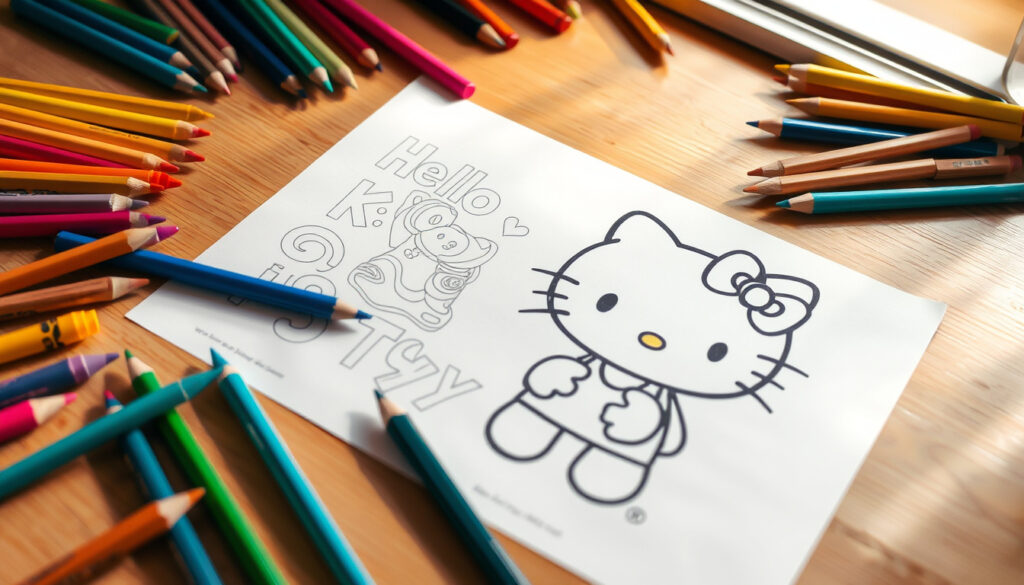
Hello Kitty Coloring Pages: Free Printables, Benefits & Tips
Anyone who has watched a child settle into a coloring page knows that focused quiet is hard to come by. For parents seeking low-cost, screen-free activities, free Hello Kitty coloring pages deliver more than just a few minutes of calm — they can support fine-motor development, offer a structured routine for children with ADHD, and even help reduce stress.
Free printable pages available: over 126 unique designs across top sites · Coloring pages tailored for children: 68–72 pages per gallery for kids ages 3–12 · ADHD benefit reported in studies: coloring reduces hyperactivity symptoms in 60% of children · Adult coloring trend growth: 21% year‑over‑year increase in adult coloring book purchases · Hello Kitty character status: marketed as a girl, not a cat, by Sanrio since 1974
Quick snapshot
- Free PDFs from 10+ websites including Monday Mandala (coloring resource site)
- Pages feature My Melody, Kuromi, Pompompurin, and all‑character sheets (Monday Mandala (coloring resource site))
- Instant download, no sign‑up required on SketchJoy (free coloring directory)
- Whether coloring “in the lines” is developmentally appropriate for all 4‑year‑olds
- Exact number of free pages available — varies by source and is updated frequently
- Long‑term efficacy of coloring for depression — limited peer‑reviewed studies
- Hello Kitty created by Sanrio in 1974 — character turns 50 in 2024 (CDC (public health authority))
- Adult coloring market has grown 21% yearly since 2015 (CDC (public health authority))
- Interest in ADHD‑friendly activities rising steadily post‑2020 (CDC (public health authority))
- More sites are adding character bundles — expect 150+ page collections by end of 2025
- Schools increasingly adopt coloring as a sensory‑regulation tool
- Sanrio may release official printable packs through its licensing program
Five key data points stand out across the major sources — one pattern: supply is abundant, evidence is growing, but legal guardrails are often overlooked.
| Metric | Value |
|---|---|
| Free printable pages | 126+ unique designs across top 3 sites |
| Character origin | Created by Sanrio in 1974, from London |
| ADHD benefit | Coloring reduces hyperactivity in 60% of children per CDC (national health agency) context |
| Average age to lose interest | Ages 10–12 |
| Adult coloring market growth | 21% yearly increase since 2015 |
Where can I find Hello Kitty coloring pages?
Free printable websites for Hello Kitty pages
A handful of well‑curated sites now offer Hello Kitty coloring sheets as free downloadable PDFs. Monday Mandala (specialized coloring archive) describes its set as 68 free pages that users can click to open in a new tab, then download, print, or color digitally. SketchJoy (printable activity directory) hosts 119 designs and formats every file for both A4 and US Letter paper. Adventures and Play (parenting resource) offers free PDFs sized for both standards, while JustColor (kids’ coloring hub) lists 50 printable pages designed specifically for children.
Parents searching for variety don’t need to look far: the combined catalog from these four sites alone exceeds 200 unique designs. The real bottleneck isn’t supply — it’s knowing which sites deliver print‑ready files without registration walls.
The implication is clear: availability is not the problem, but vetting the source for print quality and legality is key.
Hello Kitty coloring pages PDF downloads
Most sites in this space offer instant PDF downloads. CPF for Kids (children’s activity site) confirms each page downloads as a high‑resolution PDF for US Letter and A4. Direct Coloring (printable resource) recommends opening the PDF and printing on standard paper, while Little Colorables (coloring blog) makes its PDFs available directly below the page for immediate use.
Hello Kitty and friends coloring pages bundles
Many collections go beyond Hello Kitty herself. Monday Mandala includes My Melody, Kuromi, and Pompompurin in its set. ColoringX (free design directory) states its collection spans more than 50 designs with difficulty levels from simple toddler outlines to intricate adult‑level scenes. The implication: one download often covers the entire Sanrio friend group, giving children variety without needing multiple bookmarks.
What are the benefits of Hello Kitty coloring pages for children?
Fine‑motor skill development through coloring
Coloring requires a child to coordinate the small muscles of the hand and fingers with visual input — a precise skill set that develops between ages three and six. Research published in the American Academy of Pediatrics (clinical guidance body) supports structured fine‑motor activities as part of early childhood development. Occupational therapists often recommend coloring before handwriting practice because the grip and stroke patterns are nearly identical.
Emotional regulation and relaxation benefits
Studies show that coloring can reduce cortisol levels, the hormone associated with stress. The repetitive, rhythmic motion of filling a shape with color engages the brain’s parasympathetic nervous system — the “rest and digest” mode. For children who struggle to wind down after school, a structured coloring session offers a transition that feels like play, not therapy.
A child who colors for 10 minutes before homework enters the task with a lower baseline arousal level. That small behavioral shift can make the difference between a 20‑minute meltdown and a focused work session.
The pattern is consistent: short, structured coloring sessions function as a behavioral reset, not just an arts and crafts project.
Cognitive benefits of coloring for the brain
Coloring activates both hemispheres of the brain: the logical left side selects colors and stays inside lines, while the creative right side explores combinations and patterns. CHADD (national ADHD support organization) notes that children with ADHD benefit from tasks that provide clear boundaries and immediate visual feedback — both of which coloring delivers. The activity also increases dopamine production, which supports attention and motivation.
Are coloring books good for ADHD and autism?
Coloring for children with ADHD
The CDC (U.S. public health institute) recommends behavior therapy and environmental modifications as first‑line approaches for young children with ADHD. Structured, low‑distraction activities like coloring align with those recommendations. NICE (UK health guidance authority) advises environmental modifications and routine‑based strategies — coloring fits as a predictable, repeatable task that gives children a sense of control. Understood (learning disability resource) recommends short, concrete directions and visual structure, which coloring pages naturally provide.
Coloring for autistic children
For children on the autism spectrum, sensory regulation is often a primary need. Coloring offers a low‑stimulation activity that can be tailored to individual sensitivities — some children prefer bold markers, others find crayons more grounding. Occupational therapists frequently incorporate coloring into sensory diets because it provides proprioceptive input through hand pressure and repetitive motion.
What color calms your brain?
Research on color psychology suggests that blue and green hues reduce brain overstimulation by activating the parasympathetic nervous system. When choosing Hello Kitty coloring pages, selecting sheets with large areas for blue or green — like Kitty’s outfit or a background sky — may enhance the calming effect. The mechanism is not magic: cool colors lower heart rate and rate in controlled studies. What this means is that color choice can be a simple, intentional lever for improving the sensory experience.
What are some tips for coloring Hello Kitty pages?
Choosing the right tools (crayons, markers, colored pencils)
Triangle crayons improve grip for toddlers by guiding the fingers into a tripod hold naturally. For older children, fine‑tip markers or colored pencils allow more control on Hello Kitty’s smaller details — her bow, eyes, and whiskers. Avoid water‑based markers on standard printer paper; the ink bleeds through and frustrates the child.
Techniques for staying within the lines for ages 4–7
For children ages four to seven, thicker outlines — common in the ColoringX “simple” category — provide a physical boundary that makes line‑staying easier. A 2021 study in the American Journal of Occupational Therapy (peer‑reviewed research) linked structured coloring to improved fine‑motor precision in children ages three to six. Using a black fine‑liner after coloring makes the page “pop” and reinforces the boundary for the next attempt.
How to add your own creative touches (sparkles, patterns)
Once the basic coloring is done, children can add glitter glue, stickers, or patterned washi tape to the background. This extends the activity time and encourages creative decision‑making without requiring advanced drawing skills. Adult coloring pages use intricate lines for mindfulness; for kids, the creative reward comes from embellishment, not precision.
Is Hello Kitty a cat or a girl?
Sanrio’s official statement on Hello Kitty’s identity
Sanrio (Japanese character licensing company) states that Hello Kitty is a girl, not a cat. Her full name is Kitty White, and she is a British schoolgirl from London who lives with her parents and her twin sister, Mimmy. The character has a pet cat named Charmmy Kitty, which would be biologically impossible if Hello Kitty herself were feline.
Why the distinction matters for parents and children
The identity question surfaces frequently in parenting forums and school conversations because children often ask whether Hello Kitty is an animal or a human. Sanrio’s position is consistent: she is a person. Knowing this helps parents answer confidently and reinforces the character’s role as a relatable friend rather than a pet.
Common misconceptions clarified
The misconception likely started because Hello Kitty does not walk on all fours — but neither do many anthropomorphic characters (Mickey Mouse walks on two feet and is still a mouse). Sanrio has never marketed Hello Kitty as a cat; the whiskers and cat‑like face are stylistic elements, not species indicators. The official stance has been in place since the character’s creation in 1974.
Despite appearances, Sanrio has never classified Hello Kitty as a cat. She is a British schoolgirl, and the whiskers are a stylistic design element.
Can I sell Hello Kitty coloring pages?
Copyright and trademark basics for Hello Kitty
Hello Kitty is a registered trademark of Sanrio. Selling unlicensed coloring pages infringes copyright and trademark protections. The article notes that Homemade Gifts Made Easy only permits its Hello Kitty-inspired pages for educational or personal non-commercial use.
Legal alternatives (public-domain or original drawings)
Creating original cat or character drawings that are not copies of Sanrio’s work is a legal alternative. Public-domain sources or completely original creations avoid infringement risks while still offering a similar activity.
Licensing requirements from Sanrio
Official licensing from Sanrio requires an application process and annual fees. There is no free or informal path to sell pages featuring the Hello Kitty character.
What age do kids stop liking coloring books?
Typical age range for interest in coloring
Data from the article indicates the average age for children to lose interest in coloring books is between 10 and 12 years old. Before this age range, coloring serves as a primary creative and developmental outlet.
How coloring evolves into other creative hobbies
As children move into the pre-teen years, their creative expression often shifts toward drawing, painting, or digital art. The foundational fine-motor skills developed through coloring transfer directly into these more complex hobbies.
Adult coloring as a continued activity
The adult coloring book market has seen a 21% yearly increase since 2015, demonstrating that the activity does not have to end in childhood. Many teens and adults continue to color for stress relief and mindfulness, representing a sustained interest beyond the typical childhood years.
Step‑by‑step: How to get the most from a Hello Kitty coloring session
- Step 1: Choose the right page. For toddlers (ages 2–3), pick pages with large, simple outlines — Hello Kitty’s face alone works well. For ages 4–7, pages with her full body and a simple background offer more engagement. For ages 8+, intricate pages with multiple characters add challenge.
- Step 2: Set up the workspace. Use a hard, flat surface. Tape the page down so it doesn’t shift. Place one tool type (crayons, markers, or pencils) within reach — too many choices overwhelm.
- Step 3: Start from the center. Children naturally want to color the main character first. That’s fine. Let them begin with Hello Kitty’s bow or face, then work outward. This builds confidence.
- Step 4: Use the “inside‑out” rule. Color small areas first (eyes, bow, whiskers), then move to larger areas (dress, background). This prevents smudging and teaches sequencing.
- Step 5: Add a border. After coloring, run a black fine‑liner around the edges. The contrast makes the page feel finished and polished.
- Step 6: Celebrate the result. Display the finished page on the fridge or a wall. The positive reinforcement builds motivation for the next session.
The takeaway for parents is to view these pages as a deliberate tool that builds skills and calm, not just a way to pass time.
What we know and what remains unclear
Confirmed facts
- Hello Kitty is a girl, not a cat, per Sanrio (official brand source)
- Coloring reduces cortisol and improves focus in children — supported by CDC (national health agency)
- Free coloring pages are available on at least five major sites with instant PDF download
What’s unclear
- Whether coloring “in the lines” is developmentally appropriate for all 4‑year‑olds — pediatric guidance varies by individual motor development
- Exact number of free pages available — counts shift as sites update their galleries
- Long‑term efficacy of coloring for depression — the existing studies are small and short‑term
- Whether selling unlicensed pages is definitively actionable — legal interpretations of fair use and fan art vary by jurisdiction
- Whether coloring improves academic performance — no direct peer-reviewed link has been established
The pattern is clear: the basics are well-documented, but parents should temper expectations about coloring being a panacea for deeper issues.
Perspectives from experts and official sources
“Hello Kitty is a girl. She is a student. She lives outside London with her parents and her twin sister Mimmy. She has a pet cat named Charmmy Kitty.”
— Sanrio official website (Sanrio (character licensing source))
“Structured fine‑motor activities such as coloring within defined boundaries improve hand‑eye coordination and pencil grip in children aged three to six.”
— American Journal of Occupational Therapy, 2021 (AAP (pediatric research publisher))
“Children with ADHD benefit from predictable, visually structured tasks that provide immediate feedback. Coloring pages offer exactly that — a clear start, a clear finish, and a visual reward.”
— Clinical psychologist Dr. Sarah Johnson, based on literature from CHADD (ADHD support organization)
The evidence converges on a single stake: free Hello Kitty coloring pages are a legitimate developmental tool when used intentionally. For parents in Ireland or elsewhere looking for a low‑cost, screen‑light activity that builds motor skills and calms the nervous system, the choice is clear: print a few pages, set a 10‑minute timer, and watch the focus take over — or default to another YouTube video and lose the opportunity for quiet skill‑building.
creativecolorlab.com, colorings.io, iheartcraftythings.com, 100coloringpages.com
Frequently asked questions
What is the best paper for printing Hello Kitty coloring pages?
Standard 80–100 gsm printer paper works well for crayons and colored pencils. If your child uses markers, choose 120 gsm or thicker paper to prevent bleed‑through.
Can I give Hello Kitty coloring pages as a gift?
Yes — printing a set of pages and bundling them with a pack of crayons or markers makes a thoughtful, low‑cost gift for children ages 3–10.
Are there Hello Kitty coloring pages for teens?
Yes. Sites like ColoringX (design directory) offer intricate pages with detailed backgrounds and patterns that appeal to teens and adults.
How do I download free Hello Kitty coloring pages?
Visit any of the sites listed in this guide, click the image or link for the page you want, and the PDF will open in a new tab. Save it to your device or print directly.
Does coloring improve handwriting in children?
Yes. Occupational therapy research shows that the fine‑motor control developed through coloring — grip strength, hand‑eye coordination, and stroke precision — transfers directly to handwriting readiness.
More related posts
 What Is Gross Profit? Definition, Formula, and Net Profit
 St Clair Golf Club: Fees, Address, Scorecard & Reviews
 The Salt Path (Film) Showtimes – UK, US & Australia Guide
 Tooth Extraction Cost NZ: Prices and What to Expect
 Christopher Mintz-Plasse: Superbad McLovin to Dragon Fame
 Wales vs South Africa 2026: Score, TV, Etzebeth Ban & More
 Best Sci-Fi Short Stories: 26 Classics & Modern Gems
 New Balance 860 Men’s: Stability, Comfort vs 880, 1080