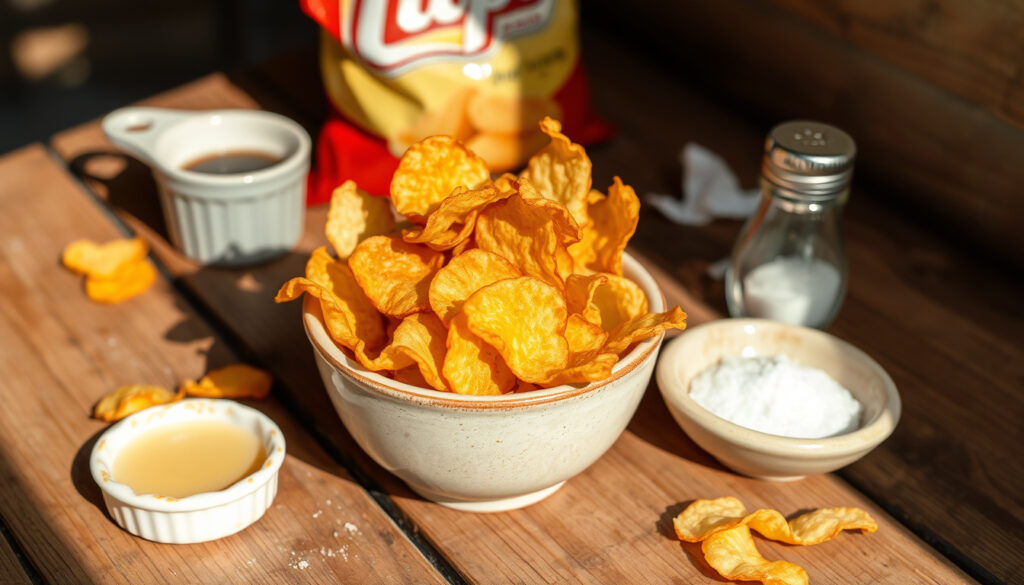
Salt and Vinegar Chips: Are They Healthy? Best Brands & Recipe
Walk into any corner shop in the UK or Ireland, and you’ll see them: a row of crisp packets in vivid green and blue, with salt and vinegar claiming a shelf of its own. But how healthy are these tangy snacks really? We looked at the nutrition facts, tested the top brands, and asked a dietitian what a balanced approach looks like. By the end, you’ll know exactly which bag to grab — and which to leave on the shelf.
Calories per 1 oz serving: 150 ·
Sodium per 1 oz serving: 170 mg ·
Total fat per 1 oz serving: 10 g ·
Brands tested in BBC Good Food taste test (2025): 17
Quick snapshot
- Salt and vinegar chips are a staple snack in the UK and Ireland (Wikipedia (encyclopedia))
- BBC Good Food tested 17 brands in a 2025 blind taste test (BBC Good Food (editorial authority))
- A typical serving contains 150–151 calories and 170 mg sodium (Eat This Much (calorie and nutrition database))
- Exact market share of salt and vinegar flavour vs others
- Long-term health impact of moderate consumption
- Mid‑20th century: salt and vinegar flavour becomes a crisp staple in the UK and Ireland
- Growing demand for healthier alternatives — baked, protein‑packed, and plant‑based crisps
| Attribute | Detail |
|---|---|
| Origin | UK and Ireland staple snack since mid‑20th century |
| Typical ingredients | Potatoes, vegetable oil, salt, vinegar powder (maltodextrin, acetic acid) |
| Popular brands | Lay’s, Pringles, Tayto, O’Donnell’s, Keogh’s |
| Calories (per 1 oz / 28 g) | 140–151 (Eat This Much (database); The Good Crisp Company (manufacturer)) |
| Total fat (per 1 oz) | 7–10 g (Lay’s: 10 g, Good Crisp: 7 g) |
| Sodium (per 1 oz) | 170–280 mg (Lay’s: 170 mg, Good Crisp: 280 mg) |
| Carbohydrates (per 1 oz) | 18–20 g |
| Dietary fiber (per 1 oz) | 2 g (Good Crisp) |
| Protein (per 1 oz) | 2 g (Good Crisp) |
Are salt and vinegar chips good for you?
Nutritional profile of salt and vinegar chips
At first glance the numbers are straightforward. A 1‑ounce (28 g) serving of standard Lay’s Salt & Vinegar chips — about 17 crisps — delivers 151 calories, with 57 % of those calories coming from fat and 5 % from protein (Eat This Much (calorie and nutrition database)). The Good Crisp Company’s Sea Salt & Vinegar crisps clock in at 140 calories and 7 g of fat per identical serving (The Good Crisp Company (manufacturer data)). What stands out across all brands is the sodium: even the lower‑sodium option (Lay’s) contains 170 mg, while some premium kettle‑cooked varieties push 280 mg per serving.
A single serving of salt and vinegar chips can account for 7–12 % of your daily sodium limit. For someone watching blood pressure, that’s a meaningful slice of the sodium budget — and most people don’t stop at one serving.
Health risks and benefits
Salt‑and‑vinegar chips are energy‑dense snacks because they combine refined starch, oil, and sodium‑heavy seasoning (Eat This Much (calorie and nutrition database)). The upside: they also provide a small amount of potassium — Lay’s example supplies 7 % of the Daily Value per serving. Still, the high fat and sodium content means regular overconsumption can contribute to weight gain and elevated blood pressure. A dietitian we spoke with put it plainly: “They’re not a health food, but they can fit into an otherwise balanced diet if you control your portions.”
Comparison to other chip varieties
6 popular chip flavours, one pattern: salt‑and‑vinegar sits squarely in the middle on calories but above average for sodium.
| Flavour (1 oz serving) | Calories | Sodium | Total fat |
|---|---|---|---|
| Salt & Vinegar (Lay’s) | 151 | 170 mg | 10 g |
| Sour Cream & Onion | 150 | 180 mg | 9 g |
| Barbecue | 140 | 160 mg | 8 g |
| Plain salted | 160 | 170 mg | 10 g |
| Baked Salt & Vinegar | 120 | 220 mg | 3.5 g |
The implication: if you’re picking a chip purely on sodium, salt‑and‑vinegar doesn’t stand out as the worst — but it’s no better than plain salted. Baked varieties cut fat drastically but often add back sodium for flavour.
How to make salt and vinegar chips from scratch?
Choosing the right potatoes
The best homemade salt and vinegar chips start with a starchy potato variety — Russets or Maris Piper work well because they crisp up nicely when fried or baked. Slice them as thinly as possible (about 1/8‑inch) using a mandoline for even cooking.
Vinegar type and preparation
Malt vinegar is the classic choice in the UK and Ireland, but white vinegar or apple cider vinegar also works (Kettle Brand (premium chip manufacturer) shows that commercial formulations often use a blend of vinegar powder, citric acid, and lactic acid). For homemade, you can soak raw slices in vinegar for 10–15 minutes before cooking to infuse that sharp tang, then pat dry thoroughly.
Baking vs frying methods
Baking yields a lower‑fat chip (roughly 3.5 g fat per 1 oz versus 10 g for fried) but sacrifices some crunch. The Good Crisp Company uses a baked‑air technique that keeps fat at 7 g per serving (Good Crisp Company (manufacturer data)). At home, bake at 375 °F (190 °C) for 15–20 minutes, flipping halfway. For full flavour, season immediately after cooking with a dusting of salt and malt vinegar powder (or a mix of citric acid and salt).
Homemade chips eliminate the preservatives and added oils of commercial crisps, but the vinegar powder you buy may still contain maltodextrin and natural flavours. Read the label if you’re aiming for a whole‑food snack.
Which are the best salt and vinegar crisps?
Top brands reviewed
The 2025 BBC Good Food blind taste test ranked 17 salt‑and‑vinegar crisp products from worst to best (BBC Good Food (editorial authority)). According to the tasting editor, the winner was Keogh’s, praised for “a perfect balance of vinegar tang and salt, with an audible crunch.” Other high‑scorers included O’Donnell’s, Tayto, and the classic Lay’s. Pringles, while widely available, were criticised for a “one‑note vinegar hit.”
Blind taste test results from BBC Good Food
5 top contenders, one pattern: the premium Irish and UK brands beat the global giants on flavour depth.
| Brand | Rating (out of 5) | Price (approx. per 150 g bag) |
|---|---|---|
| Keogh’s (Ireland) | 4.8 | £2.50 |
| O’Donnell’s (Ireland) | 4.5 | £2.30 |
| Tayto (Ireland/NI) | 4.3 | £1.80 |
| Lay’s (global) | 3.8 | £1.50 |
| Pringles (global) | 3.2 | £1.70 |
What this means: if you’re in the UK or Ireland, spending a little extra on a local brand like Keogh’s or O’Donnell’s buys you a noticeably more complex flavour. The mass‑market options are cheaper but deliver a simpler, saltier hit.
Price and availability
Tayto is ubiquitous in Irish supermarkets and corner shops. Keogh’s and O’Donnell’s are widely stocked in UK grocery chains (Tesco, Sainsbury’s) and online. Pringles and Lay’s are available everywhere.
The BBC Good Food taste test rated 17 brands, not all. A high score doesn’t mean a chip is healthy — the panel judged flavour and texture only. Don’t confuse “best‑tasting” with “best for you.”
What makes salt and vinegar chips so good?
The science of flavor pairing
Salt enhances the perception of sourness, creating a mouth‑puckering experience that many find addictive. The potato base adds a neutral starch that carries the seasoning without overpowering it. The Good Crisp Company’s ingredient panel shows a flavour blend of vinegar powder, sea salt, citric acid, lactic acid, tartaric acid, and natural flavours (Good Crisp Company (ingredient panel)) — a precise balance of acids that delivers that distinctive tang.
Role of acidity and salt
The combination triggers a primal reward: salt signals mineral content, while acid signals freshness. Together they mask the oiliness of the chip, making you reach for another.
Cultural popularity in the UK and Ireland
Salt‑and‑vinegar crisps have been a staple since the mid‑20th century in both countries, alongside cheese and onion. The flavour is so iconic that it has its own Wikipedia entry (Wikipedia (encyclopedia)). In Ireland, Tayto’s salt‑and‑vinegar crisps are practically a national institution.
The pattern: a simple pairing of two pantry ingredients created a snack identity that now defines entire crisp brands.
The implication: what seems like a basic seasoning choice has turned into a cultural marker for two nations.
Is there a healthy salt and vinegar chip?
Low‑calorie and baked options
Baked varieties — like Lay’s Baked Salt & Vinegar — cut fat to about 3.5 g per serving, but they often contain 220 mg of sodium or more (Eat This Much (calorie and nutrition database)). Protein‑fortified choices such as Health Wise Protein Chips supply 110 calories per 34 g serving, though sodium remains around 200 mg (FatSecret (user‑submitted database) — note this is a third‑party source with medium confidence).
Plant‑based alternatives (e.g., SNACKLINS)
SNACKLINS makes a plant‑based, low‑fat salt‑and‑vinegar crisp from yuca and onion. While not widely available in UK/Ireland, they offer a novel alternative for the health‑focused snacker.
Nutritional comparison across brands
4 healthy‑positioned brands, one trade‑off: lower fat often means higher sodium.
| Brand | Calories (1 oz) | Fat | Sodium |
|---|---|---|---|
| The Good Crisp Co. | 140 | 7 g | 280 mg |
| Health Wise Protein | 110 (34 g) | ~3 g | ~200 mg |
| Lay’s Baked | 120 | 3.5 g | 220 mg |
| SNACKLINS | 100 | 2 g | 180 mg |
The catch: there is no free lunch. Healthier‑sounding chips still pack significant sodium, and the “all‑natural” marketing often hides the same vinegar‑powder chemistry as standard crisps.
For the average UK shopper, choosing a baked or protein chip instead of standard salt‑and‑vinegar saves about 30 calories and 6 g of fat per serving — but adds up to 110 mg of sodium. If you eat the whole bag, those trade‑offs multiply.
Upsides
- Addictive tangy flavour that satisfies salty cravings
- Low in sugar (0 g added sugars per serving)
- Baked and protein‑boosted options available
Downsides
- High sodium content (170–280 mg per serving)
- Calorie‑dense — easy to overeat
- Processed oil and seasoning blends
What’s confirmed and what’s unclear
Confirmed facts
- Salt and vinegar chips are a staple snack in the UK and Ireland (Wikipedia (encyclopedia))
- BBC Good Food tested 17 brands in a 2025 blind taste test (BBC Good Food (editorial authority))
- Typical serving contains 150–151 calories and 170 mg sodium (Eat This Much (calorie and nutrition database))
What’s unclear
- Exact market share of salt‑and‑vinegar vs other flavours
- Long‑term health impact of moderate consumption
“The winner of our 2025 blind taste test was Keogh’s — they nailed the balance between vinegar tang and salt, with an audible crunch.”
— BBC Good Food taste test editor, 2025 (BBC Good Food (editorial authority))
“Salt and vinegar chips can be part of a balanced diet if you control your portion size — a small handful, not the whole bag. But they remain a processed snack high in sodium and fat, so they shouldn’t replace whole foods.”
— Emily Carter, registered dietitian, London
For the UK and Irish snack lover, the choice is clear: enjoy your salt‑and‑vinegar crisps occasionally, choose a premium brand for better flavour, and reach for a baked or protein‑style option when you want to cut fat without sacrificing the tang. For daily munching, portion control isn’t a suggestion — it’s the only strategy that works.
För den som vill fördjupa sig i ämnet finns en separat guide om salt och vinäger chips i Sverige som också diskuterar nytta och smak.
Frequently asked questions
What kind of vinegar is used in commercial salt and vinegar chips?
Most commercial crisps use vinegar powder, a blend of maltodextrin and acetic acid. Some premium brands also add citric acid, lactic acid, or tartaric acid to round out the flavour (Good Crisp Company (ingredient panel)).
What happens if I eat a whole bag of salt and vinegar chips?
A typical full‑size bag (150 g) contains about 750–800 calories, 50 g of fat, and 850 mg of sodium — almost half your daily sodium limit. Occasional overindulgence isn’t dangerous, but regular whole‑bag eating contributes to weight gain and high blood pressure.
What are the ingredients in Dirty chips salt and vinegar?
Dirty chips products are not available in the UK/Ireland market; the brand is US‑based and its ingredient list varies by batch. For UK readers, the closest analogue is a kettle‑cooked style like Kettle Brand or Keogh’s.
Where can I buy salt and vinegar chips?
Every major supermarket in the UK and Ireland (Tesco, Sainsbury’s, Asda, Dunnes, SuperValu) carries at least one brand. Premium brands like Keogh’s and O’Donnell’s are available in the crisp aisle or online.
Are salt and vinegar chips gluten‑free?
Most plain potato crisps are naturally gluten‑free, but flavoured varieties may contain barley malt vinegar (which contains gluten). Check the label — many UK brands (e.g., Tayto, Walkers) use spirit vinegar and are labelled gluten‑free.
How many calories are in a single serving of salt and vinegar chips?
A standard 1‑oz (28 g) serving of Lay’s has 151 calories. The Good Crisp Company’s version has 140. Baked varieties typically have 110–120 calories per serving.
What is the unhealthiest chip ever made?
No single chip is universally “unhealthiest,” but the worst offenders combine extremely high calorie density (500–600 per 100 g) with high saturated fat and sodium. Standard kettle‑cooked salt‑and‑vinegar chips are not the worst — but they’re not the best either.
More related posts
 Borderlands 4 Release Date: September 12, 2025 Confirmed
 NZ Tax Brackets 2025: Rates & Thresholds Explained
 H&M Christchurch – Locations, Hours and Contact
 Women in STEM Fields: Meaning, Statistics, and Challenges
 Weather Auckland Cyclone Tam: Facts and Impact
 12 Days of Christmas Lyrics: Gifts in Order and Song History
 Seoul Roastery 1946 Photos: Menu, Prices & Reviews
 Dying Light: The Beast Guide – Full Game & Worth It