How Long Do Eggs Last in the Fridge? Safe Storage Times
If you’ve ever stared at a carton of eggs wondering if they’re still safe to crack, the USDA says raw shell eggs can be safely refrigerated for 3 to 5 weeks beyond the pack date—provided the fridge is at 40°F (4°C) or below. This guide separates fact from myth, covering storage durations, freshness tests, and label meanings.
Raw eggs in shell: 4 to 5 weeks beyond pack date · Hard-boiled eggs: Up to 1 week · Cooked egg dishes: 3 to 4 days · Optimal fridge temp: 35°F to 40°F (1.7°C to 4.4°C)
Quick snapshot
- Raw shell eggs last 4–5 weeks in fridge when stored at 40°F or below (USDA)
- Hard-boiled eggs should be used within 1 week after cooking (FDA Refrigerator & Freezer Storage Chart)
- Check the water float test or sniff test before using older eggs (CNET)
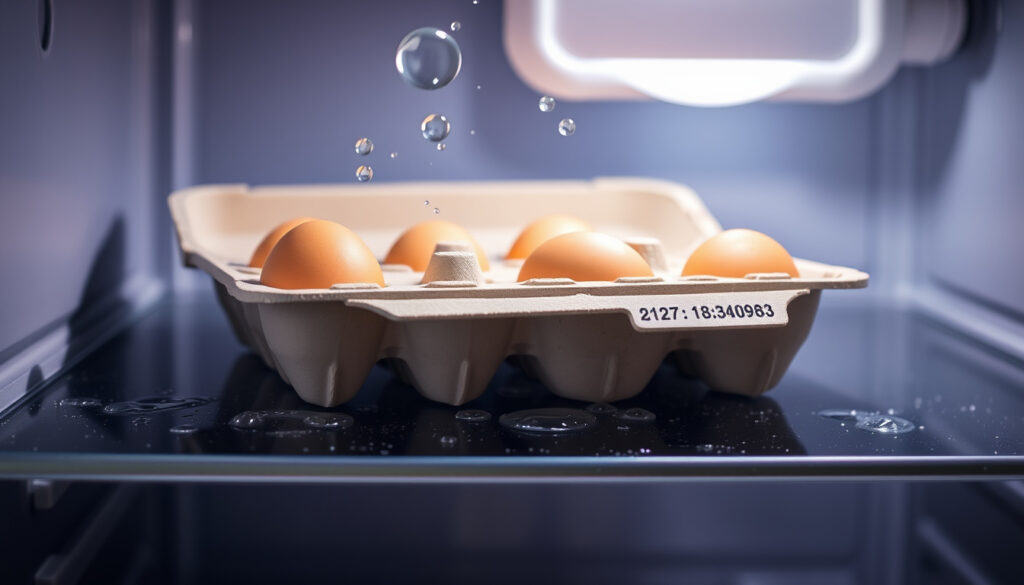
- Store eggs in original carton on a shelf, not the door (FDA general food safety)
- When in doubt, cook eggs thoroughly to firm yolks and whites (FDA)
Five key numbers summarise the shelf life of eggs in your fridge, from raw whole eggs to cooked dishes.
| Food item | Maximum fridge storage time | Source |
|---|---|---|
| Raw shell eggs | 4–5 weeks beyond pack date | USDA |
| Hard-boiled eggs | Up to 1 week | FDA Storage Chart |
| Cooked egg dishes (scrambled, fried) | 3–4 days | FDA Storage Chart |
| Egg whites/yolks separated | Up to 4 days | USDA |
| Cracked eggs (transferred to sealed container) | Use within 2 days | USDA |
How Long Do Eggs Last in the Fridge?
Raw eggs in shell
- USDA guidance says raw shell eggs are usable within 3–5 weeks when the refrigerator is at 40°F (4°C) or below (USDA Egg & Egg Product Safety).
- For best quality, the FDA recommends using refrigerated shell eggs within 3 weeks (U.S. Food and Drug Administration).
- After 5 weeks, the risk of quality loss increases, but properly stored eggs are still safe if no signs of spoilage are present.
Hard-boiled eggs
- Hard-cooked eggs should be refrigerated within 2 hours of cooking and used within 1 week (FDA Refrigerator & Freezer Storage Chart).
- Peel them only when ready to eat, as the shell protects against bacteria.
Cooked egg dishes
- Scrambled eggs, omelets, and quiches should be refrigerated in airtight containers and eaten within 3–4 days (FDA).
- The same rule applies to any egg-containing leftovers.
For most home cooks, the 4–5 week window for raw eggs is generous—but once you cook them, the clock ticks faster. Hard-boiled eggs lose quality after a week; cooked dishes after four days.
The pattern: raw eggs last longer than you might think, but cooking shortens the clock significantly.
How Can You Tell If Eggs Have Gone Bad?
The water test
- The float test is a quick indicator of age: an egg that sinks in a bowl of water is fresh; one that stands on its end is older; one that floats is very old (CNET).
- However, a floating egg may still be safe to eat if it has no odor or discoloration after cracking (CNET).
Sniff test
- A strong sulfur (rotten‑egg) smell after cracking is a sure sign to discard the egg (CNET).
- Always crack an egg into a separate container before adding it to a recipe so you can check for off-odors.
Visual inspection
- Look for unusual pink, green, or iridescent discoloration in the yolk or white—these can indicate spoilage or bacterial growth (CNET).
- If the egg white is unusually runny or the yolk breaks easily, the egg is likely past its prime but may still be safe if it passes the sniff test.
The float test reveals age, not safety. A very old egg that floats might still be edible—but cracking and sniffing is the only way to be sure.
What this means: relying solely on the float test can be misleading—always confirm with your nose.
What Is the 5 5 5 Rule for Eggs?
Origin of the rule
- The “5‑5‑5 rule” is a popular method for making perfect hard-boiled eggs: 5 minutes in boiling water, 5 minutes in cold (ice) water, then 5 minutes of rest before peeling.
- It originated in food blogs and cooking communities as a simple, repeatable technique.
How to apply
- Place eggs in a saucepan, cover with cold water, bring to a rolling boil, then cover and remove from heat for 5 minutes.
- Transfer to an ice bath for exactly 5 minutes, then let them sit for 5 more minutes before peeling.
- The result is a yolk that is fully cooked but still tender, without a green ring.
The 5‑5‑5 rule is about texture, not food safety. As long as eggs are cooked to a firm yolk and white (160°F internal), they’re safe—the rule just refines the timing.
The implication: this method prioritizes texture over safety, but both are achievable with proper cooking.
Can You Eat Eggs After the Expiration Date?
Understanding sell-by and expiration dates
- “Sell‑by” dates are for retailers, not consumers. Eggs can be safe weeks past the sell-by date if stored continuously at 40°F (FDA).
- “Use by” or “expiration” dates are more conservative but still not safety deadlines. USDA states eggs may be refrigerated 3–5 weeks beyond the pack date (USDA).
Safety guidelines
- After the “use by” date, check freshness with the sniff test and the water test before using.
- If eggs have been left out of the refrigerator for more than 2 hours (or 1 hour if it’s over 90°F), discard them regardless of date (FDA general food safety).
- When in doubt, cook eggs thoroughly—heat kills Salmonella, which can be present even in fresh, clean eggs (FDA).
Eating eggs after the expiration date is often safe, but quality declines. The trade-off: you extend shelf life, but you must be diligent about sensory checks.
The catch: dates are guidelines, not guarantees—trust your senses more than the carton.
How Should You Store Eggs for Maximum Freshness?
Fridge temperature
- Set your refrigerator to 40°F (4°C) or below. Warmer temperatures accelerate bacterial growth (FDA food safety guidelines).
- Use a refrigerator thermometer to verify; the built-in dial may be inaccurate.
Original carton vs. egg tray
- Keep eggs in their original carton. It protects against moisture loss, odor absorption, and temperature fluctuations (FDA egg safety).
- Store them on a middle shelf, not in the door—the door experiences more temperature swings.
Avoid washing
- Do not wash eggs before storage. Washing removes the natural protective cuticle and can increase the risk of contamination (USDA Agricultural Research Service).
- If an egg cracks during transport, transfer it to a clean covered container and use within 2 days (USDA).
Most fridge doors are the warmest spot. Moving your egg carton to a shelf can extend usable life by a week or more—a simple change with real impact.
What this means: proper storage is the easiest way to maximize egg shelf life without extra effort.
For more on food storage, see our guide on How Long Does Cooked Chicken Last in Fridge.
Advantages and Risks of Egg Storage
Upsides
- Proper storage keeps eggs safe for weeks past the date on the carton.
- Raw eggs in shell are the longest-lasting egg form—low maintenance.
- Freezing eggs (beaten or separated) extends shelf life even further.
- Simple freshness tests let you verify quality without waste.
Downsides
- Hard-boiled eggs spoil quickly—only 1 week.
- Cooked egg dishes have a short 3–4 day window.
- Temperature abuse (warm fridge, door storage) shortens shelf life unpredictably.
- Salmonella risk exists even in fresh, clean eggs.
The pattern: raw eggs are forgiving; cooked eggs demand vigilance.
How to Test Egg Freshness Step by Step
- Fill a bowl or glass with cold tap water.
- Gently place the egg into the water.
- Observe: if it sinks and lies flat, it’s very fresh. If it stands upright on the bottom, it’s older but still usable. If it floats, crack it into a separate bowl and sniff before using (CNET).
- If the egg floats, crack it into a clean bowl. Smell immediately for any sulfur odor and look for unusual discoloration.
- If the egg passes the sniff and visual test, it is likely safe to cook and eat.
The water test is a quick quality guesstimate, but the sniff test is the only reliable safety check.
The implication: combine both tests for confidence—don’t rely on one alone.
Egg Shelf Life Timeline
- 0–3 weeks from pack date: Optimal freshness for raw shell eggs (FDA).
- 4–5 weeks: Still safe if stored continuously at 40°F or below (USDA).
- Over 5 weeks: Increased risk of quality loss—test before eating (CNET).
- 2+ months: Discard for safety regardless of appearance.
The catch: beyond 5 weeks, even a fresh-looking egg can be risky—use sensory checks.
Check out our Quick and Easy Meals for recipe ideas using eggs.
What We Know vs. What’s Still Unclear
Confirmed facts
- Raw shell eggs last 4–5 weeks in fridge at proper temperature (USDA).
- Hard-boiled eggs last 1 week in the fridge (FDA).
What’s still unclear
- Whether eggs stored beyond 5 weeks are always safe even if they pass sensory tests.
- How effective the float test is as a safety indicator vs. a freshness indicator.
What this means: science has firm numbers, but individual egg behavior varies—stay cautious.
What Experts Say
Eggs can be kept in the refrigerator for 3 to 5 weeks beyond the pack date as long as they are stored properly.
— USDA Egg & Egg Product Safety (U.S. government food safety authority)
Hard‑boiled eggs should be refrigerated within 2 hours and used within 1 week.
— FDA Refrigerator & Freezer Storage Chart (U.S. food safety regulator)
For home cooks, the takeaway is clear: trust your fridge temperature, keep eggs in their carton, and always do the sniff test before cooking. Ignoring these steps could mean wasting good eggs—or worse, risking foodborne illness. The choice is simple: store wisely, test honestly.
Frequently asked questions
Will eggs last 2 months in the fridge?
Can I eat eggs after 6 months in the fridge?
Are 4 month old eggs safe to eat?
Can I eat 2 week old hard-boiled eggs?
What happens if you hard boil an egg for 30 minutes?
Is it safe to eat boiled eggs every day?
More related posts
 $100 USD to NZD: Live Exchange Rate & Converter Today
 04 Area Code NZ: Wellington Landline & ANZ Bank Prefix
 My Food Bag NZ: Pricing, Menu & Cancellation Guide
 285/75R16 in Inches: Tire Size, 33 Equivalent & 265 Comparison
 Tova O’Brien TVNZ Breakfast: New Co-Host, Career & Personal Life
 A Good Girl’s Guide to Murder: Book vs. TV Guide
 Is the Warehouse Open Today? Hours, Membership & Cancellation
 How to Glaze Donuts: Easy Recipes & Science Tips