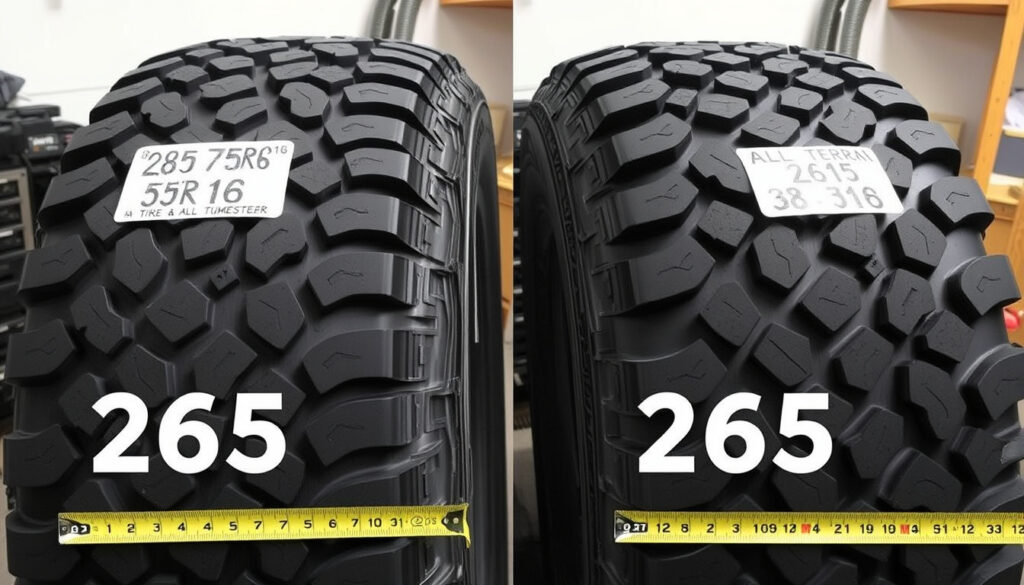
285/75R16 in Inches: Tire Size, 33 Equivalent & 265 Comparison
Anyone who has squinted at a tire sidewall and wondered what the numbers mean has landed here for the same reason: 285/75R16 looks like math homework, but it’s a 33-inch tire with a specific footprint. The code breaks down simply — 285 mm wide, 75 percent aspect ratio, 16-inch rim — and those inch measurements decide whether it fits your truck and what it does to your speedometer.
Overall diameter: 33 in ·
Section width: 11.6 in ·
Rim diameter: 16 in ·
Revolutions per mile: ≈630 ·
Typical weight: 55 lbs ·
Max load (single/dual): 3,750 / 3,415 lbs
Quick snapshot
- 285/75R16 diameter: 32.83 in — why it’s sold as a 33 (TireWheelGuide tire size calculator)
- Approved rim width 7.5–9.0 in; max load 3,750 lb at 80 psi (Cooper Tire manufacturer spec)
- Exact mpg loss varies by truck, gearing, and driving mix
- Optimal tire pressure depends on the vehicle placard and load
- Stock-suspension fitment depends on the specific truck and trim
- Speedometer offset starts the moment 285s replace the tires the truck was calibrated for
- Every mile logged stays slightly short until the truck’s computer is reprogrammed
- Verify your current wheel width — 7.5 in is the approved minimum (Toyo Tires load-inflation guidance)
- Compare your truck’s stock tire size before ordering (Toyo Tires load-inflation guidance)
- Match inflation to load with your tire maker’s load-inflation table (Toyo Tires load-inflation guidance)
Six specs, one pattern: the 285/75R16 is a 33-inch tire that asks for wider rims and a recalibrated speedometer.
| Specification | 285/75R16 |
|---|---|
| Overall diameter | 33 in (32.83 in calculated) (TireWheelGuide tire size calculator) |
| Section width | 11.6 in |
| Rim diameter | 16 in |
| Revolutions per mile | ≈630 (brand-dependent) |
| Typical weight | 55 lbs |
| Max load (single/dual) | 3,750 / 3,415 lbs (Cooper Tire manufacturer spec) |
Is a 285/75/16 the same as a 33?
Exactly how tall is a 285/75R16 tire?
- Overall diameter: 32.83 in (834 mm)
- Sidewall height: 213.8 mm (8.4 in)
- Circumference: 103.14 in (2,620 mm)
The math behind those numbers is simple. A 285/75R16 has a 285 mm section width, and the “75” means the sidewall is 75 percent of that width — 213.75 mm. Two sidewalls (427.5 mm) plus the 16-inch rim (406.4 mm) give a total diameter of 833.9 mm, or 32.83 inches.
When a tire shop calls a 285/75R16 a “33,” the rounding works in your favor: 32.83 in is close enough that fitment charts treat the two as the same size.
The same calculation explains the whole size code. The 285 is the nominal width in mm, the 75 is the aspect ratio (sidewall height as a percentage of width), and the 16 is the wheel diameter in inches. With those three inputs, every other measurement — sidewall, circumference, overall height — is arithmetic.
How does it compare to a 33-inch tire?
- Calculated diameter: 32.83 in (834 mm)
- Different brands’ 33-inch tires can vary by a few tenths of an inch depending on tread and construction
- For clearance checks, use the spec-sheet diameter, not the marketing label
In practical terms, yes: a 285/75R16 is a 33-inch tire. When a truck owner says “33s on 16s,” this is the metric size that answers that description, and the two labels are used interchangeably in fitment guides and lift-kit charts.
The catch: when the question is “will 33s clear my suspension?”, the number underneath the label — 32.83 inches — is the one to check against your truck, not the rounded-up name.
What is a 285/75 tire equivalent to?
285/75R16 dimensions in inches
- Diameter: 32.83 in (834 mm)
- Section width: ~11.2 in nominal (285 mm); 11.6 in on many spec sheets
- Sidewall: 8.4 in (213.8 mm)
Ten rows, one pattern: height, width, and circumference define the tire, while load, pressure, and rim width define its limits.
| Specification | 285/75R16 value |
|---|---|
| Overall diameter | 32.83 in (834 mm) |
| Section width (nominal) | 285 mm / 11.2 in |
| Section width (typical spec listing) | 11.6 in |
| Sidewall height | 8.4 in (213.8 mm) |
| Circumference | 103.14 in (2,620 mm) |
| Rim diameter | 16 in |
| Revolutions per mile | ≈630 (brand-dependent) |
| Typical weight | ≈55 lbs |
| Max load (LT example) | 3,750 lb at 80 psi |
| Approved rim width | 7.5–9.0 in |
The pattern: those load and rim-width figures come straight from an LT tire spec sheet — a 285/75R16 rated for 3,750 lb at 80 psi is a truck-tire specification, not a car-tire one. That distinction decides whether the tire fits your vehicle’s wheels and weight rating.
Equivalent sizes and metric conversion
- A 33-in tire is about 838 mm in metric; the 285/75R16’s 834 mm is within rounding distance
- The 265/75R16 equivalent: 31.65 in (804 mm) — the next size down in the same family
- Conversion rule: divide mm by 25.4 to get inches (285 ÷ 25.4 = 11.2 in)
So the equivalent answer is simple: the 285/75R16 is a 33-inch tire with roughly an 11.6-inch section width on a 16-inch rim. Pulling “33 inches” out of the metric code is the whole game — every lift-kit chart and fitment forum uses it.
The implication: metric sizing gives precision in mm, while inch sizing gives portability in charts. For the 285/75R16, the translation is 32.83 in — use that number, not the label, for clearance and gearing decisions.
Is a 285 tire taller than a 265?
Side-by-side height comparison
- 285/75R16: 32.83 in diameter (834 mm)
- 265/75R16: 31.65 in diameter (804 mm)
- Difference: 1.18 in, or 3.7% — the number TireWheelGuide’s calculator returns
Yes, the 285 is taller than the 265 — by just over an inch. Because that diameter difference splits between the top and bottom of the tire, the axle sits about 0.6 in higher, which is real ground clearance when the trail gets rough. The 285 is also about 20 mm (0.8 in) wider, so it changes steering feel and brings new rubbing points at full lock.
For fitment, the extra height matters most at the fender and inner-liner edges. A truck that clears a 265/75R16 with an inch to spare can rub a 285 at full compression, which is why clearance checks should happen with the suspension loaded, not just parked on flat ground.
Impact on speedometer accuracy
- Larger circumference (103.14 in vs 99.43 in) means fewer wheel rotations per mile
- On a truck calibrated for 265s, 285s make the speedometer read about 2 mph low at 60 mph
- Odometer and trip-computer mpg readings drift by the same ~3.7%
The speedometer effect is arithmetic, not speculation. When the truck’s computer assumes a 99.43 in circumference, a 103.14 in tire covers more ground per revolution, so the odometer under-counts distance and the speedometer under-reads speed. The “2 mph at 60” example is the same 3.7% the size calculators report for the diameter.
The 3.7% offset assumes the truck’s stock tire was a 265/75R16. If the factory fitment was a different size, the error changes — check the door-jamb placard before assuming the number.
If the offset bothers you, a shop that can program the truck’s tire diameter usually fixes it. Without that step, the drift stays for the life of the tire, and every mile the odometer counts is a little shorter than a real mile.
Which tire is better, 265/75R16 or 285/75R16, and is there a difference in size?
Dimensions comparison table
- Diameter gap: 1.18 in, or 3.7% — the 285 is taller
- Width gap: 20 mm, or about 0.8 in — the 285 is wider
- Circumference gap: 3.71 in — the source of speedometer and gearing changes
Eight rows, one pattern: the 285 gives up fuel economy and fitment simplicity to earn more height, width, and load capacity.
| Specification | 285/75R16 | 265/75R16 |
|---|---|---|
| Overall diameter | 32.83 in (834 mm) (TireWheelGuide tire size calculator) | 31.65 in (804 mm) |
| Diameter vs. the other size | +1.18 in (+3.7%) | baseline |
| Section width | 285 mm / ~11.2 in | 265 mm / ~10.4 in |
| Sidewall height | 213.8 mm / 8.4 in | 198.8 mm / 7.8 in |
| Circumference | 103.14 in (2,620 mm) | 99.43 in (2,526 mm) |
| Example max load (LT version) | 3,750 lb @ 80 psi | 3,415 lb @ 80 psi (E load) (TirePressure.com tire spec database) |
| Approved rim width | 7.5–9.0 in | varies by brand; check the spec sheet |
| Speedometer (if stock size was 265) | reads ~3.7% low | baseline |
The pattern: the last row is the one most buyers forget. The 285 is not just a bigger tire; it’s a different speedometer calibration, a different wheel requirement, and a different fuel bill. The 265 stays closer to a “fits like stock” compromise.
Pros and cons of each size
The 285 is the stronger off-road and load-carrying tire; the 265 is the sharper daily driver. Pick the mission before you pick the size.
Upsides
- 20 mm more width means more traction and a more aggressive stance
- Higher example load capacity: 3,750 lb vs 3,415 lb in common LT versions
- Taller sidewall (213.8 mm vs 198.8 mm) soaks up off-road terrain
Downsides
- Typically costs 1–3 mpg in real-world owner reports
- Speedometer and odometer drift ~3.7% unless recalibrated
- Needs 7.5–9.0 in rims and a real clearance check; stock 7-in wheels are below the approved range
Fuel mileage and handling trade-offs
- Wider footprint and heavier casing add rolling resistance; owner-reported loss is typically 1–3 mpg vs the 265
- The 285’s taller sidewall (213.8 mm) rides more softly over rough terrain than the 265’s 198.8 mm sidewall
- Larger circumference lowers engine rpm at a given road speed, which helps highway cruising but rarely cancels the drag
There is no free lunch in tire sizing. The 285 puts more rubber on the ground per revolution, which helps it bridge ruts and spread load, but every one of those traits adds weight, drag, and heat. On a truck used for towing and off-road work, the mpg penalty is a business cost; on a daily commuter, it’s the number that pushes most buyers back to the 265.
Rim width compatibility
- Approved rim width for the 285/75R16: 7.5–9.0 in, with 8.0 in as the measured reference width
- Mounting on a 7-in rim — common on trucks factory-fitted with 265s — is possible but outside the approved range
- Narrow rims let the sidewall bulge, which dulls steering response and can cause uneven tread wear
Can you put a 285 on a “265 rim”? The honest answer depends on the wheel, not the tire name. If the 265s rode on 16×7 wheels, that width is below the 285’s approved minimum. If they rode on 16×8, you’re inside the range. Check the width stamped on the back of the spokes before ordering anything.
The pattern: every meaningful difference between the two sizes — height, width, load, speedometer, fuel — traces back to the same 1.18 in and 20 mm of extra tire. Decide whether that’s an asset or a liability before you pay for mounting.
What is the best rim width for a 285/75R16 tire?
Factory rim options
- Factory 16-in wheels on trucks typically measure 7.0 or 8.0 in wide; the size is stamped into the wheel
- Cooper’s approved range for the 285/75R16 starts at 7.5 in, so a factory 7.0-in wheel misses the spec
- A factory 16×8 wheel sits inside the approved range and works without modification
The factory-wheel question is really a width question. Trucks that came with 265/75R16 often sit on narrower wheels, and those narrower wheels are exactly the ones the 285’s spec excludes. If the stock wheel is an 8-incher, you’re fine; if it’s a 7-incher, the 285 is mountable but out of the manufacturer’s approved envelope.
Aftermarket rim width recommendations
- Best all-around rim width: 8.0 in — the width Cooper uses for its measured specs
- Approved range: 7.5–9.0 in
- Staying inside the approved range keeps the tread flat, the bead seated, and sidewall stress low
For aftermarket wheels, 16×8 is the sweet spot for most owners. A 16×9 is also approved and firms up steering response at the cost of a harsher ride and more curb-scuff risk. A 16×7.5 sits on the narrow edge and gives a softer feel, but it’s the most sensitive to heavy loads and high inflation pressure.
Can you mount on a 7-inch wide rim?
- Yes, it can physically be mounted, but it is outside the 7.5–9.0 in approved range
- Risks include a bulged sidewall, slower steering response, and uneven tread wear
- On an LT tire designed for 80 psi max inflation, the margin for error on a too-narrow rim shrinks
If a shop agrees to mount 285/75R16 on 7-in rims, ask why they’d ignore the fitment spec. For low-speed, off-road-only use, some owners accept the compromise. For highway speeds, loaded towing, and long tread life, the industry-approved answer stays the same: 7.5 in minimum, 8.0 in ideal.
What’s confirmed, what’s still unclear
Confirmed facts
- 285/75R16 diameter: 32.83 in (834 mm), sold and grouped as a 33-in tire (TireWheelGuide tire size calculator)
- Approved rim width: 7.5–9.0 in, measured on an 8.0-in rim
- Example LT max load: 3,750 lb at 80 psi (load index 126, speed rating Q)
- 265/75R16 diameter: 31.65 in (804 mm) — 1.18 in shorter
What’s unclear
- Exact mpg difference between the two sizes — it varies by truck, gearing, and terrain
- Optimal tire pressure — it depends on the vehicle placard, actual axle loads, and the tire’s load range
- Stock-suspension fitment — some trucks clear without changes; others need a leveling kit or trimming
- Speedometer offset — the 3.7% figure assumes a 265/75R16 baseline, not every factory size
- Published revs-per-mile and weight specs, such as ≈630 and 55 lbs, shift between tire brands
The pattern: the confirmed list is where the calculator and manufacturer agree; the unclear list is where real-world variables — load, truck, terrain — take over. Both lists are part of the same answer.
What the source data says
“285/75R16, load index 126, speed rating Q, max load 3,750 lb, max inflation pressure 80 psi. Measured rim width: 8.0 inches; approved rim width: 7.5 to 9.0 inches.”
“LT265/75R16 is available in load ranges C, D, and E.”
Why these numbers matter: the same tire size carries different load ratings and rim requirements across brands, so the spec sheet — not the marketing name — is the final authority for fitment.
For a truck owner weighing 265/75R16 against 285/75R16, the decision is a straight trade: the 285 provides 1.18 in more diameter, about 20 mm more width, and a stronger load rating, but it also asks for a 7.5–9.0 in rim, costs owner-reported fuel economy (often 1–3 mpg), and shifts the speedometer by nearly 4 percent unless recalibrated. The 265 is the lower-risk default for daily driving; the 285 is the pick when ground clearance, load capacity, and off-road presence win the priority list. For the daily-driven pickup owner, the choice is clear: stick with the 265s to keep the speedometer and fuel bills honest, or move to the 285s and budget for recalibration, a possible leveling kit, and a careful fitment check — because on a 16-inch rim, a 33-inch tire is a commitment, not an accessory.
mm.lv, mm.lv, walmart.com, simpletire.com, simpletire.com, customwheeloffset.com
Frequently asked questions
What is the height of a 285/75R16 tire?
A 285/75R16 is 32.83 inches (834 mm) tall on the calculator, which is why it is sold and grouped as a 33-inch tire. The height comes from the metric code: 285 mm width, 75 aspect ratio, and a 16-inch rim.
Can I run 285/75R16 on stock suspension?
It depends on the truck. At roughly 32.83 inches tall and 11.2–11.6 inches wide, the 285 clears some trucks with zero changes and rubs on others at full lock or over bumps. Measure the tight spots with the suspension loaded; trucks with a leveling kit or lift simply have more margin.
What is the difference in load capacity between 265 and 285?
In LT versions, a 285/75R16 example carries about 3,750 lb at 80 psi, while an LT265/75R16 E-load carries about 3,415 lb at 80 psi. According to TirePressure.com tire spec database, the 265 is offered in load ranges C, D, and E; SimpleTire tire retailer catalog shows E-load 265s at load index 123/120, and Custom Wheel Offset fitment listing lists a Nitto Ridge Grappler LT265/75R16 at 3,415 lb and 80 psi.
What happens if I mount 285/75R16 on a 7-inch wheel?
It can be mounted, but Cooper’s approved rim width for the 285/75R16 starts at 7.5 inches, so a 7.0-inch wheel is below spec. Expect a bulged sidewall, duller steering response, and a higher risk of uneven wear.
How much fuel economy will I lose going from 265 to 285?
Owner reports typically put the penalty at 1–3 mpg, though the number depends on gearing, terrain, and driving mix. The wider 285 footprint and heavier casing add rolling resistance, and the larger circumference lowers highway rpm without canceling the drag.
What is the recommended tire pressure for 285/75R16 on a pickup truck?
Most pickup applications land between 35 and 45 psi, but the right number comes from the vehicle’s placard, the actual axle load, and the tire’s load range. An LT285 example lists 80 psi as max inflation; Toyo Tires load-inflation guidance explains how pressure should rise with added weight.
Is a 285/75R16 best on an 8-inch rim?
For most owners, yes. Cooper’s data lists 8.0 inches as the measured rim width, with 7.5–9.0 inches approved. The 8.0-inch middle ground balances steering response, ride comfort, and even tread wear.
Related reading
More related posts
 Salt and Vinegar Chips: Are They Healthy? Best Brands & Recipe
 When Do Babies Start Smiling? Timeline, 3-6-9 Rule & Signs
 How to Divide Fractions: Step-by-Step Guide with Examples
 Minister of Education NZ: Current Role, Contact, and History
 Briscoes Sales This Weekend: Deals, Promo Codes & Free Delivery
 Stolen Girlfriends Club Hoodie: Meaning, Materials, and Where to Buy
 DJI Mini 5 Pro: Price, Specs & Mini 4 Pro Comparison
 Bed Bath N’ Table Australia: Stores, Clearance & Sale Guide