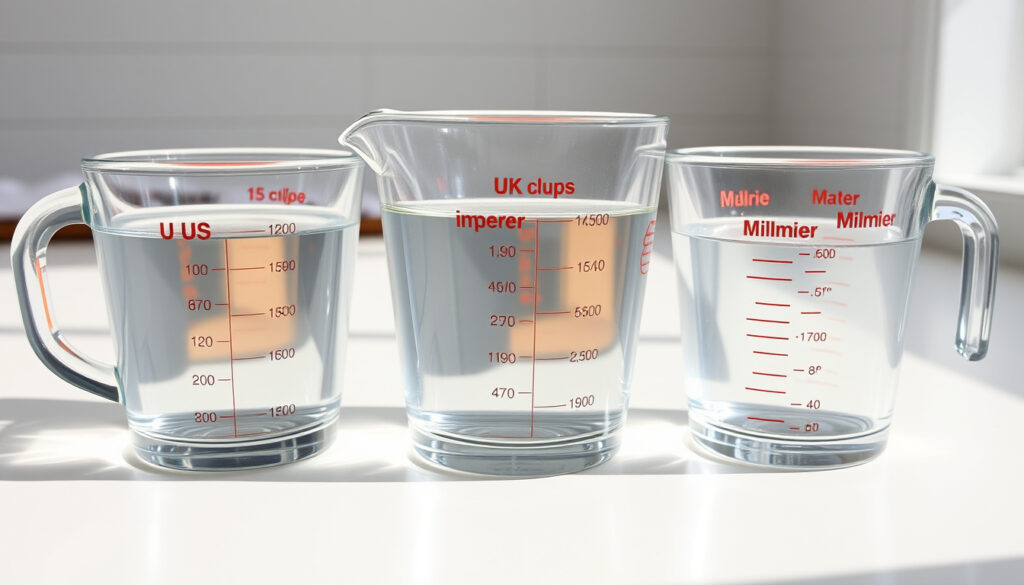
How Many mL in a Cup? US, UK, and Metric Conversions
You’ve found a recipe you’re excited to try, but the ingredients list calls for “1 cup” of something. The catch: not all cups hold the same amount — the US standard cup holds 237 ml, while many other countries use a 250 ml metric cup, and older UK recipes might refer to a 284 ml imperial cup, and understanding these differences can save your dish from turning out too dry or too runny.
US cup (liquid): 237 ml ·
UK imperial cup: 284 ml ·
Metric cup: 250 ml ·
Japanese cup: 200 ml
Quick snapshot
- 237 ml (UnitConverters.net)
- 8 fl oz (UnitConverters.net)
- Used in US recipes (UnitConverters.net)
- 284 ml (AGA Living)
- 10 fl oz (AGA Living)
- Historical, now rare (AGA Living)
- 250 ml (UnitConverters.net)
- Used in Australia, NZ, Canada (UnitConverters.net)
- Common in modern cookbooks (UnitConverters.net)
The following table summarizes the exact milliliter equivalents for each cup definition.
| Label | Value |
|---|---|
| US Customary Cup | 237 ml |
| UK Imperial Cup | 284 ml |
| Metric Cup | 250 ml |
| US half cup | 118 ml |
| US quarter cup | 59 ml |
How many milliliters are in a cup?
US customary cup: 237 ml
The US customary cup is defined as 8 US fluid ounces, which equals exactly 236.5882365 milliliters (NIST Handbook 44). Most recipes and measuring cups round this to 237 ml. This standard applies to both liquid and dry ingredients in American recipes.
Fluid ounces equivalent: 8 fl oz
One US cup equals 8 US fluid ounces (NIST Handbook 44). That also means 16 tablespoons or 48 teaspoons. The US cup is the default in all American cookbooks and food labels.
The implication: if a recipe says “1 cup” and was published in the US, you can confidently measure 237 ml.
Is 1 cup equal to 250 mL?
Metric cup definition: 250 ml
Many countries use a metric cup of 250 milliliters (UnitConverters.net). It’s the standard in Australia, New Zealand, Canada, and much of Europe for home cooking.
Countries using the metric cup
Australia, New Zealand, Canada (alongside the US cup), South Africa, and many metricated nations. Confusion arises because some measuring cups are sold with both 237 ml and 250 ml markings, but the intended use depends on the recipe origin.
The catch: if the recipe doesn’t specify origin, assume 237 ml for US-style recipes and 250 ml for everything else.
What is 1 cup in mL in the UK?
Traditional UK imperial cup: 284 ml (10 fl oz)
Historically, a UK cup was based on the imperial pint (20 oz), making one cup 284 ml (10 imperial fluid ounces) (AGA Living conversion guide).
Modern UK metric cup: 250 ml
Today, most UK cookbooks and brands like Nigella.com use a 250 ml cup. The shift from imperial to metric means old recipes may reference 284 ml, while new ones use 250 ml. Always check the recipe’s notes or the measuring cup itself.
The pattern: UK recipes are in transition, so verifying the intended cup size is essential.
Is a cup 200ml or 250ml?
Japanese cup: 200 ml
Japan defines a cup as 200 milliliters (based on the traditional ‘gō’ unit). Some Latin American countries also use 200 ml cups.
When a recipe calls for a ‘cup’ in Japan or older cookbooks
If you are using a Japanese cookbook or an older European recipe, the cup may mean 200 ml. For modern standard international recipes, 250 ml is the safe default.
What this means: the same “1 cup” instruction can vary by up to 84 ml depending on the regional definition – enough to change a batter from runny to thick.
A home baker following a US recipe with a UK metric cup will add 13 ml extra liquid per cup. Scale that to a 4-cup cake, and the batter becomes noticeably thinner.
Four cup definitions, one pattern: the region determines the volume. Here’s how they stack up side by side.
| Cup type | Volume (ml) | Fluid ounces | Primary region |
|---|---|---|---|
| US customary | 237 | 8 US fl oz | United States |
| UK imperial | 284 | 10 imperial fl oz | United Kingdom (historic) |
| Metric | 250 | 8.8 US fl oz | Australia, NZ, Canada, Europe |
| Japanese | 200 | 7 US fl oz | Japan, some Latin America |
How to measure 1 cup?
- Use a clear measuring cup with a spout and measurement lines for liquids.
- Place the cup on a flat surface and check at eye level.
- Pour to the line without lifting – the meniscus should touch the line.
- For dry ingredients, use stackable metal or plastic cups that fill to the brim. Spoon the ingredient into the cup (don’t scoop) and level off with a straight edge.
- Never use a dry cup for liquids; the different calibration causes inaccuracy.
Using a liquid measuring cup
For liquids, always use a clear measuring cup with a spout and measurement lines. Place it on a flat surface and check at eye level. Pour to the line without lifting the cup – the meniscus (curved surface) should touch the line.
Using dry measuring cups
For dry ingredients (flour, sugar, oats), use stackable metal or plastic cups that fill to the brim. Spoon the ingredient into the cup (don’t scoop) and level off the top with a straight edge (Nigella.com warns that scooping compacts flour, adding extra weight).
Why you should not use dry cups for liquids
Dry measuring cups are not calibrated for the meniscus. Pouring liquid into a dry cup usually results in overfilling or inaccurate amounts. Stick to liquid cups for any pourable ingredient.
The trade-off: using the wrong type of cup can skew your measurement by 5-10%, which in baking meaningfully changes texture (Exploratorium cooking lab).
Clarity check: What we know and what’s still fuzzy
Confirmed facts
- US cup = 237 ml (based on NIST Handbook 44)
- Imperial cup = 284 ml (UK legal definition until metrication, per AGA Living)
What’s unclear
- Whether modern UK recipes use imperial or metric cups – it depends on the publisher. Check the recipe’s notes or the nutritional panel on packaged foods.
- The exact definition of a metric cup – while often given as 250 ml (UnitConverters.net), the source is a conversion tool not a standards body, so verify with local guidelines.
- Japanese cup volume – traditionally 200 ml, but lacks a widely cited official source; treat as approximate.
The implication: without a clear standard, region and recipe origin are the best guides
Quotes from trusted sources
“The US customary cup, as defined in NIST Handbook 44, equals exactly 236.5882365 milliliters.”
“For baking, it may help to remove 2 teaspoons from each cup measure when converting from UK to US measures – flour can vary depending on whether you scoop or spoon and level.”
“In Britain, one pint holds 20 ounces; in North America, one pint holds 16 ounces. A UK 1/4 pint (5 oz / 150 ml) converts to about 2/3 cup in North America.”
AGA Living (kitchen appliance brand with conversion guides)
Why this matters
The next time a recipe says “1 cup,” pause and consider where that recipe came from. Using the wrong cup definition can throw off ratios by more than 15%. For home cooks in the US following an Australian blog, the metric cup (250 ml) adds 13 ml per cup – enough to turn a crisp cookie dough into a spread. For anyone converting an old family recipe from the UK, the imperial cup (284 ml) adds 47 ml per cup, which can ruin a delicate cake. Always match your measuring tool to the recipe’s origin, and when in doubt, use a digital scale for the most accurate result.
For a detailed breakdown of the differences between national standards, see our companion guide on US, UK, and metric equivalents.
Frequently asked questions
How many mls in a cup of water?
A US cup of water is 237 ml. A metric cup is 250 ml. Use the cup type that matches your recipe origin.
How many mls in a cup of milk?
Same volume as water: 237 ml for US, 250 ml for metric. Milk density is close to water, so no conversion adjustment needed.
How many mls in a cup of oil?
Again, same volume. 1 US cup of oil = 237 ml. Be careful with viscous oils – use a liquid measuring cup for accuracy.
How many ounces are in a cup?
A US cup holds 8 US fluid ounces. A UK imperial cup holds 10 imperial fluid ounces. A metric cup holds 8.8 US fluid ounces.
1 cup to grams?
There is no single conversion – it depends on the ingredient. 1 cup of all-purpose flour weighs about 120 g (spooned and leveled), while 1 cup of granulated sugar weighs 200 g. Use a kitchen scale for reliable results (Nigella.com notes there is no standard weight per cup because ingredients pack differently).
Is a dry measuring cup the same as a liquid measuring cup?
No. Dry cups are designed to be filled to the brim and leveled. Liquid cups have extra room above the line to prevent spills. Using the wrong type leads to inaccuracy.
What is a legal cup in the US?
The US legal cup, used for nutrition labeling, is defined as 240 ml. This differs from the customary cup (237 ml) used in recipes.
Related reading
More related posts
 Star Signs in Order: 12 Zodiac Signs List with Dates
 Alcaraz Wins 2026 Australian Open Results Over Djokovic
 230 USD to NZD – Live Rate, Trends and Conversion Guide
 Houses for Sale Papamoa: 2025 Buyer’s Guide & Listings
 Job Job Job Sahur: Meaning, Ritual & How to Get It in Steal a Brainrot
 Red Magic 10 Pro Review: Gaming Beast With Trade-Offs
 Only Organic Baby Food: Reviews & Is It Best for Babies?
 The Summer I Turned Pretty Season 3 Episode 8: Recap & Ending