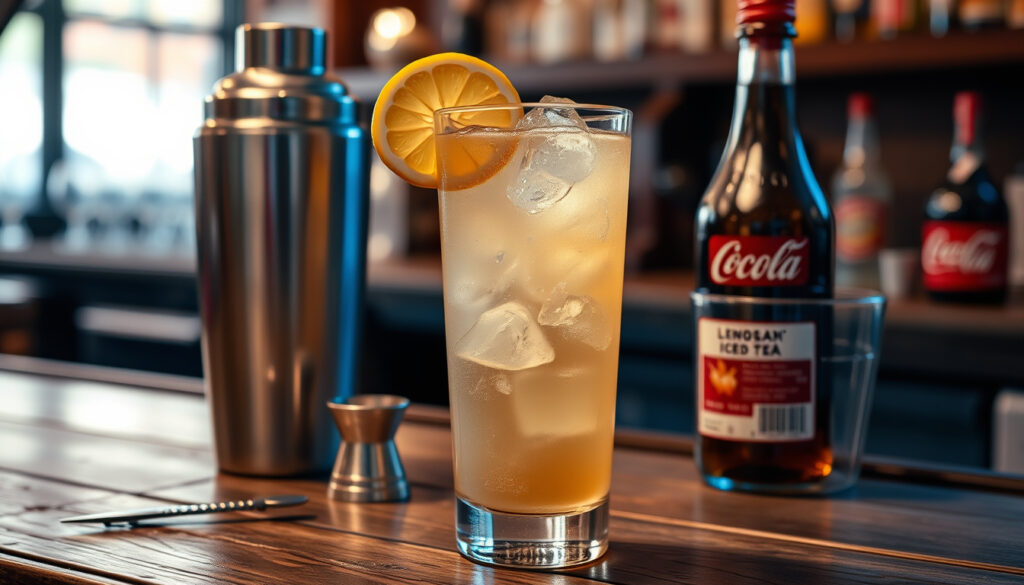
Long Island Iced Tea Guide: Recipe, ABV, and History
There’s a moment at almost every bar when someone orders a Long Island Iced Tea and the person next to them does a double take. The drink looks and tastes like iced tea while quietly carrying five different spirits — vodka, tequila, white rum, gin, and orange liqueur — in one glass. The official International Bartenders Association (official cocktail standards body) recipe calls for 15 ml of each spirit, which is why one round can end the conversation faster than anyone expects.
Typical ABV: ~22%, commonly cited but variable ·
Spirits in the glass: 5 (Food Network (cooking media site)) ·
IBA official: Yes, since the 2000s (IBA (standards body))
Quick snapshot
- The core formula is five spirits: vodka, tequila, white rum, gin, and orange liqueur, plus lemon and cola (Food Network (cooking media site)).
- There is no tea in the drink — the color comes entirely from a splash of cola. (Food Network (cooking media site))
- Who invented it first: a Prohibition-era Tennessee story competes with the 1970s Long Island claim (Epicurious (recipe publisher)).
- The true ABV of any single glass: pour size, cola volume, ice melt, and glass size all change the number (Difford’s Guide (specialist cocktail reference)).
- 1970s: Robert “Rosebud” Butt is credited with creating the drink at the Oak Beach Inn on Long Island (Wine Enthusiast (drinks media)).
- 2000s: the IBA adopts an official recipe, turning a bar stunt into a listed classic. (Wine Enthusiast (drinks media))
- Canned Long Islands already span 13.2% to 21% ABV, so the drink’s strength is now a product decision, not just a bartender’s (Wine Enthusiast (drinks media)).
- Expect the “typical” 22% figure to keep varying as recipes and ready-to-drink brands multiply (Difford’s Guide (specialist cocktail reference)).
Five spirits, one deceptive color, and a wider spread of numbers than most people expect — here is the drink’s profile at a glance.
| Attribute | Detail | Source |
|---|---|---|
| Name | Long Island Iced Tea | — |
| Type | Mixed drink (cocktail) | — |
| ABV | About 22%, commonly cited | Wikipedia (community-maintained reference) |
| Origin | Long Island, New York, 1970s (contested) | Epicurious (recipe publisher) |
| IBA status | Official cocktail since the 2000s | IBA (standards body) |
| IBA spirits | 15 ml each: vodka, tequila, white rum, gin, Cointreau | IBA (standards body) |
| Alcohol before mixers (IBA) | 75 ml | IBA (standards body) |
| Pure alcohol per IBA pour | Roughly 30 ml before dilution | IBA (standards body) |
| Difford’s Guide calculated ABV | 11.56% (its own recipe) | Difford’s Guide (specialist cocktail reference) |
| Canned versions | 13.2% to 21% ABV | Wine Enthusiast (drinks media) |
What is the Long Island Iced Tea made of?
Strip away the name and this is a five-spirit cocktail built to taste much milder than it actually is. The recipes that claim the name all follow the same skeleton, with small but meaningful differences in the pour.
Core spirits
- Vodka, tequila, white rum, and gin form the four full-strength base spirits; the fifth alcoholic component is orange liqueur, usually Cointreau or triple sec (Food Network (cooking media site)).
- The IBA’s official spec sets each spirit at 15 ml — a 75 ml alcohol base before any mixer gets near the glass (IBA (standards body)).
The balance is deliberate: no single spirit dominates, which is why the drink tastes smoother than its parts suggest. That smoothness is also what makes the strength easy to underestimate.
Mixers and proportions
- IBA version: 25 ml lemon juice and 30 ml simple syrup balance the spirits, then cola tops the glass (IBA (standards body)).
- Epicurious’s version: 1/2 oz each of gin, vodka, light rum, tequila, and triple sec, with 1 oz lemon juice, sugar, and 4 oz cola (Epicurious (recipe publisher)).
- Difford’s Guide adds lime juice and rich syrup alongside 2 fl oz of cola in its take on the drink (Difford’s Guide (specialist cocktail reference)).
The cola does the visual work — its caramel color creates the iced-tea illusion — and its sweetness masks the proof. The lemon keeps the whole thing from tasting like a soda.
Variations
- American bar standard, as in the Food Network recipe: 1 oz each of vodka, gin, white rum, and tequila, plus 1/2 oz triple sec — a heavier pour than the IBA’s 15 ml spec (Food Network (cooking media site)).
- Canned ready-to-drink versions turn the drink into a product category of its own, testing between 13.2% and 21% ABV (Wine Enthusiast (drinks media)).
The practical takeaway: “Long Island Iced Tea” is a family of recipes, not a single formula. The IBA version is the official one; most bars pour something closer to the American standard.
The pattern is consistent across every version: equal-ish parts of five spirits, a sharp citrus lift, and enough cola to disguise what is actually happening. The trade-off is that “equal-ish” changes by house style, which is exactly why the drink’s strength is so hard to pin down.
How alcoholic is Long Island ice tea?
A lot more than it tastes — but the exact number depends entirely on which recipe, which pour, and which glass you are holding.
Typical ABV range
- A commonly cited estimate puts the Long Island around 22% ABV, though the figure shifts with recipe and dilution (Wikipedia (community-maintained reference)).
- Difford’s Guide calculates its own version at 11.56% ABV — a materially different result for the same drink name (Difford’s Guide (specialist cocktail reference)).
- Wine Enthusiast reports canned Long Island products ranging from 13.2% to 21% ABV (Wine Enthusiast (drinks media)).
The spread is not a mistake. The IBA spec pours roughly 30 ml of pure alcohol before ice and cola get involved; from there, glass size, cola brand, and ice melt decide the number that actually reaches you.
Comparison to other cocktails
- A classic martini comes in around 18% ABV before dilution — below the Long Island’s commonly cited 22%.
- A glass of wine sits near 12–14% ABV, roughly half the Long Island’s typical strength.
- The Long Island is strong, but it is not close to the top of the bar: tiki-style drinks built on multiple high-proof rums go well above it.
Factors affecting potency
- Pour size: a 1 oz pour instead of the IBA’s 15 ml doubles the base-spirit volume.
- Ice and dilution: stirring over ice adds water, which lowers the measured ABV without changing the amount of alcohol consumed.
- Cola volume: a taller glass topped with more cola stretches the drink into a lower ABV — but the same total alcohol.
Never trust one ABV number for this drink. The only honest answer is “it depends on who pours it” — and that uncertainty is exactly why the Long Island catches people off guard.
The implication for anyone reading a cocktail menu: the 22% figure is a useful shorthand, not a laboratory result. Order the drink expecting a strong pour, and you will not be far off.
Is Long Island Iced Tea the strongest cocktail?
No — and the gap between the drink’s reputation and the actual list of stronger cocktails is wider than most people expect.
How it compares to other strong cocktails
- At a commonly cited ~22% ABV, the Long Island sits above a standard martini but below the strongest drinks on any serious back bar (Wikipedia (community-maintained reference)).
- Wine Enthusiast notes that its four full-strength base liquors total only 2 oz — about the same spirit volume as many single-spirit cocktails (Wine Enthusiast (drinks media)).
Cocktails with higher ABV
- Drinks like the Zombie and Jet Fuel often come up in the strongest-cocktail discussion; both pack multiple high-proof spirits into one glass.
- A straight pour of an undiluted 100-proof whiskey has a higher ABV than any mixed drink, because no mixer is involved.
What determines cocktail strength
- ABV measures the percentage of alcohol in the finished drink, so the amount of cola and ice directly changes the number.
- Total alcohol load is a separate measure: a large tiki glass can contain more standard drinks than a smaller, higher-proof cocktail.
- Because the Long Island has no fixed recipe, no single source can crown it — or anything else — the definitive strongest cocktail.
The distinction that matters is between strength per sip and total alcohol per glass. The Long Island is dangerous on both counts; it is just not a record holder on either.
Will one Long Island get you drunk?
For most adults, the honest answer is yes — but how fast and how hard depends on the pour, the person, and the pace.
Factors affecting intoxication
- Speed matters: a Long Island looks and tastes like iced tea, so it tends to be finished in minutes rather than sipped over an hour.
- Empty stomach: without food, alcohol moves into the bloodstream faster, and this drink’s mild flavor makes that easy to forget.
- Alcohol load: a heavy American-style pour can carry the alcohol equivalent of roughly three standard drinks in one glass.
Standard serving size
- IBA spec: 75 ml of alcoholic ingredients before dilution, or roughly 30 ml of pure alcohol (IBA (standards body)).
- Food Network recipe: nearly five ounces of liquor per glass (Food Network (cooking media site)).
- Canned versions: 13.2% to 21% ABV — stronger than a standard beer, but usually lighter than the bar classic (Wine Enthusiast (drinks media)).
Individual tolerance
- Body weight, sex, enzyme variability, and drinking history all shift the point where one glass produces noticeable impairment.
- For most people, the IBA pour alone works out to roughly 1.7 standard drinks — about 30 ml of pure alcohol — before you consider that most bars pour more.
The drink’s design defeats the body’s normal warning system. By the time the iced-tea flavor signals that something is off, most people are already a drink or two past their planned stop.
The catch is that nobody plans on a single drink when the first one tastes this mild. For the average adult, the math catches up faster than the flavor suggests.
Why is it called Long Island iced Tea?
Two answers, really: geography and disguise. The name points to where the drink was supposedly invented, and the “iced tea” part describes what it imitates.
The story behind the name
- The best-known story, as Wine Enthusiast recounts it, credits bartender Robert “Rosebud” Butt with creating the drink at the Oak Beach Inn on Long Island, New York, in the 1970s (Wine Enthusiast (drinks media)).
- Epicurious notes the origin is contested, with a competing claim tracing the drink to Prohibition-era Tennessee (Epicurious (recipe publisher)).
The role of appearance
- The cola creates the amber tea color, and a lemon wedge on the rim completes the illusion.
- There is no tea in the drink: the IBA recipe stops at spirits, lemon juice, simple syrup, and cola (IBA (standards body)).
Together, the color and the citrus read as something you could sip all afternoon. That is precisely the point.
Early history
- 1970s: the Long Island origin story places the first pour at the Oak Beach Inn.
- Mid-20th century: the Tennessee account would push the invention back by decades.
- 2000s: the IBA adds an official recipe, cementing the drink’s status as a global standard.
Whatever the true origin, the drink spread because it tasted like tea and acted far stronger — a combination that has kept it on bar menus for decades.
The name is the whole trick: it promises a light, refreshing tea and delivers five spirits in a glass. That contradiction, more than any single inventor, is the reason the drink is still famous.
How to Make a Long Island Iced Tea: Step-by-Step
The IBA’s official method is the closest thing to a neutral reference point, and it is almost comically simple (International Bartenders Association (official cocktail standards body)).
- Fill a highball glass with ice.
- Add 15 ml vodka, 15 ml tequila, 15 ml white rum, 15 ml gin, and 15 ml Cointreau.
- Add 25 ml lemon juice and 30 ml simple syrup.
- Stir gently.
- Top with a splash of cola.
- Garnish with a lemon slice if you want the full iced-tea illusion.
Most American bars use a bigger pour than this. The Food Network version, for example, starts with 1 oz of each base spirit and 1/2 oz triple sec — roughly double the IBA’s base-spirit volume. Same name, meaningfully different drink.
The IBA pours 15 ml per spirit; many American bars pour 30 ml. Ordering “a Long Island” tells you nothing about whether you are getting 1.7 or 3 standard drinks in the glass.
If you are making one at home, the IBA spec is a good starting point; if you are ordering one out, assume the house version is stronger and plan accordingly.
Timeline: From Oak Beach Inn to the IBA List
- — Robert “Rosebud” Butt is credited with creating the Long Island Iced Tea at the Oak Beach Inn on Long Island, New York (Wine Enthusiast (drinks media)).
- — Some accounts trace an ancestor of the drink to Prohibition-era Tennessee, decades before the Long Island story (Epicurious (recipe publisher)).
- — The International Bartenders Association adds the cocktail to its official list with a standardized 15 ml-per-spirit recipe (IBA (standards body)).
What the timeline shows is a drink that spent its first decades as a local stunt before the IBA turned it into a global standard. The standardization settled the recipe; the origin question is still unsettled.
Confirmed Facts vs. What’s Still Unclear
Confirmed facts
- The IBA official recipe uses 15 ml each of vodka, tequila, white rum, gin, and Cointreau (IBA (standards body)).
- The IBA build adds 25 ml lemon juice and 30 ml simple syrup, then tops the glass with cola (IBA (standards body)).
- There is no tea in the drink — the color comes entirely from cola.
What’s unclear
- The exact inventor and first-pour date: Wine Enthusiast credits Robert Butt in the 1970s (Wine Enthusiast (drinks media)), while Epicurious documents a competing Tennessee claim (Epicurious (recipe publisher)).
- The original recipe: Food Network, Epicurious, and Difford’s Guide all publish different proportions (Food Network (cooking media site)).
- Any single glass’s true ABV, which depends on the bar’s pour, cola volume, ice melt, and glass size.
- Whether the name came from a specific local tea brand or just from the visual resemblance — no source reviewed here settles it.
The split tells you how to read any Long Island Iced Tea statement online: the IBA numbers are solid, and almost everything around them depends on whose recipe you are holding.
What Bartenders and Drink Historians Say
Different sources treat the Long Island differently — as a calculation problem, a folklore case, or a simple recipe.
“The origins are contested — one account points to Prohibition-era Tennessee, while the better-known story places the invention on Long Island decades later.”
— Epicurious, recipe publisher (recipe archive)
“The origin story that most people know credits bartender Robert ‘Rosebud’ Butt with creating the drink at the Oak Beach Inn in the 1970s.”
— Wine Enthusiast, drinks media (origin feature)
The pattern: everyone agrees the drink looks like tea and hits harder than that. What no one can agree on is the exact number — and that disagreement is the most reliable fact about the Long Island Iced Tea.
The Takeaway
The Long Island Iced Tea is a genuinely well-engineered cocktail: five spirits, a citrus lift, and a splash of cola that hides the proof. The engineering works a little too well, because the drink tastes like tea, so it gets consumed like tea, and the commonly cited 22% ABV only adds to the confusion. For anyone ordering one without checking the pour, the choice is clear: pace yourself as if the glass holds three standard drinks, or find out what the “iced tea” actually was when you stand up.
Frequently asked questions
Is there tea in a Long Island Iced Tea?
No. The official IBA recipe uses vodka, tequila, white rum, gin, orange liqueur, lemon juice, simple syrup, and a splash of cola. The cola is what produces the tea color.
What is the strongest cocktail in the world?
There is no official ranking. What is clear is that the Long Island — at the commonly cited ~22% ABV — is not close to the top; drinks built on multiple high-proof spirits easily exceed it.
What drink gets you the drunkest?
Usually a high-ABV drink that tastes mild and goes down fast. The Long Island Iced Tea is the classic example: a heavy pour can carry the alcohol equivalent of three standard drinks in a single glass.
What drink is 95% alcohol?
In the United States, the usual answer is Everclear, a neutral grain spirit sold at up to 95% ABV (190 proof) where state law allows it. It is a straight spirit, not a cocktail, and it rarely appears in mixed drinks because it overpowers everything else.
What should you eat before drinking alcohol?
Protein, fat, and complex carbohydrates slow alcohol absorption. A Long Island on an empty stomach hits harder because the iced-tea flavor makes it easy to drink quickly.
What is the easiest alcoholic drink to get drunk on?
A high-ABV drink that tastes mild — exactly what a Long Island Iced Tea is at its commonly cited 22% ABV. The mild flavor removes the natural warning signal that usually slows people down.
None of these answers will end a bar argument — but the sourced numbers at least keep the argument honest.
Related reading
- Speights Ale House Invercargill: Menu, Prices & Reviews — a New Zealand bar guide for planning where to sit down with a mixed drink.
- Keystone Bar and Restaurant: Menu, Hours & Reviews | Hamilton — a Hamilton venue guide for drinkers comparing local spots.
Both guides are more useful on a night out than a night in.
More related posts
 Houses for Sale in Masterton: Listings, Prices & Agents
 Long Sleeve Dress NZ: Compare Formal, Midi & Winter Styles
 Borderlands 4 Release Date: September 12, 2025 Confirmed
 5 Foot 10 in cm: Conversion, Height & Social Perceptions
 The Body Keeps the Score: Summary, Accuracy, and Controversy
 Women’s Running Shoes NZ: Best Picks & Buying Guide (2025)
 Rebus Puzzles with Answers: PDF, Kids, Tricky & Easy
 Redmi 4X to Buy: Is This 7-Year-Old Phone Still Worth It in 2024