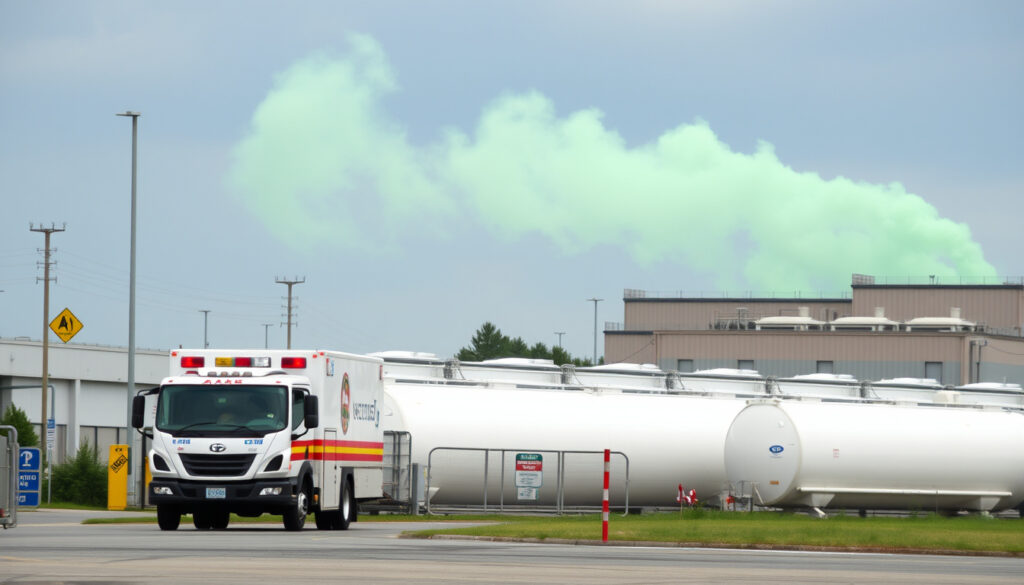
Alliance Group Levin Chemical Leak: 22 Treated, 3 Hospitalized
A chemical leak at Alliance Group’s Levin meat processing plant on 19 February 2026 sent 22 workers for treatment, with three needing hospital care. The response — involving firefighters performing on-site decontamination and a multi-agency emergency coordination — reveals how New Zealand handles industrial chemical exposures.
People treated at the scene: 22 · People transported to hospital: 3 · Location: Alliance Group meat processing plant, Hamaria Road, Levin · Date of incident: 19 February 2026, approximately 6:30pm · Emergency services decontaminated on site: Multiple workers decontaminated by firefighters
Confirmed facts
- 22 people were assessed at the scene for exposure to the chemical leak, reported by RNZ (national broadcaster).
- Most were treated for minor conditions and did not require hospital transport. (RNZ (national broadcaster))
- 3 people were taken to hospital for further assessment. (RNZ (national broadcaster))
- The specific hospital and their conditions have not been disclosed, according to RNZ (national broadcaster).
- Firefighters, St John Ambulance, and police attended the Levin plant, per RNZ (national broadcaster).
- Firefighters performed on-site decontamination of affected individuals. (RNZ (national broadcaster))
What happened during the chemical leak at Alliance Group’s Levin plant?
Emergency services responded to a reported chemical leak at the Alliance Group Levin plant on Hamaria Road around 6:30pm on 19 February 2026. Fire and Emergency New Zealand (Firefighters) led the response, establishing a decontamination unit and street cordon, while St John Ambulance dispatched five ambulances, three rapid response units, two operations managers, and a Major Incident Support Team, as reported by RNZ (national broadcaster). Police set up cordons around the site.
Timeline of the incident on 19 February 2026
Crews were called to the incident at about 6:30pm. Firefighters quickly isolated the leak and began decontaminating affected workers, removing contaminated clothing and washing exposed skin. Alliance Group confirmed that processing at the plant was suspended after the chemical incident caused a gas reaction, according to RNZ (national broadcaster).
Immediate emergency response at Hamaria Road
The scene involved a coordinated multi-agency response. Firefighters performed decontamination procedures on affected individuals. St John Ambulance crews treated 22 people who reported symptoms, assessing most as fit to remain at the scene. Three needed hospital transport for more thorough evaluation. Police assisted with scene control, managing traffic and keeping unauthorized personnel away from the affected area.
Decontamination procedures performed by firefighters
Firefighters set up decontamination gear at the plant after reports of a chemical leak. The process involved removing contaminated clothing and washing exposed skin to reduce the chemical’s impact. RNZ (national broadcaster) reported that this decontamination was standard for chemical incidents and helped prevent more serious outcomes.
How many people were affected by the Levin chemical leak and what treatment did they receive?
A total of 22 people were treated by emergency services at the scene. Of these, three were transported to hospital for further care, while 18 others were assessed and treated for minor conditions and did not require hospital transport, according to RNZ (national broadcaster) follow-up reporting.
Breakdown of the 22 people treated at the scene
The 22 affected individuals included workers directly exposed to the chemical at the plant. Most reported minor symptoms such as respiratory irritation or skin discomfort, treated on-site by St John Ambulance personnel. The response involved precautionary decontamination before hospital transfer decisions were finalised.
Hospital admissions: details of the three transported cases
Three workers were transported to Palmerston North Hospital, RNZ (national broadcaster) reported. One patient was in a serious condition upon arrival, while three were in moderate condition. All four hospitalised patients had been discharged by the time RNZ published its follow-up report.
St John training exercise connection to the response
Notably, the incident occurred during an active St John training exercise, which a spokesperson described as “St John training gets real” when the real emergency call came in. The Palmerston North unit which had been training on chemical incident scenarios was redirected to the Levin scene, providing immediate expertise.
Where is the Alliance Group Levin plant and what is its role?
The Levin plant is one of Alliance Group’s processing facilities, located on Hamaria Road, in the Horowhenua district of New Zealand’s North Island. A meat processing plant, it handles livestock and produces meat products for domestic and export markets. The plant’s role in the local economy is significant, employing a substantial workforce in a region where such industrial sites are major employers.
Location details: Hamaria Road and the Levin industrial context
The plant’s location on the outskirts of Levin means residents might not have noticed anything unusual, but workers on-site were directly exposed. The response from Fire and Emergency New Zealand (Firefighters) involved decontamination procedures, indicating the substance posed a health risk upon contact or inhalation.
Alliance Group’s operations as a meat processing company
Alliance Group Ltd operates multiple processing plants across New Zealand, including in Levin, Lorneville, and other locations. The company processes livestock and exports meat products internationally. When a chemical leak occurs at a facility like this, the impact reaches beyond the immediate emergency — it raises questions about workplace safety protocols and the transparency of incident reporting for the community nearby.
The plant’s history and significance to the Levin community
The plant is a major employer in the Horowhenua district. Its operation affects not only workers but also local suppliers, transport companies, and the broader regional economy. Alliance Group said processing at the plant was suspended after the chemical incident, according to RNZ (national broadcaster).
How does the Levin chemical leak compare to the later Lorneville plant fire?
The Levin incident on 19 February 2026 was followed by another chemical-related event at Alliance Group’s Lorneville plant on 7 April 2026. Both involved toxic gas exposure and required emergency response with decontamination, suggesting a potential pattern in the company’s safety approach.
Overview of the April 2026 Lorneville plant incident
The Lorneville incident involved elevated levels of toxic gas detected after a fire at Alliance Group’s plant, as reported by RNZ (national broadcaster). This event also required firefighter response and decontamination measures, mirroring the Levin incident’s emergency protocols.
Both incidents involved toxic gas at Alliance Group sites
The pattern — two chemical-related incidents within roughly seven weeks — raises questions about whether Alliance Group has systemic safety gaps. While a single incident can be a random accident, two similar events at different plants point to possible common causes: staff training deficiencies, substandard equipment, or inadequate hazard communication.
Was there a pattern in Alliance Group’s safety approach?
Neither incident has been fully investigated in public sources, so the underlying cause remains unknown. The proximity of these two events is concerning for a company that operates multiple plants across New Zealand. The operational impact on the Levin plant following the incident is not detailed in the provided sources.
Two chemical leaks in two months at different Alliance plants signals a potential pattern — this is not an isolated event, and the company’s safety culture deserves scrutiny.
What are the broader safety procedures for chemical incidents at New Zealand industrial sites?
The Levin incident demonstrates standard emergency response to chemical leaks in industrial settings. Fire and Emergency New Zealand (Firefighters) leads the response, establishing decontamination units and cordons, while St John Ambulance provides medical treatment and transport. Police manage site security and traffic control.
Standard emergency response to chemical leaks in meat processing
For workers at plants like Alliance Group, the first step is always to follow the site’s emergency procedures. This includes moving to designated safe zones, notifying a supervisor immediately, and following decontamination instructions if exposed. For residents living near such facilities, the New Zealand WorkSafe NZ (regulator for workplace health and safety) recommends understanding the potential hazards in your area and knowing the plant’s emergency alert systems.
The role of Fire and Emergency New Zealand (Firefighters) in decontamination
Firefighters performed decontamination at the Levin plant, a standard procedure for chemical incidents. This involves removing contaminated clothing and washing exposed skin to reduce the chemical’s impact. Fire and Emergency established a decontamination unit and a street cordon at the scene, according to RNZ (national broadcaster).
Medical screening and follow-up for chemical exposure victims
St John Ambulance crews were also present, treating the 22 people who reported symptoms. The assessment process determined that most were fit to remain at the scene, but three needed hospital transport for more thorough evaluation. The long-term health effects on the 22 affected individuals are not yet known, and follow-up care is an open question.
- Recognize the hazard: If you smell chemicals or notice unusual symptoms, alert others and move to a safe area.
- Report immediately: Notify your supervisor or call emergency services. Do not assume the smell is harmless.
- Follow decontamination instructions: Remove contaminated clothing and wash exposed skin with water if directed by emergency responders.
- Seek medical assessment: Even if symptoms seem mild, get checked by medical professionals to ensure no delayed effects.
- Monitor for symptoms: Watch for respiratory issues, skin irritation, or dizziness in the hours and days following exposure.
- Report to health authorities: If you were in the vicinity during the incident, inform your doctor or local health authority to assist in tracking potential long-term effects.
What is Alliance Group Ltd’s track record on chemical safety, and what are the implications?
Alliance Group Ltd operates both the Levin and Lorneville plants, which experienced chemical-related incidents within weeks of each other. The Levin incident affected 22 people on 19 February 2026, while the Lorneville incident on 7 April 2026 involved elevated toxic gas after a fire.
Recent incidents: Levin leak and Lorneville fire timeline
The Levin chemical leak on 19 February 2026 involved chlorine, according to a St John spokesperson cited in RNZ (national broadcaster) follow-up reporting. Alliance Group clarified that the event was a chemical incident rather than a gas leak. The Lorneville fire on 7 April 2026 also required emergency response and decontamination.
Health and safety history of Alliance Group plants in New Zealand
The proximity of these two events — roughly seven weeks apart — raises questions about whether Alliance Group has systemic safety gaps. Neither incident has been fully investigated in public sources, so the underlying cause remains unknown. This is particularly concerning for a company that operates multiple plants across New Zealand.
Potential regulatory or industry-wide changes for meat processors
If a systemic issue is found, Alliance Group could be required to update its chemical handling procedures across all its New Zealand plants. WorkSafe NZ may investigate the incidents and could impose safety improvements or fines. The events highlight the need for transparent reporting and rigorous safety protocols in the meat processing industry.
The likely next step is an investigation by WorkSafe NZ into the Alliance Group Levin plant, which could reveal the chemical involved, the cause of the leak, and any safety violations. The company may also face questions from workers and the community about prevention measures.
Confirmed vs. unconfirmed details of the Levin response
The Levin incident report contains a mix of confirmed operational facts and unresolved details. The confirmed facts, sourced from RNZ (national broadcaster) and other public reports, include the number of people treated, the emergency response, and the location. The unconfirmed or missing details are just as important.
- Confirmed: 22 people treated at the scene, 3 transported to hospital, firefighters conducted decontamination, incident on 19 February 2026 at 6:30pm. Source: RNZ (national broadcaster).
- Unconfirmed: The chemical involved (chlorine was named by a St John spokesperson but not officially confirmed by Alliance Group), the source of the leak, the cause of the incident, and any investigation by WorkSafe NZ.
- Missing: Official statements from Alliance Group beyond the suspension of processing, the hospital status of the 3 transported patients after discharge, and any public health advice for Levin residents.
The public has the response facts — 22 treated, 3 hospitalized — but not the core causes: what leaked, why it leaked, and how it will be prevented from happening again. Without a named chemical and a clear cause, the community cannot fully assess the risks they faced.
Related reading: Levin Boy Racer Impounded Cars Sale: Legal Loophole
rnz.co.nz, rnz.co.nz, rnz.co.nz, rnz.co.nz, pmc.ncbi.nlm.nih.gov, who.int, ncdc.mohfw.gov.in, ncdc.mohfw.gov.in, health.gov.au, chemm.hhs.gov
Frequently asked questions
What chemical was involved in the Alliance Group Levin leak?
The specific chemical substance involved in the Levin leak has not been officially confirmed by Alliance Group or emergency services. A St John spokesperson indicated the gas was chlorine, according to RNZ (national broadcaster), but this has not been formally confirmed. Reports from RNZ and other outlets refer to it as a “chemical leak” without naming the compound, leaving a significant information gap for affected workers and the public.
How many people were affected by the Levin chemical leak?
In total, 22 people were assessed and treated at the scene for exposure-related symptoms. Of these, 3 were transported to Palmerston North Hospital for further care — one in serious condition and three in moderate condition — while the remaining 18 were treated on-site by firefighters and St John Ambulance personnel. All four hospitalised patients had been discharged by the time RNZ published its follow-up report, according to RNZ (national broadcaster).
Where is the Alliance Group Levin plant located?
The plant is located on Hamaria Road in Levin, a town in the Horowhenua district of New Zealand’s North Island. The facility is a meat processing plant that employs a significant workforce in the region.
What did firefighters do in response to the Levin leak?
Firefighters from Fire and Emergency New Zealand attended the scene and performed decontamination procedures on affected workers. This involved removing contaminated clothing and washing exposed skin to reduce the chemical’s impact. They also established a decontamination unit and a street cordon, as reported by RNZ (national broadcaster).
Have there been other chemical leaks at Alliance Group plants in the past?
Yes. An earlier chemical-related incident occurred at Alliance Group’s Lorneville plant on 7 April 2026, just weeks after the Levin leak. Both events required emergency response and decontamination, suggesting a potential pattern of chemical handling issues across the company’s operations.
What should Levin residents do if they experienced symptoms after the leak?
Anyone who was in the vicinity of the Levin plant on 19 February 2026 and experienced symptoms such as respiratory irritation, skin rashes, or dizziness should seek medical advice promptly. They should also report their exposure to health authorities to assist in tracking potential long-term effects, as the chemical has not been publicly identified.
Is Alliance Group required to disclose the chemical involved in the leak?
Under New Zealand’s Health and Safety at Work Act, businesses must manage risks from hazardous substances, but public disclosure of a specific chemical after an incident is not always mandatory unless it presents an ongoing public health threat. However, WorkSafe NZ may compel the company to release details as part of an investigation.
More related posts
 New World Brown Bay Supermarket Fire: What Happened & Hi tory
 House for Sale Palmerston North: Prices & Suburbs Guide
 A Good Year Poster: Quotes, History & Where to Buy
 The Summer I Turned Pretty Season 3 Episode 8: Recap & Ending
 Old Bay Seasoning NZ: Where to Buy, Substitutes & DIY
 Jetstar Luggage Scale Discrepancy – MBIE Order and Key Facts
 The Twelve Season 3: Plot, Cast, and Ending
 Cast of The Conjuring: Last Rites (2025) Full Cast List