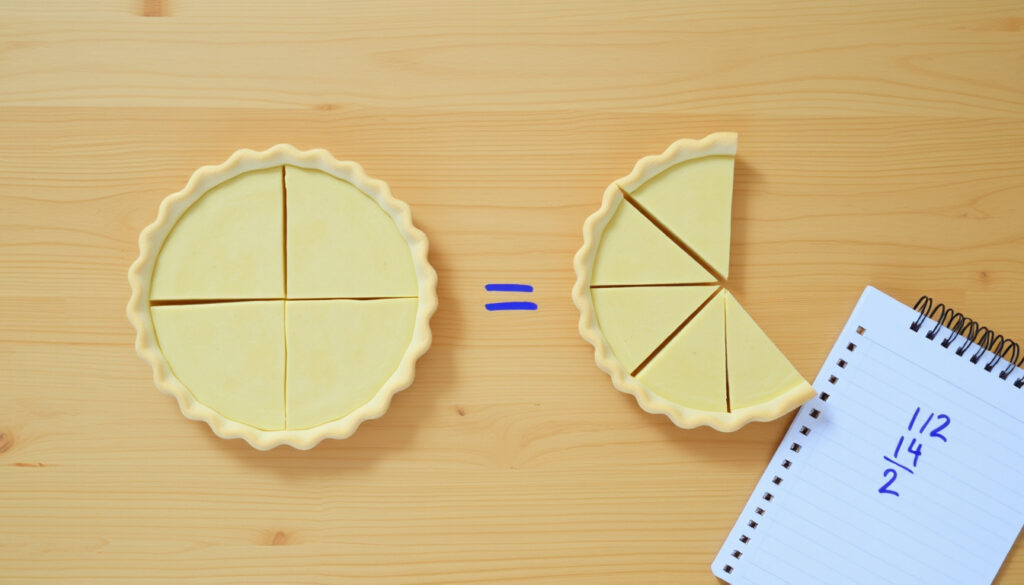
How to Divide Fractions: Step-by-Step Guide with Examples
Dividing fractions doesn’t have to be confusing. There’s one powerful rule—multiply by the reciprocal—that works every time, whether the problem involves whole numbers, mixed numbers, or two fractions.
Standard method steps: 3 ·
Common denominator needed: No ·
KFC mnemonic: Keep, Flip, Change ·
Example result: 3/4 ÷ 2 = 3/8
Quick snapshot
- Dividing by a fraction = multiplying by its reciprocal (Math is Fun)
- KFC stands for Keep, Flip, Change (The Axiom Academy)
- The numerator‑division shortcut works only when the numerator is a multiple of the whole number (BBC Bitesize)
- The numerator-division shortcut is not universally applicable (BBC Bitesize)
- Practice mixed numbers by converting to improper fractions first (Third Space Learning)
Six illustrative examples show how the reciprocal method plays out in different scenarios. All come from high‑authority educational sources.
| Concept | Example / Value |
|---|---|
| General rule | a/b ÷ c/d = a/b × d/c = ad/bc |
| KFC mnemonic | Keep, Flip, Change |
| 1/2 ÷ 1/3 | 1/2 × 3/1 = 3/2 = 1.5 |
| 1/2 ÷ 3 | 1/2 × 1/3 = 1/6 (Math is Fun) |
| 5/6 ÷ 3 | 5/6 × 1/3 = 5/18 (MathWords) |
| 4/9 ÷ 2 | 4/9 × 1/2 = 2/9 (MathWords) |
| 2/9 ÷ 2 | 2/9 × 1/2 = 1/9 (AAA Math) |
| 3/4 ÷ 2/5 | 3/4 × 5/2 = 15/8 = 1⅞ (MultiplyFractions.com) |
How do you divide 3/4 by 2?
Start with a concrete example. The goal: share three‑quarters of a pizza between two people.
Step 1: Write the division problem
3/4 ÷ 2. Because 2 is a whole number, rewrite it as 2/1 (Third Space Learning).
Step 2: Change division to multiplication
Flip the second fraction (2/1) to get its reciprocal: 1/2. Then swap the ÷ for ×.
Step 3: Multiply numerator and denominator
3/4 × 1/2 = (3×1)/(4×2) = 3/8. Each person gets 3/8 of a pizza. MultiplyFractions.com confirms this result.
The 3/8 answer is less than the original fraction (3/4) because division by a number greater than 1 shrinks the result—a intuitive check that the method is correct.
The implication: the answer being smaller than the original fraction reinforces the logic of division.
What’s the trick for dividing fractions?
The trick is a three‑word mnemonic: Keep‑Change‑Flip. It works for every fraction division problem.
- Keep the first fraction. Leave the first fraction exactly as it is. Do not simplify or rewrite it.
- Change the division sign to multiplication. Replace ÷ with ×. This switches the operation from division to its inverse.
- Flip the second fraction. Swap numerator and denominator of the second fraction. This is called taking the reciprocal. The Axiom Academy defines flipping as swapping the numerator and denominator to form the reciprocal.
BBC Bitesize puts it concisely: “keep the first fraction as it is, change the divide sign to a multiply and flip the second fraction upside down.”
BBC Bitesize
The pattern: Keep-Change-Flip is the universal method for fraction division.
What is the KFC method in math?
KFC is just a variation of Keep‑Change‑Flip—the letters stand for the same operations in a slightly different order.
K = Keep the first fraction as is
Do not modify the numerator or denominator.
F = Flip the second fraction (reciprocal)
Swap numerator and denominator. This step is identical to the “Flip” in Keep‑Change‑Flip.
C = Change division to multiplication
Replace ÷ with ×. MultiplyFractions.com explains that the order of the last two steps can be swapped (Flip then Change vs. Change then Flip) and the result is the same.
The implication: KFC and Keep‑Change‑Flip are the same method. Pick whichever mnemonic is easier to remember.
Some students confuse “flip” with “invert the first fraction.” Always flip only the second fraction—the one after the division sign.
The catch: students must remember to flip only the second fraction.
How do I solve 1/3 divided by 4?
Another common problem: one‑third shared among four people.
Treat 4 as 4/1
Any whole number becomes a fraction with denominator 1 (MathWords).
Find reciprocal: 1/4
Flip 4/1 to get 1/4.
Multiply: 1/3 x 1/4 = 1/12
1/3 ÷ 4 = 1/12. AAA Math confirms this result after simplifying.
Khan Academy demonstrates this visually: shading one‑third and then splitting it into four equal parts shows each person gets 1/12.
Khan Academy
The takeaway: whole numbers are just fractions with denominator 1, so the same method applies directly.
How do you divide fractions with different denominators?
A frequent worry is that different denominators require extra work. They don’t.
Reciprocal rule still applies
The method is identical: keep the first fraction, flip the second, multiply straight across.
No need for common denominator
Unlike addition or subtraction, division does not ask you to match denominators. Math is Fun emphasizes that you multiply numerators and denominators directly.
Example: 2/5 ÷ 3/7 = 14/15
- Flip 3/7 → 7/3
- Multiply: 2/5 × 7/3 = (2×7)/(5×3) = 14/15
MultiplyFractions.com gives a similar example 3/4 ÷ 2/5 = 15/8, confirming the same pattern.
The trade‑off: while no common denominator is needed, the resulting fraction may be improper (numerator larger than denominator) and require conversion to a mixed number—a quick extra step.
Summary
Dividing fractions boils down to one operation: multiply by the reciprocal. The Keep‑Change‑Flip (or KFC) mnemonic makes it automatic, but understanding why the reciprocal works builds lasting number sense. For students preparing for high‑stakes math tests, the choice is clear: master the reciprocal method now, or risk confusing division of fractions with addition later.
youtube.com, mathematicalmysteries.org, youtube.com, youtube.com
Frequently asked questions
Do you need a common denominator to divide fractions?
No. Division of fractions uses multiplication by the reciprocal, which works directly regardless of denominators. Only addition and subtraction require common denominators.
Can you divide a fraction by zero?
No. Division by zero is undefined in mathematics. The reciprocal of zero cannot be defined because 1/0 has no finite value.
What is the reciprocal of a fraction?
The reciprocal of a fraction a/b is b/a. For example, the reciprocal of 2/3 is 3/2. Multiplying a fraction by its reciprocal always gives 1.
How do you divide a fraction by a whole number?
Rewrite the whole number as a fraction over 1, then apply Keep‑Change‑Flip. For example, 3/4 ÷ 2 = 3/4 ÷ 2/1 = 3/4 × 1/2 = 3/8.
How do you divide mixed numbers?
Convert the mixed number to an improper fraction first. Then use the standard keep‑change‑flip method. For example, 1½ ÷ 2 = 3/2 ÷ 2/1 = 3/2 × 1/2 = 3/4.
What is the difference between KFC and keep-change-flip?
None. KFC stands for Keep, Flip, Change; keep‑change‑flip uses the same three operations. The order of the last two steps doesn’t matter as long as you flip the second fraction and change the sign.
How do you check your answer when dividing fractions?
Multiply your result by the divisor. If it equals the dividend, the answer is correct. For example, 3/8 × 2 = 3/4, so 3/8 is correct for 3/4 ÷ 2.
More related posts
 Seoul Roastery 1946 Photos: Menu, Prices & Reviews
 AUD to NZD Exchange Rate Today: Convert Australian Dollars
 Best Rocoto Relleno Near Me: Find Authentic Stuffed Peppers
 John Tamihere Daughter Accident: Who Is Kiri Tamihere
 Free Solitaire Card Games: Play Online & Download
 Car Loan Calculator NZ – Get Accurate Repayment Estimates
 Cheaper by the Dozen 2: Cast, Sequel Status, and FAQs
 Bed Bath N’ Table Australia: Stores, Clearance & Sale Guide