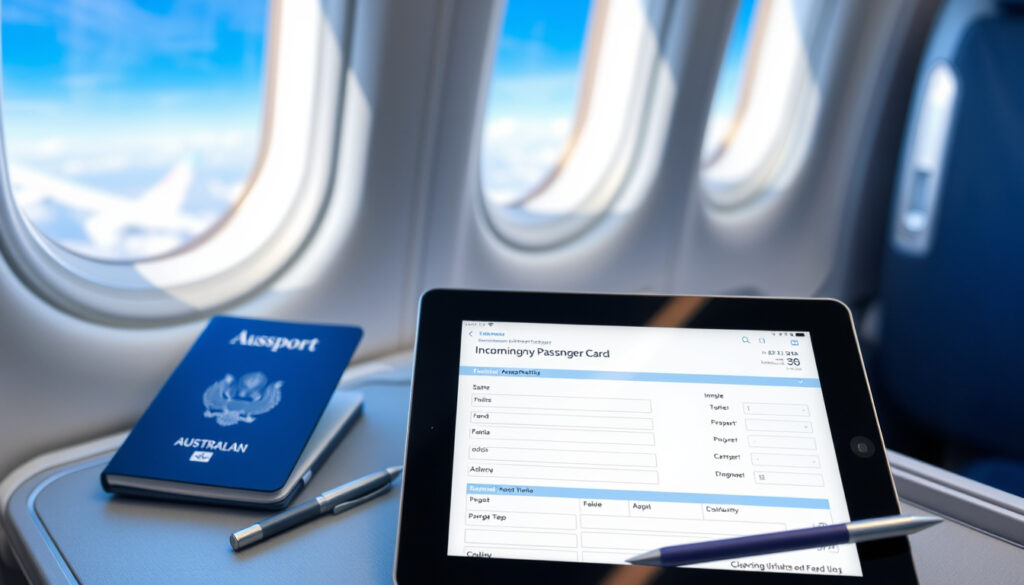
Australia Arrival Card Online: Digital Incoming Passenger Card
If you’re planning a trip to Australia, the arrival card is one of those small but essential steps. The good news is that the paper version you fill out on the plane is gradually being replaced by a digital alternative called the Australia Travel Declaration (ATD), already available on select flights. This guide walks you through both the digital and paper processes, with the latest deadlines and eligibility rules for 2026–2027.
Digital IPC rollout start: 2024 ·
Target full rollout: 2027 ·
Time to complete digital card: 5–10 minutes ·
Paper card availability: On all international flights ·
ETA fee (if required): AUD 20 ·
ETA typical processing: Instant to 24 hours
Quick snapshot
- Digital card is available for eligible travelers on selected flights into Australia (Australian Border Force (national border agency)).
- Paper cards remain accepted at all airports (Australian Border Force sample IPC).
- ETA and eVisitor are separate visa requirements (ABF IPC FAQs).
- Exact date when paper cards will be fully discontinued.
- Whether all airlines will support the digital submission process pre-departure.
- If the digital card will eventually be mandatory for all passengers.
- 2024: Digital IPC trial launched at Melbourne Airport (Minister for Home Affairs (Australian government)).
- 2025–2026: Gradual rollout to Sydney, Brisbane, and other major airports (ABC News (Australian public broadcaster)).
- 2027: Full national rollout; paper cards may be phased out (Minister for Trade and Tourism (Australian government)).
- Perth and Adelaide included before end of 2026 (ABC News).
- Webform available to all travellers from 2027 (Minister for Trade and Tourism).
- Airline-app capabilities to be co-designed with industry (Minister for Trade and Tourism).
Five key facts summarise the current state of the Australia arrival card system.
| Label | Value |
|---|---|
| Official source | Australian Border Force (ABF) |
| Arrival card cost | Free |
| Digital card lead time | Up to 72 hours before arrival |
| ETA fee | AUD 20 |
| Paper card availability | On all flights |
Can I fill Australia’s incoming passenger card online?
Yes, if you’re on an eligible flight. The Australian Border Force launched the Australia Travel Declaration (ATD) pilot in October 2024, initially for passengers on selected Qantas flights into Brisbane, Sydney, and Melbourne. Since May 2026, Melbourne-bound travellers on eligible Qantas flights can also use the digital card (Minister for Home Affairs).
How the digital Incoming Passenger Card works
- The ATD is a digital alternative to the paper IPC (Australian Border Force).
- You can complete it up to 72 hours before departure (ABF IPC FAQs).
- After submission, a unique QR code is generated and scanned by border officers on arrival (ABC News).
- No printing required — the digital pass is stored on your phone or device (Nine (Australian media)).
Who can use the digital card?
Currently, only passengers on selected Qantas flights into Brisbane, Sydney, and Melbourne are eligible. The government announced in July 2026 that the ATD would be expanded to all Australian international airports and seaports over the next 12 to 18 months (Minister for Trade and Tourism). The ABC reported that Perth and Adelaide would be included before the end of 2026 (ABC News).
Devices and browsers supported
The ATD pilot on Qantas flights is accessed through the Qantas app. For the broader webform rollout planned for 2027, the government intends to use a standard webform accessible from any device with a modern browser (Minister for Trade and Tourism).
If you withdraw a submitted ATD, you may be required to answer the same questions on a paper IPC upon arrival — so only submit when you’re confident in your declarations (Australian Border Force consent declaration).
Where to get an Australia arrival card?
You have two options: the traditional paper card handed out on flights, or the digital ATD portal for eligible travellers.
Onboard paper cards
- Paper Incoming Passenger Cards are handed out on all international flights to Australia (Australian Border Force).
- Complete with a blue or black pen, sign and date, and hand it to border officers with your passport.
- Accepted at all airports until the full digital transition is completed.
Online digital arrival card portal
- Available through the ABF online portal or partner apps (currently Qantas app) (Australian Border Force).
- You can access it up to 72 hours before departure.
- From 2027, a webform will be available for all travellers, not just Qantas passengers (ABC News).
Airport kiosks and assistance
Airports do not currently have dedicated kiosks for the digital card. If you haven’t filled either card before landing, cabin crew will provide a paper form. At the border, ABF officers can assist with questions.
The pattern: paper remains the universal option; digital is a growing but still exclusive channel.
How do I get a digital arrival card?
If you’re eligible, creating a digital card takes about 5–10 minutes. Here’s the step-by-step.
Steps to create a digital arrival card
- Open the Qantas app (if flying Qantas) or the ABF Incoming Passenger Declaration portal.
- Create an account or log in using your booking reference.
- Fill in personal details: full name, passport number, date of birth, flight number, and intended address in Australia.
- Answer the customs and quarantine declaration questions — same as the paper card.
- Review and submit. You’ll receive a QR code via email or in the app.
Required information and documents
- Passport (valid for at least 6 months beyond departure).
- Flight number and booking reference.
- Address in Australia (hotel, private residence, etc.).
- Details of any goods to declare: food, plants, animal products, medication, and currency over AUD 10,000.
Submission and receiving the QR code
After submission, the system generates a digital pass with a unique QR code. Save it to your phone or take a screenshot. On arrival, present the QR code and your passport to the ABF officer (ABC News).
Travellers who submit the digital card avoid queuing with a paper form and reduce the risk of errors — but only if they are on an eligible flight and complete the process within the 72-hour window.
The trade-off: digital is faster but currently limited to Qantas; paper is universal but slower at border processing.
How to fill out an Australia arrival card?
Whether you use paper or digital, the information required is nearly identical.
Paper card instructions
- Use a pen (blue or black) and write in block letters.
- Enter your passport details, flight number, and intended address in Australia.
- Declare all goods, food, and currency over AUD 10,000.
- Sign and date the card at the bottom. The sample IPC from the ABF shows the layout (Australian Border Force sample IPC).
Digital card instructions
- Fill in the same fields electronically.
- The digital form includes help text and drop-down menus, reducing errors.
- Electronic signature replaces the handwritten one.
- You can save and return to the form before submission.
Common mistakes to avoid
- Forgetting to declare food or souvenirs — even sealed snacks must be declared.
- Using a pen colour other than blue or black on the paper card.
- Not signing the paper card — it will be rejected at the border.
- Entering the wrong flight number or intended address.
The implication: the digital card’s built-in validation catches many errors that paper forms miss, but the consequences of a mistake are the same — delays and potential penalties.
Do I need to fill out an arrival card for Australia?
Yes, unless you’re an Australian citizen or permanent resident who has nothing to declare. But even then, it’s wise to fill one out if you carry duty-free goods or restricted items.
Who must complete the card?
- All non-Australian passport holders entering Australia must complete an arrival card (ABF IPC FAQs).
- Australian citizens and permanent residents are not required to fill a card unless they have goods to declare (e.g., alcohol, tobacco, plant material).
Exemptions for Australian citizens and residents
If you’re an Australian citizen returning with no duty-free goods beyond the allowance and no restricted items, you can hand the blank card to the officer. However, many choose to fill it out to avoid questioning.
Consequences of not submitting
- Failure to submit a declaration (paper or digital) can result in delays at the border.
- Knowingly failing to declare restricted goods can lead to penalties, including fines of up to AUD 266,400 or prosecution (Australian Border Force).
The pattern: the card is a legal document, not just a formality.
Timeline: Digital transition of the Incoming Passenger Card
Here is the rollout sequence based on official announcements.
- October 2024 – Digital IPC trial launched at Melbourne Airport for eligible Qantas passengers (Minister for Home Affairs).
- 2025–2026 – Expanded to Brisbane, Sydney, then Melbourne (May 2026) (Minister for Home Affairs).
- 2026 (second half) – Perth and Adelaide to join; government announces phased rollout to all airports and seaports over 12–18 months (ABC News).
- 2027 – Full national rollout with webform for all travellers; paper cards may be phased out (Minister for Trade and Tourism).
Confirmed facts
- Digital card is available for eligible travelers on selected flights into Australia (ABF).
- Paper cards remain accepted at all airports (ABF sample IPC).
- ETA and eVisitor are separate visa requirements (ABF FAQs).
What’s unclear
- Exact date when paper cards will be fully discontinued.
- Whether all airlines will support the digital submission process pre-departure.
- If the digital card will eventually be mandatory for all passengers.
What travellers say about the experience
“The incoming passenger declaration card is going digital across the country by 2027.”
“Eligible travellers can submit their declaration electronically up to 72 hours before a flight to Australia.”
For travellers heading to Australia in 2026–2027, the choice is clear: use the digital ATD if you’re on a Qantas flight into a participating airport, or stick with the paper card. But the real deadline is the visa — an ETA (AUD 20) or eVisitor must be arranged before you board. For the traveller, the digital card is a welcome convenience, but the paper card remains the reliable fallback until the 2027 webform opens to all.
vacationstravel.com, theguardian.com, indoneo.com, abf.gov.au, trip.com
Frequently asked questions
Can I use the digital arrival card if I have a connecting flight within Australia?
Yes, the digital card is valid for your final arrival airport in Australia. If you transit through Brisbane to Melbourne, for example, you can use the digital card as long as your first port of entry is a participating airport.
What if I don’t have a smartphone or internet access?
You can still use the paper Incoming Passenger Card, which is provided on board. The digital card is optional.
Do children need a separate arrival card?
Yes, each traveller, including children, must have their own arrival card. Parents or guardians can fill the card on behalf of minors.
Can I change or cancel my declaration after submitting it?
Yes, you can withdraw your digital declaration and submit a new one before departure. However, if you withdraw, you may need to complete a paper card on arrival (ABF consent declaration).
Is the digital arrival card available in languages other than English?
Currently, the digital ATD pilot is in English. The paper card is available in multiple languages. The 2027 webform may include additional language options.
What should I do if I made a mistake on my paper card?
Ask cabin crew for a new card. If you’ve already handed it in, inform the ABF officer at the border — they will help you correct it.
Do Australian citizens or permanent residents ever need to fill out an arrival card?
Not if they have nothing to declare. But if you carry duty-free goods, restricted items, or are bringing in food or plant material, you must declare them on the card.
Related reading
More related posts
 True Size of Countries: Compare Real Land Areas
 Best Rocoto Relleno Near Me: Find Authentic Stuffed Peppers
 St John’s College Hastings: Fees, Rankings, Uniform & More
 1000 GBP to NZD Today: Live Rate & Transfer Tips
 When Do Babies Start Smiling? Timeline, 3-6-9 Rule & Signs
 How to Read Thailand Gold Price Tables Like a Pro in 2026
 Dying Light: The Beast Guide – Full Game & Worth It
 TVNZ On Demand: Access, Troubleshoot, Compare TVNZ+ (Free Guide)