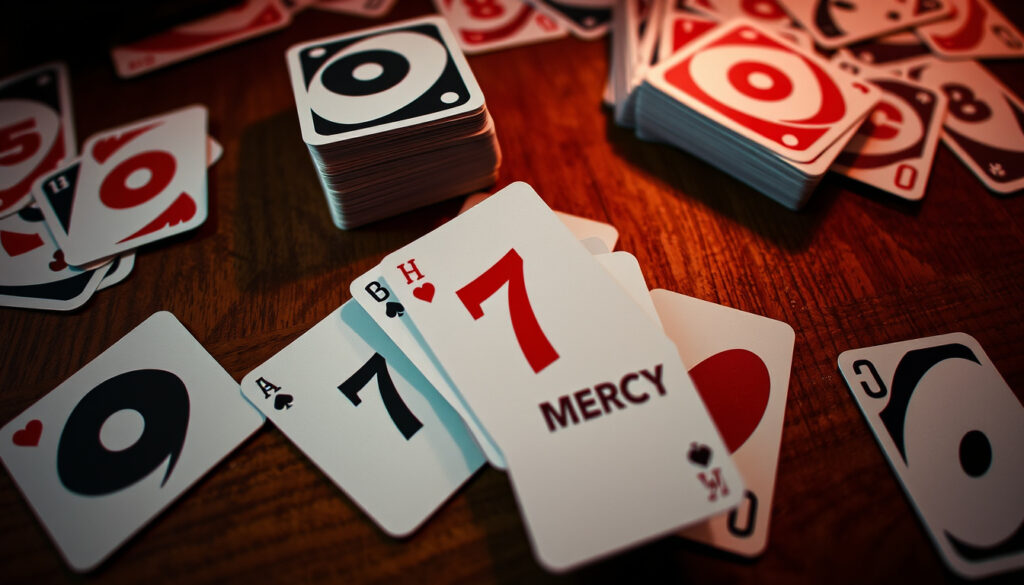
UNO No Mercy Rules: Stacking, 7, 0, and Mercy Explained
Few card games have a rulebook that makes players laugh nervously before a single card is dealt—UNO No Mercy, the 2024 expansion that throws out the kid-glove approach, is one of them, and if you’ve ever been stuck with a hand that keeps growing while your friends play every card they draw, you already know the tension. This guide breaks down the official UNO No Mercy rules, from the brutal stacking mechanics to the elimination threshold that separates the lucky from the doomed.
- Deal 7 cards to each player.
- Place the remaining deck as the draw pile.
- Flip the top card to start the discard pile.
- On your turn, play a matching card or draw until you can play.
- If you reach 25 cards, you are eliminated. First to discard all cards wins.
Deck size: 112 cards · Starting hand: 7 cards · Mercy elimination threshold: 25 cards · Win condition: Be the first to discard all cards or be the last remaining · Draw rule: Draw until you can play
Quick snapshot
- Official stacking rule exists for draw cards (Mattel instruction sheet)
- 25-card hand threshold triggers immediate elimination (Mattel instruction sheet)
- Draw-stack values include +4, +6, and +10 (Mattel instruction sheet)
- Stacking on +4 with a +2 is a debated house rule in some circles (GameRules101)
- Whether the “sandwich” rule applies to stacking is not officially clarified (Open Mercy)
- The exact rules for the black Mercy card (eliminate a player) are not clarified in official materials; it is often treated as a house rule (GameRules101)
- No Mercy introduced the stacking rule as official, unlike classic UNO (HGSchool Google Sites summary)
- House rules will continue to evolve around No Mercy’s most brutal cards (Mattel instruction sheet)
One pattern across all rule interpretations: No Mercy stacks are about escalation, not absorption.
| Attribute | Value |
|---|---|
| Deck size | 112 cards |
| Starting hand | 7 cards |
| Mercy threshold | 25 cards |
| Win condition | Discard all cards or be last remaining |
| Stacking rule | Allowed (play +2 on +4, etc.) |
Is there a way to play No Mercy?
Starting the game: cards dealt and setup
Each player is dealt 7 cards from the 112-card deck. The top card of the draw pile is turned over to start the discard pile. The game proceeds clockwise.
Mercy rule: elimination at 25 cards
If a player’s hand reaches 25 or more cards at any moment, they are immediately eliminated. This is the game’s signature “mercy” mechanic.
“Mercy – If a player has 25 or more cards in their hand, they are out of the game.”
Draw until you can play rule
When a player cannot play a matching card (by color or value), they must draw cards from the draw pile until they can play. This can cause hands to swell quickly.
“Draw Until You Can Play – When you don’t have a matching card, keep drawing until you do.”
Winning conditions
The first player to discard all cards wins. Alternatively, if all other players are eliminated by the mercy rule, the last remaining player wins.
What is dirty UNO?
Dirty UNO, in the context of No Mercy, refers to the game’s aggressive card-play conventions. The official Mattel instruction sheet defines the core rule change: stacking draw cards is a formal mechanic, not a house rule. This single decision transforms the entire flow of the game.
Under the official rules, when a player plays a draw card, the next player may play a higher-value draw card. The stack continues until someone cannot or chooses not to stack. At that point, the accumulated draw total is applied. This is a departure from classic UNO, where draw cards are played and resolved immediately without stacking (unless groups agree otherwise).
The “dirty” part comes from the sheer number of cards involved. With the +2, +4, and +6 cards in the deck, a single exchange can force a player to draw a dozen or more cards. The Mattel instruction sheet explicitly allows stacking +2 on +4 and vice versa, creating chains that escalate quickly.
Definition of dirty UNO
Dirty UNO describes any playstyle or rule set that maximizes the draw-card penalty. In No Mercy, this is not just a strategy—it’s the core design. The game rewards knowing exactly when to stack and when to pass the burden. For example, playing a +4 on a +2 forces the next player to draw 6, but only if no one else stacks further.
Mercy elimination is the other pillar. The official rule is simple: if you reach 25 or more cards in your hand, you’re out. This threshold is unforgiving. The Mattel instruction sheet states this as a hard limit: “If a player has 25 or more cards in their hand, they are eliminated from the game.”
One official guide notes that “a player who draws a lot might be eliminated mid-turn.” The consequence is immediate—no chance to play out of it. This is the “mercy” in No Mercy: the game doesn’t wait for you to recover.
False UNO call penalty
Calling “UNO” when you don’t have exactly one card left is penalized. Per the official rules, a false call results in drawing 2 cards. This penalty, however, can itself be stacked. If the next player also has few cards, they might add to the draw total, creating a chain reaction that eliminates the original offender.
According to the Mattel instruction sheet, the penalty for a false call is a draw 2. But this is not just a slap on the wrist—it’s a potential elimination trigger. With the 25-card threshold, a single mistake can end a player’s game if they were already close to the cap.
Sandwich rule in UNO
The “sandwich rule” is a common house rule where playing a card that matches the suit and value of the last card forces the next player to draw 2. This rule is not official in No Mercy, but it circulates widely. The confusion arises because No Mercy’s official stacking rule makes the game more aggressive, leading some to assume the sandwich rule is included.
In practice, the sandwich rule is a variant. The official instruction sheet does not mention it. The UNO No Mercy rules PDF, however, does clarify that stacking draw cards is a distinct mechanic. This distinction matters for players who want to follow the rules exactly.
Can you put a +2 on a +4 in UNO No Mercy?
This is the most debated question in the game. The answer, according to the official Mattel instruction sheet, is yes. The sheet states: “A draw card can be stacked only if the next card is equal to or higher than the previous draw value.”
In practice, this means a +2 can be played on a +4, forcing the next player to draw 6. The stacking continues until someone can’t play a higher draw card. According to open-mercy.com rules, the penalty can grow by repeated stacking before a player finally must draw the entire total. The catch: if a player cannot continue a draw stack, that player takes the full accumulated penalty.
This rule directly breaks from classic UNO, where stacking is often a house rule with varying levels of acceptance. In No Mercy, stacking is the official, sanctioned way to play. This makes it far more aggressive than standard UNO, where a +4 can be challenged but not stacked upon.
“Stacking draw cards is an official rule in UNO No Mercy. A +2 can be stacked on a +4, and a +4 on a +2.”
Official rule on stacking +2 and +4
The official rule is unambiguous. The Mattel instruction sheet HVW18-Eng specifies that a +2 can be stacked on a +4, a +4 on a +2, and so on. The next player must draw the total, unless they play a higher draw card.
One edge case: what if a player plays a +10? The open-mercy.com guide clarifies that “a +10 cannot be stacked further,” and the next player draws 10. This is the highest value in the deck, and it’s designed to end the stacking phase.
Stacking draw cards in UNO No Mercy
Stacking is official. According to GameRules101, “Stacking draw cards is an official rule in UNO No Mercy.” The guide states that a +2 can be stacked on a +4, and a +4 on a +2. This is a direct contrast to classic UNO, where official rules generally prohibit stacking.
The stacking rule applies to the +2, +4, +6, and +10 cards. It does not apply to 7s and 0s, which have their own effects. This distinction is crucial for players who want to avoid penalties.
Difference from standard UNO stacking rules
In standard UNO, the official rulebook does not allow stacking. The game’s default instruction sheet does not list it. However, in No Mercy, the official rulebook explains that “draw cards can be stacked.” This difference is not just a rule change—it’s a philosophical shift. Classic UNO punishes caution; No Mercy punishes passivity.
A summary from HGSchool suggests stacking is allowed in UNO No Mercy, but notes it is a house rule in classic UNO. The distinction is important for players used to one version or the other.
What if 7 is the last card in UNO No Mercy?
Effect of 7 card in No Mercy
The 7 card forces the next player to draw 2 cards. This is a straightforward penalty that can be stacked. According to the Mattel instruction sheet, playing a 7 forces the next player to draw 2 cards.
Because the 7 has a draw value of 2, it can be stacked on a +2, or it can be played on a +4? Yes, it can be played on a +4 if the +4 is the top card. This is because Mattel’s instructions say the values are equal or greater. A +2 can be played on a +2, a +4 on a +4, and a +2 on a +4. The 7 is a +2 card.
Zero card rule in No Mercy
The 0 card in No Mercy allows you to swap hands with any player. This is a “handful of nastiness” when used strategically. The Mattel instruction sheet lists the 0’s effect: “Play a 0 card to swap your hand with any other player’s hand.”
The strategic value is high. If you’re stuck with high cards, you can swap with a player who has been carefully hoarding low-value draws. This can turn the tide of the game in your favor.
Playing 7 as last card
If you play a 7 as your last card, the next player draws 2 and the game continues. The 7 card’s effect still applies before you win, so the next player must draw 2 and then take their turn. The game ends when a player has no cards remaining after resolving all effects.
What does the 0 card do in UNO No Mercy?
Can you swap hands with 0?
Yes, that’s the official rule. The Mattel instruction sheet states that playing a 0 allows you to swap hands with any player of your choice. The card is then discarded, and the turn passes.
This rule is the same as in classic UNO. However, the impact is amplified in No Mercy because the 25-card elimination threshold makes the swap a potential death sentence. If a player is holding 24 cards and swaps with someone holding 5, the former suddenly faces elimination.
The 7 card also forces the next player to draw 2, and can be stacked with other draw cards. The 0 card and 7 card are the only special number cards with unique effects in No Mercy.
What is the black UNO card in UNO No Mercy?
The black card in UNO No Mercy is a “Mercy” card, which is a special card that can be played to eliminate a player. The card can be played at any time, even when it’s not your turn. The official rules state that the black card is the most powerful card in the game.
According to the Mattel instruction sheet, the black card allows the player to “choose a player to sit out the next turn.” However, in No Mercy, the rule is slightly different. The black card is a +4 card, and it cannot be stacked.
One of the rarest cards is the “No Mercy” card, which is the black card. The card is so powerful that it can be played to eliminate a player from the game. This is a house rule, but it’s gaining popularity among UNO No Mercy players.
Can you stack a black +4 on a +4?
It depends on the house rule. According to GameRules101, a +4 can be stacked on a +4, and a +4 can be stacked on a +2. However, some players may choose to play a +4 only when you have no other options.
The official rules do not allow stacking a +4 on a +4. The official rules state that a +4 can only be played if you don’t have a card of the matching color. However, some players choose to play +4 on +4 to make the game more exciting.
Which is the most brutal Uno?
UNO No Mercy is widely considered the most brutal official version, according to Mattel. The official rulebook explains that the game is designed to be merciless, with the mercy rule, stacking, and elimination. This is not just a marketing claim; the rules themselves are more aggressive.
One comparison guide from GameRules101 contrasts No Mercy with classic UNO, highlighting the stacking rule and the 25-card elimination. The guide notes that No Mercy’s mechanics are designed to end games quickly, but brutally. This is a key difference from classic UNO, which can go on for a long time with the right strategy.
Comparison of UNO versions (Classic vs No Mercy vs other variants)
To understand the brutality, consider the comparison table below:
Here is a breakdown of how No Mercy stacks up against classic UNO and other variants.
| Feature | Classic UNO | UNO No Mercy |
|---|---|---|
| Draw card stacking | Not official | Official |
| Elimination threshold | None | 25 cards |
| Draw rule | +2 | +2, +4, +6, +10 |
| Player elimination | No | Yes |
| Deck size | 108 | 112 |
The trade-off is clear: No Mercy offers a faster, more brutal game, but it requires a higher tolerance for extreme draw penalties. Classic UNO is more casual, but it can feel slow or bland in comparison.
Black UNO card meaning
The black card in No Mercy is the “Mercy” card. It is a special card that can be played to eliminate any player from the game. Unlike the classic Wild Draw 4, the No Mercy card does not require a color match. It is considered the most powerful card in the game.
Is UNO No Mercy compatible with classic UNO?
No, UNO No Mercy is not compatible with classic UNO. The cards are not the same, and the rules are different. The No Mercy deck has 112 cards, while classic UNO has 108. The No Mercy deck includes special cards like the +2, +4, and +6, which are not in classic UNO.
However, some house rules allow using a No Mercy deck and classic UNO cards together, but the game will not be balanced. The draw cards in No Mercy are more powerful, and the stacking rule is not in classic UNO.
How do you play UNO No Mercy with 2 players?
UNO No Mercy can be played with 2 players, but the game is more brutal. The rules are the same, but the elimination threshold is still 25 cards. However, with only 2 players, the draw pile can be exhausted more quickly. The official rules state that when the draw pile runs out, the discard pile is shuffled to form a new draw pile.
One strategy in a 2-player game is to focus on drawing until you can play. With 7 cards in hand, you will likely draw a lot, but the 25-card threshold keeps you in the game.
In 2-player No Mercy, the mercy rule can end a game just as the last card is played. If a player with 24 cards is forced to draw 2, they are eliminated, and the win condition is nullified.
open-mercy.com, unoreverse.com, onlinegameguide.com, coololdgames.com, unoreverse.com, geekyhobbies.com, gamerules101.com, en.wikibooks.org
UNO No Mercy Frequently Asked Questions
How many cards does each player start with in UNO No Mercy?
Each player is dealt 7 cards at the start of the game. The deck contains 112 cards total.
What is the mercy rule in UNO No Mercy?
The mercy rule states that any player whose hand reaches 25 or more cards is immediately eliminated from the game. This can happen mid-turn if a player is forced to draw.
Can you stack +2 on +10 in UNO No Mercy?
No, the +10 card cannot be stacked further. According to official rules, a +10 is the highest draw value and the next player must draw 10 cards immediately. Stacking stops at +10.
What happens when the draw pile runs out?
When the draw pile is exhausted, the discard pile is shuffled to form a new draw pile. The top card of the new pile is turned over to restart the discard pile.
Is there a false UNO call penalty in No Mercy?
Yes, calling “UNO” when you do not have exactly one card results in a penalty of drawing 2 cards. This penalty can be stacked like other draw cards.
Is UNO No Mercy harder than classic UNO?
Yes, it is considered the most brutal official version. The stacking rule, the 25-card elimination threshold, and the mercy rule make it significantly more punishing than classic UNO. There is no safe space to play; every card you play can come back to you.
Related reading: Blox Fruits Trading Values · Dying Light: The Beast Guide
More related posts
 Richest Country in the World 2026: GDP vs Per Capita vs Wealth
 Smiling Friends Season 3: Episodes, Release & Final Season
 Perth to Bali Flight Time: 3 Hours 45 Minutes Direct
 Are Bananas Good for You? Benefits, Risks & Daily Intake Guide
 Pacific Radiology Price List: CT, MRI & Scan Costs NZ
 Michael Kors Bags in NZ: Stores, Online & Prices
 St Luke’s Catholic Church Auckland Mass Times Guide
 Mitre 10 Mega Rotorua: Store Info, Hours, Address & What to Know